The stage begins before the stage
Professional speaker’s secret: the audience sees 45 minutes of magic. It never sees the four hours of invisible plumbing.
Most people arrive, sit down, talk, check their phones and wait for the official start. Then the light changes. The music starts. The speaker walks in. The microphone works. The screen shows the right image. The first silence lands at the right moment. The room shifts.
Everything feels smooth.
That is exactly where the misunderstanding begins.
Because a successful keynote often feels as if it happened naturally. As if the speaker simply picked up a microphone, walked to the center of the stage, took two breaths and delivered the message with effortless presence.
Reality is less romantic.
It looks more like a restaurant kitchen before service. Cables. Tests. Corrections. Glances toward the control booth. Lighting adjustments. A microphone rubbing against fabric. A slide that refuses to load. Sound that is too loud. An entrance that feels wrong. A missing confidence monitor. A timing issue.
The audience sees the plated dish.
It never sees the pans.
The invisible plumbing of impact
When you are a professional speaker, the stage rarely begins on stage.
It begins several hours earlier, in an empty room, with a strange, almost clinical silence. No applause yet. No collective energy yet. No eye contact yet. Just the raw space, the aligned seats, the platform, the technicians, the organizer, sometimes the producer, sometimes a full production crew.
That is where a crucial part of the keynote is built.
Test the microphone.
Check the screen.
Observe the distance between the entrance and center stage.
Walk the path.
Look for blind spots.
Measure the light.
Check whether the audience will see the demonstrations.
Understand where the VIPs will sit.
Find the confidence monitor.
Set the music.
Test the videos.
Validate the transitions.
Ask what happens if the system fails.
At that moment, no one talks about inspiration. People talk about connectors, batteries, cables, resolution, timing, sound levels, backups and controlled stress.
It is less glamorous.
It is much more professional.
Public speaking preparation guides also emphasize rehearsal, knowledge of the space, equipment checks, timing and familiarity with the room before delivery. What the audience later calls “ease” often begins with that very concrete discipline. (Toastmasters)
Natural delivery is built
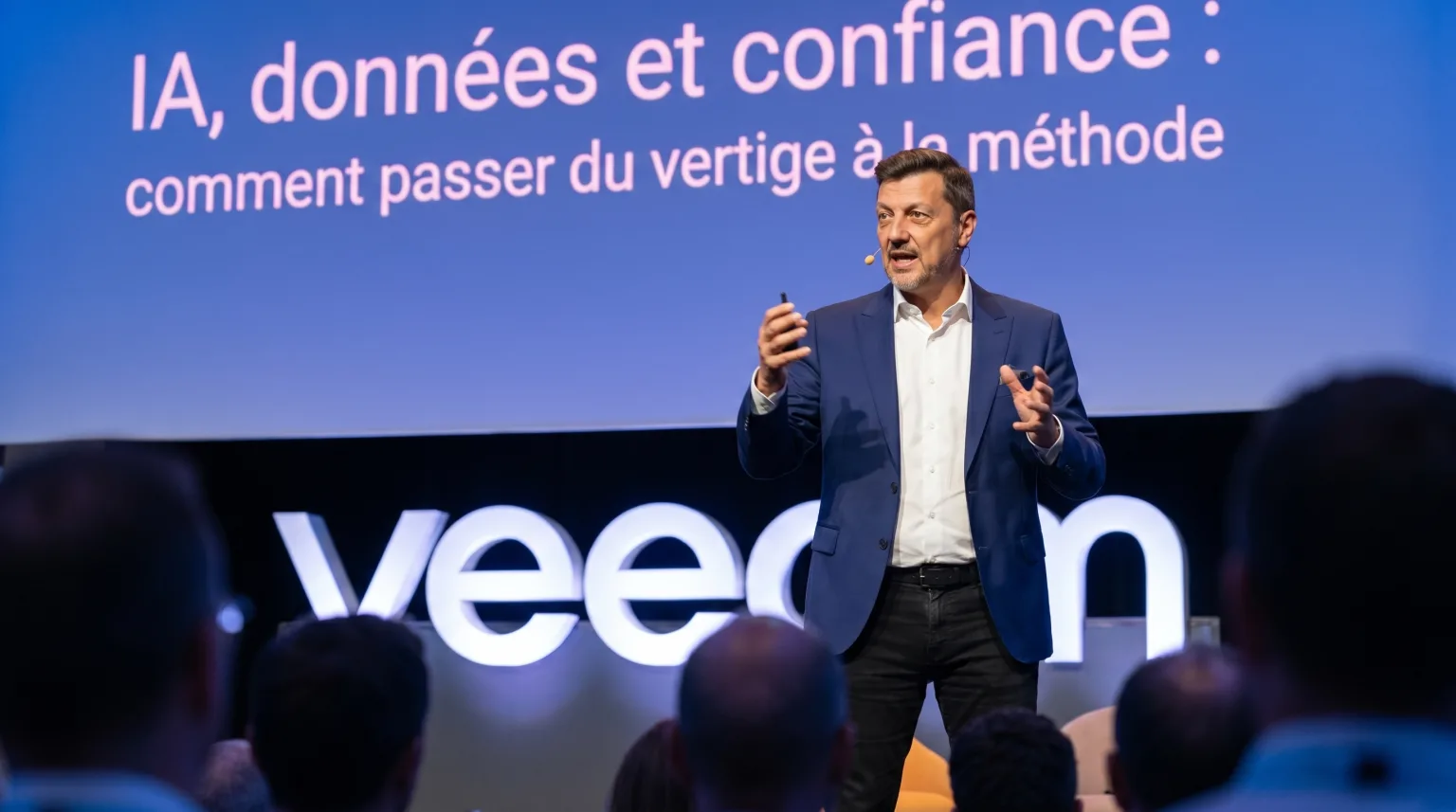
In this video, I am not yet wearing my stage suit.
I am not yet performing.
I am in that intermediate zone between craftsperson and athlete.
The craftsperson checks the tools.
The athlete prepares the body.
The speaker does both.
I sign books for VIPs. I check the details. I look at the room. I talk with the team. I gradually synchronize myself with the event. I enter the energy of the keynote before the keynote officially begins.
Then comes the change.
The shirt.
The jacket.
The stage suit.
The posture.
The professional mask.
The concentration mask.
Not the mask of pretending. The mask of the role.
A surgeon does not behave the same way in a living room and in an operating room. A pilot does not enter a cockpit with the same mental availability as when ordering coffee. A speaker does not step on stage as if entering a regular meeting.
The suit marks a shift.
Before, I prepare.
After, I embody.
A keynote is a living system
People sometimes think a keynote is just public speaking.
That is too small.
A keynote is a living experience. It combines content, rhythm, silence, images, light, movement, interaction, emotion, tension, breathing, surprise and a relationship with the audience.
And like any living experience, it can go off track.
A microphone can fail.
A video can refuse to play.
An audience can feel cold.
The timing can change.
The previous speaker can run 20 minutes over.
The room can be too bright.
The sound can distort.
A screen can be unreadable from the back.
A participant can ask a question that shifts the energy of the entire room.
The professional’s role is to make it feel as if this was expected, or at least as if nothing has the power to destabilize the moment. That ability does not come from some abstract “natural talent.” It comes from preparation, experience, method and obsession with detail.
Chris Anderson, who led TED for many years, wrote in Harvard Business Review that a great presentation is built through a clear idea, precise examples, a story and substantial preparation work. (Harvard Business Review)
The audience should not see the structure
The most interesting part of this profession is that preparation must disappear.
When the audience sees too much of the mechanism, the magic drops.
So you prepare with precision to create a sense of obviousness. You rehearse so you can breathe. You structure so you can seem free. You anticipate so you can improvise properly. You know the path so you can leave it without getting lost.
The TEDx speaker guide expresses a simple idea: the structure should be invisible to the audience. In other words, people do not come to watch the plan. They come to experience an idea. (TEDx Speaker Guide)
It is a beautiful paradox.
The stronger the work, the less visible it should be.
The more serious the preparation, the more natural the experience should feel.
The stronger the architecture, the more fluid the audience experience becomes.
In reality, the audience should not think: “What a nice structure.”
It should think: “I understand. I feel it. I remember it. I want to act.”
The moment of signed books
There are also moments that look peripheral but are not.
Signing books before a keynote for VIPs, for example.
From the outside, it is a pleasant detail. A public relations moment. A line in the event plan.
In reality, it is a ritual.
Each signature reminds me that a keynote does not end with applause. It continues through conversations, ideas that travel, books passed from hand to hand and decisions made after the event.
Signing a book before going on stage also means accepting a responsibility: someone will leave with a physical trace of that moment.
A book can be kept.
A sentence can disappear.
A well-embodied idea can remain.
This is exactly what I discuss in my book, chapter 15, dedicated to the construction of my keynotes: this profession is a discipline, not inspired improvisation.
Innovation works the same way
The profession of speaker looks a lot like innovation.
From far away, people see the launch.
From up close, they see the system.
From far away, people talk about the idea.
From up close, they talk about experiments, tests, friction, risks, timing, alignment, communication, method and decisions.
Those who only see the result talk about inspiration.
Those who know the backstage talk about mechanics.
A successful innovation often looks obvious after the fact. Everyone explains that someone simply had to think of it. Everyone rebuilds the story as if success were logical. Everyone forgets the failed prototypes, difficult meetings, painful trade-offs, invalidated assumptions, defended budgets, internal resistance, short nights and late adjustments.
In a keynote, as in innovation, visible elegance rests on invisible architecture.
The audience sees impact.
The team sees the system.
The professional respects both.
Detail is never just detail
There is a sentence attributed to Charles Eames: “The details are not the details. They make the design.”
In the profession of speaking, this is operational reality.
The microphone is not a detail.
Stage placement is not a detail.
The length of the silence before the first sentence is not a detail.
A slide font that is too small is not a detail.
Lighting that turns you into a dark silhouette is not a detail.
The transition between two sequences is not a detail.
The breath before the conclusion is not a detail.
Most great experiences deteriorate through an accumulation of small neglects. Conversely, they become memorable through an accumulation of small attentions.
Duarte recommends rehearsing in conditions close to reality, working on transitions and not limiting preparation to content alone. (Duarte)
A keynote is not only “what I am going to say.”
It also includes: how I will enter, where I will look, when I will slow down, how I will let an idea breathe, how I will handle a failure, how I will return to the thread if the audience takes me somewhere else.
Cables, sweat and method
There is a fantasy around talent.
People like to believe someone is “made for it.”
That is reassuring, because it avoids looking at the method.
Talent may exist. Experience transforms it. Preparation makes it usable. Method makes it reproducible.
Without method, talent depends on the mood of the day.
With method, performance becomes more stable.
A professional event also depends on technical elements that must be tested before the audience enters the room: microphones, slides, videos, lighting, transitions, speaker order, backups and coordination with the control booth. Recent AV checklists emphasize the importance of testing audio inputs, video outputs, presentations, microphones and transitions before going live. (AVL Services)
This is not spectacular.
It is what allows the spectacular to exist.
And this is exactly why I love this profession: it blends art and engineering.
A keynote is a living work with technical architecture.
An emotional moment carried by cables.
An embodied presence supported by procedures.
A human experience protected by logistics.
What no one sees often makes all the difference
In your profession too, there is probably an invisible part.
Your clients may not see the hours of preparation.
Your team may not see the trade-offs you make.
Your leadership may not see the risks you absorb.
Your audience may not see the rehearsals, tests, mistakes, corrections, moments of doubt and tiny decisions that make the final result simpler, clearer and smoother.
It can feel unfair.
It is also a sign of work well done.
When the mechanism works, the user sees ease.
When preparation works, the audience sees magic.
When organization works, the client sees simplicity.
The invisible part of your work may be your real professional signature.
Not the one you display.
The one people feel without always being able to name.
What I really want to show in this video
This video does not only show a speaker signing books before putting on a stage suit.
It shows a border.
Before the show.
Before the light.
Before visible impact.
It shows the moment when the keynote is still a construction site.
A calm, demanding, precise construction site.
A few hours later, that construction site will become an experience.
The audience will see 45 minutes. Or 30 minutes. Or one hour.
It will never see the four hours of invisible plumbing. It will never see the multiple days to customize the keynote.
And that is perfectly fine.
Because the profession is not about showing effort.
It is about turning effort into impact.
👉 In your profession, which essential part of your work remains completely invisible to your clients, your team or your audience?
And yes, this obsession with backstage work is also part of my workshops and advisory work. Because between “speaking” and “leaving a mark,” there are a few kilometers of cables, sweat and method.

References
(Harvard Business Review) = https://hbr.org/2013/06/how-to-give-a-killer-presentation
(TEDx Speaker Guide) = https://storage.ted.com/tedx/manuals/tedx_speaker_guide.pdf
(Toastmasters) = https://www.toastmasters.org/resources/public-speaking-tips/preparing-a-speech
(Toastmasters Magazine) = https://www.toastmasters.org/magazine/magazine-issues/2020/apr/9-tips-from-toastmasters
(Duarte) = https://www.duarte.com/blog/3-expert-tips-to-maximize-your-presentation-rehearsal-time/
(AVL Services) = https://avlservices.com.sg/blog/av-checklist-conference-organisers