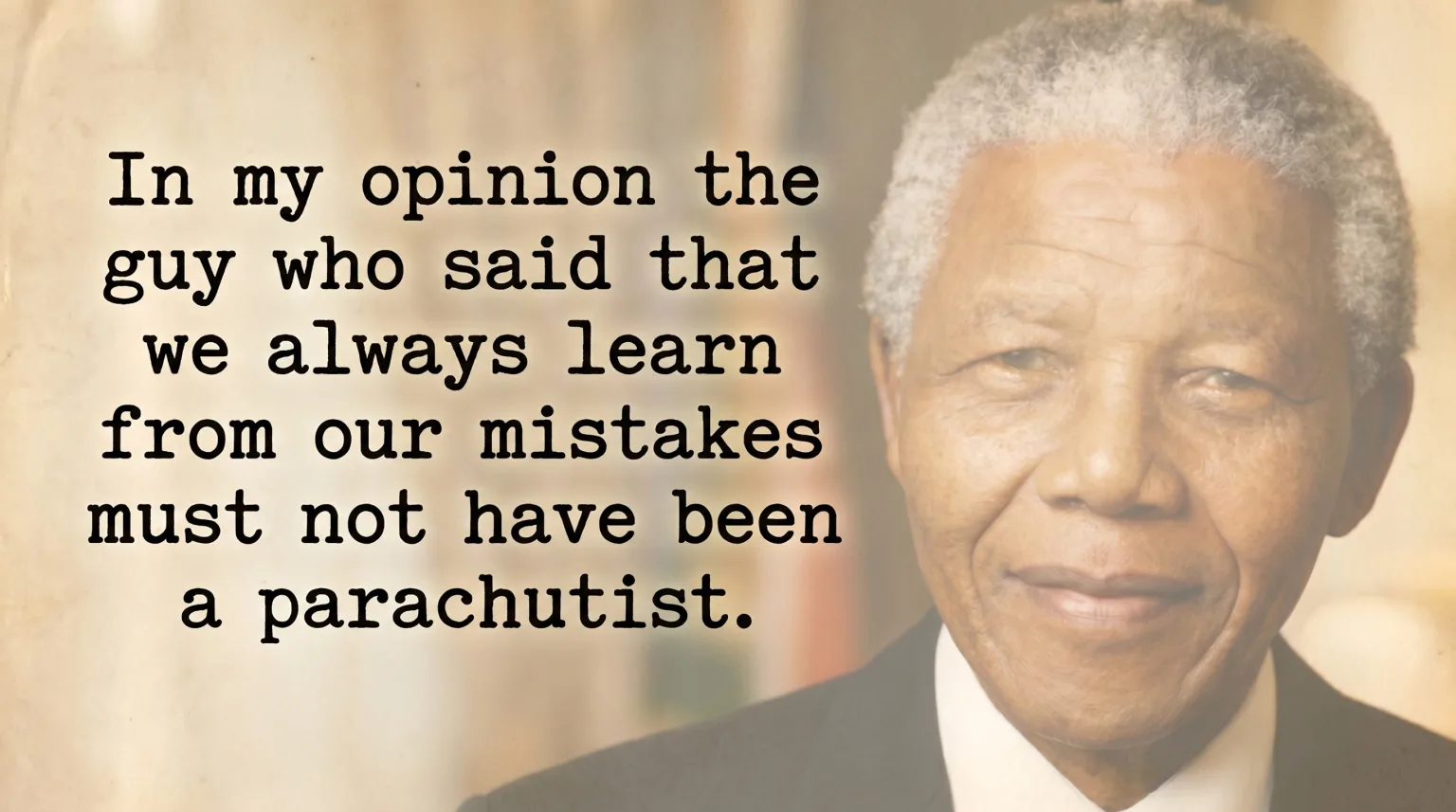
The parachutist, Mandela, and the crash
The parachutist who learns from his mistakes rarely ends up as a consultant.
The image is funny because it points directly at something many companies prefer to cover with a motivational sticker.
A parachutist is falling. The backpack looks like a parachute. The intention was probably good. The preparation, probably less so. Suddenly, the grand philosophy of learning from failure meets a far more vertical reality: in some professions, mistakes do not create a post-mortem. They create an impact.
Yes, we can learn from mistakes.
Yes, the sentence attributed to Nelson Mandela remains powerful: “I never fail. I either succeed or I learn.”
But that sentence becomes dangerous when it turns into a lazy slogan.
Because some mistakes teach.
And some mistakes stop everything.
In a meeting room, it feels comfortable to say: “In our company, people have the right to make mistakes.” The sentence checks all the modern management boxes. It smells like trust, agility, psychological safety, innovation, and enlightened leadership.
Fine.
But what kind of mistake?
At what cost?
With what consequences?
Within what perimeter?
For how long?
With what damage limit?
With what rollback capacity?
With what protection for customers, teams, brand, cash flow, or safety?
Innovation does not require worshipping failure. It requires organizing learning.
And organizing learning often starts with an uncomfortable question: how much are we willing to lose in order to learn something truly useful?
Corporate failure has become wall decoration
In many companies, failure has become an internal communication object.
It is celebrated in seminars.
It is placed in the values.
It appears on slides.
It is printed as inspiring quotes on office walls.
People explain that innovation requires daring, experimenting, moving beyond the frame, testing fast, failing fast, learning fast.
On paper, it sounds intelligent.
In practice, failure is often accepted as long as it costs nothing, disturbs nobody, delays no schedule, touches no budget, embarrasses no executive, upsets no strategic customer, and challenges no political decision.
In other words, companies like failure when it remains theoretical.
The problem begins when an experiment truly fails.
A prototype does not work.
A campaign does not convert.
An AI tool produces inconsistent results.
A redesigned process slows the team down.
A customer hypothesis falls apart.
An expected feature interests nobody.
A strategic partnership becomes a time sink.
At that moment, the company discovers whether it has a real experimentation culture or simply a storytelling culture.
Useful failure is not an accident nicely narrated afterward. It is a learning mechanism designed before action.
Affordable loss: the innovator’s parachute
In healthy innovation management, we do not begin by fantasizing about maximum gain.
We begin by defining affordable loss.
It is one of the five principles of effectuation: reasoning from what can be afforded as a loss rather than building the entire decision around a hypothetical future return. Effectuation, formalized by Saras Sarasvathy, invites entrepreneurs to start from available means and limit risk to what can be lost at each step (Effectuation.org) .
In my book, in chapter 12, I discuss the five principles of effectuation, including “affordable loss,” defined as what we can afford to lose rather than attempting to assess potential future gains or returns.
This principle shows remarkable maturity.
It helps avoid two caricatures.
First caricature: the fearful company that tests nothing because it wants everything secured before acting.
Second caricature: the excited company that tests everything because it confuses boldness with Russian roulette.
Between the two, there is a much more powerful path: framed experimentation.
Test, yes.
But with a limit.
Learn, yes.
But without pushing the organization toward the edge.
Dare, yes.
But with a parachute that opens.
“Fail fast” is no longer enough
The “fail fast” mantra had its use. It helped counter corporate cultures obsessed with perfection, hierarchical validation, five-year plans, and endless committees.
But repeated without nuance, it becomes an immature slogan.
Failing fast is not enough.
A company can fail fast, often, expensively, badly, pointlessly, and without learning much.
The issue is not the speed of failure. The issue is the quality of learning produced by the experiment.
Amy Edmondson, professor at Harvard Business School, distinguishes intelligent failures from basic or complex failures. Intelligent failure happens in new territory, with a hypothesis, a learning intention, and calculated risk (Harvard Business School Working Knowledge) .
This is exactly where many companies get it wrong.
They want the benefits of innovation without accepting the discipline of experimentation.
They want new ideas without testable hypotheses.
They want boldness without explicit risk.
They want learning without deciding what can be lost.
They want innovative parachutists, but forget to check whether the parachute was packed properly.
Not all failures are equal
A bug discovered in a test environment does not have the same status as a bug exposed to all customers.
A campaign tested on a microsegment does not have the same cost as an improvised global repositioning.
An AI prototype used by an internal team does not carry the same risk as an autonomous agent directly connected to critical decisions.
An experimentation workshop with eight managers does not have the same scope as a transformation launched across 8,000 employees.
Putting all these situations under the same “right to make mistakes” banner is intellectual laziness.
The right approach is to distinguish environments.
In a discovery environment, failure is a source of information.
In a critical production environment, failure can become a breakdown.
In a safety environment, failure can endanger people.
In a financial environment, failure can consume vital cash.
In a reputational environment, failure can damage trust for a long time.
The parachutist does not need a failure culture.
He needs a culture of preparation, verification, training, and debriefing on a simulator before the jump.
So does the innovator.
The difference between experimentation and casino behavior
The difference between a company that experiments and a company that gambles rarely lies in creativity.
It lies in the ability to frame boldness.
A serious experiment begins with a clear hypothesis.
What do we believe to be true?
What are we going to test?
What signal will tell us we were right?
What signal will tell us we should stop?
How much time are we willing to spend?
What budget can we lose?
What team energy are we willing to mobilize?
What reputation are we willing to expose?
What strategic option are we ready to abandon?
What level of ego are we ready to sacrifice?
Affordable loss is not limited to money. It includes time, attention, credibility, mental availability, team trust, and political energy.
In organizations, one of the most underestimated losses is team energy.
A poorly framed project does not only consume a budget. It exhausts volunteers. It makes skeptics more skeptical. It gives opponents better arguments. It turns innovation into a painful memory.
A well-framed experiment produces the opposite effect: even when it fails, it makes people want to continue.
Because everyone knows what was learned.
Because the loss had been anticipated.
Because nobody feels they were sent without a parachute.
Innovation is a discipline, not a mood
The OECD, in the Oslo Manual 2018, reminds us that innovation can be measured and concerns new or improved products or processes made available to users or brought into use within an organization (OECD) .
This definition matters because it brings innovation back to reality.
An untested idea remains an idea.
A prototype never confronted with use remains a promise.
A concept never implemented remains an intention.
Innovation starts becoming serious when it reaches the field.
And as soon as it reaches the field, risk appears.
That is why innovation needs a frame.
Not to suffocate it.
To help it survive.
McKinsey also notes that overly risk-averse cultures can hinder innovation, while leaders should allocate explicit time and resources to teams within the organization’s risk appetite (McKinsey & Company) .
That is the essential point: authorizing mistakes is not enough. The organization must define the field where mistakes become acceptable.
Before you jump, ask the right questions
Before your next experiment, ask these questions.
What do we want to learn?
Why does this learning deserve an experiment?
What is the main hypothesis?
What is the smallest experiment capable of producing useful learning?
What is the maximum acceptable cost?
What maximum duration do we accept?
Who might be affected?
What perimeter must remain protected?
What signal triggers stopping?
What signal triggers scaling?
Who decides?
How do we capture the learning?
These questions are less seductive than a grand speech about boldness.
They are much more useful.
Because they transform innovation into professional practice.
They avoid confusing courage with recklessness.
They reduce the risk of turning a test into an industrial accident.
They allow the company to create a space where people can learn without putting the system in danger.
Good failure is designed before the fall
The parachutist who learns from his mistakes rarely ends up as a consultant.
The sentence is funny because it contains a truth companies often forget: learning needs conditions.
We learn better when loss has been thought through.
We learn better when risk has been made visible.
We learn better when the experiment has been limited.
We learn better when the team does not feel sacrificed on the altar of a slogan.
Useful failure is not the one that produces a beautiful story after the fall.
It is the one designed to produce learning without creating a crash.
So, before your next experiment, do not only ask: “What can we gain?”
Ask also: “What are we truly willing to lose?”
That is often where mature innovation begins.
To go deeper on this topic, read the corresponding article on my blog. The link is in the first comment.
Of course, I discuss this topic in my keynotes, workshops, and advisory work, usually before someone suggests testing a parachute in production.



References
(Effectuation.org) = https://effectuation.org/
(UVA Darden School of Business) = https://www.darden.virginia.edu/effectuation
(Harvard Business School Working Knowledge) = https://www.library.hbs.edu/working-knowledge/failing-well-1-when-failure-is-intelligent
(Harvard Business School Executive Education) = https://www.exed.hbs.edu/Documents/programs-organizations/framing-failure-learning-innovation.pdf
(OECD) = https://www.oecd.org/en/publications/2018/10/oslo-manual-2018_g1g9373b.html
(McKinsey & Company) = https://www.mckinsey.com/capabilities/strategy-and-corporate-finance/our-insights/investing-in-innovation-three-ways-to-do-more-with-less
(Nelson Mandela Foundation) = https://www.nelsonmandela.org/selected-quotes