The day imitation becomes a compliment
The day your competitors start copying you, send them an invoice for gratitude.
Not because they have suddenly become charming.
Not because they deserve applause.
But because they have just given you something the market rarely provides so clearly: delayed proof that you moved the line.
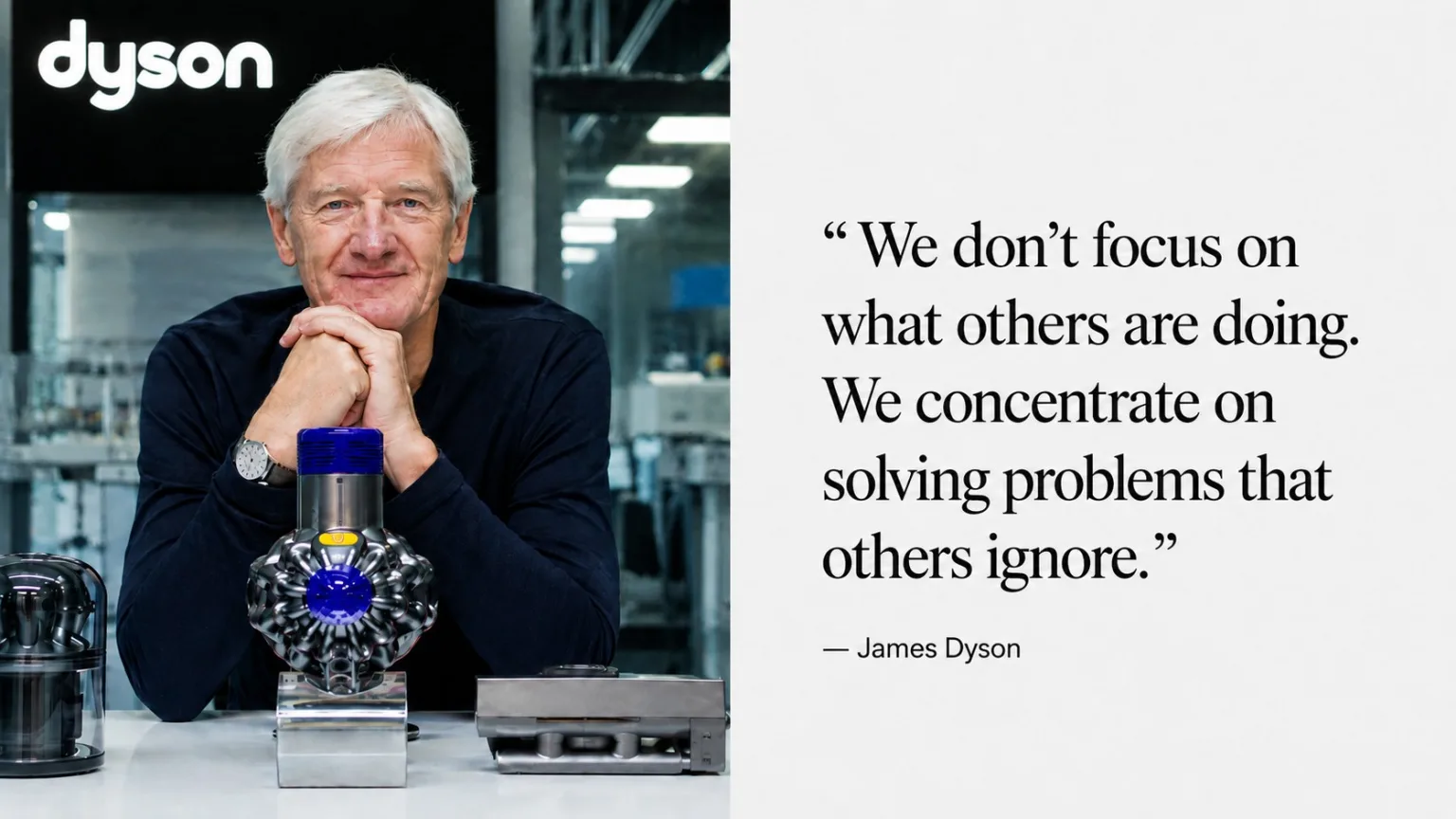
For years, James Dyson looked like the annoying man who refused to accept a mediocre vacuum cleaner. Too stubborn. Too obsessive. Too expensive. Too different.
Then he stacked prototypes.
Again.
Again.
Again.
Until failure became an industrial method.
According to the James Dyson Foundation, it took five years and 5,127 prototypes to create the DC01, described by the foundation as the brand’s first bagless vacuum cleaner (James Dyson Foundation).
The market stopped laughing.
It started watching.
Then it started buying.
Then it started copying.
And that is often when innovation becomes truly interesting: when the people who said yesterday that your idea would not work start reproducing it today with remarkable seriousness.
Dyson did not improve the vacuum cleaner. Dyson moved the vacuum cleaner.
Dyson did not only sell vacuum cleaners.
The brand changed the perception of an ordinary object.
A vacuum cleaner became an object of desire.
A hair dryer became an engineering object.
A fan became a technological sculpture.
Dyson says its engineers start with a problem, test, iterate, and develop radical solutions before bringing them into real homes (Dyson).
This is the uncomfortable point for many companies: an innovative brand does not merely improve a product. It reprograms the entire category.
Before Dyson, the vacuum cleaner was often treated as a functional household tool.
After Dyson, it could become something people display, compare, choose almost like a status object.
Before Dyson, the hair dryer was mostly a hot machine that blows air.
With the Supersonic, Dyson highlights a digital V9 motor spinning at up to 110,000 rpm, intelligent heat control measuring temperature more than 40 times per second, and an architecture designed for balance in the hand (Dyson Supersonic).
Before Dyson, a fan was a blade behind a grille.
With Air Multiplier, Dyson made the absence of visible blades more spectacular than the blades themselves, while explaining airflow amplification technology (Dyson Air Multiplier).
That is what it means to reprogram a category.
You are no longer just selling better.
You are forcing competitors to respond to your definition of the market.
The real weak signal: when the market adopts your vocabulary
An innovation becomes dangerous for others when it imposes its words.
Bagless.
Cyclonic.
Air Multiplier.
Coanda.
Digital motor.
Intelligent heat control.
Laser dust detection.
These words are not just technical arguments. They are mental hooks. They give customers a new way to evaluate a product.
And when customers begin comparing other brands through your criteria, you have already won part of the battle.
Then imitation follows.
Sometimes as visual imitation.
Sometimes as technical inspiration.
Sometimes as a legal battle.
In 2002, The Guardian reported that Hoover agreed to pay Dyson £4 million after a patent infringement case related to dual cyclone technology (The Guardian).
Imitation is not a charming side story of innovation.
It is part of the cycle.
First, they ignore you.
Then they criticize you.
Then they imitate you.
Then they explain that everyone always knew it was obvious.
Failure is not a wound. It is raw material.
The story of the 5,127 prototypes is often used as a comfortable entrepreneurial fable.
Just persevere and everything will work out.
No.
Perseverance alone can also keep you trapped in a dead end.
What matters is not simply trying a lot.
It is learning from every attempt.
Dyson explains that its machines are tested intensively, with prototypes repeatedly challenged in labs and real homes (Dyson).
The difference between useless stubbornness and structured innovation lies in this nuance: every prototype must produce knowledge.
A failed prototype that teaches you nothing is a cost.
A failed prototype that teaches you something is an investment.
That is how failure can become an industrial method.
Provided it is instrumented.
Provided it is measured.
Provided reality is heard.
Provided ego is not protected more than the project.
In my book, I explain that a new idea will often be criticized and fought before being accepted, even copied (my book, chapter 2).
Imitation then becomes the delayed birth certificate of an innovation.
Imitation flatters the ego. Momentum feeds the company.
The trap, when people copy you, is to settle into satisfaction.
Look, they imitate us.
Look, we were right.
Look, the market follows us.
Very well.
And now?
Because the day your competitors copy your previous lead, your only serious subject becomes the next one.
Innovation is not a trophy sitting in a glass case.
It is a muscle.
And a muscle that stops working loses power.
A company that innovated yesterday can become the company defending its old world today.
An admired company can become a museum of its own victories.
A copied company can believe that imitation confirms its lasting superiority.
Dangerous mistake.
Imitation mostly confirms that your previous advantage has become visible, understandable, reproducible, or circumventable.
In other words: it is already becoming ordinary.
Innovation is not limited to the product
The OECD defines innovation as a new or improved product or process that has been introduced on the market or brought into use by the firm (OECD).
This definition matters.
It reminds us of something many companies forget: a brilliant idea that is not implemented remains an idea.
An invention that is not exploited remains an invention.
A PowerPoint presentation is not enough.
An ideation meeting is not enough.
Innovation exists when it changes a use, a process, an experience, a business model, or an organization.
Dyson is interesting because the brand does not appear to limit its effort to the technical performance of the product.
It works on demonstration.
It works on design.
It works on perception.
It works on proof.
It works on price.
It works on desirability.
It even works on the staging of the problem.
The vacuum cleaner does not lose suction.
The hair dryer better protects hair from extreme heat.
The fan has no visible blades.
Invisible dust becomes visible.
The ordinary becomes remarkable.
That is why some competitors can copy the shape without copying the strength.
The shape is visible.
The strength comes from the system.
The risk for copycats: chasing the past
Copying an innovator often means running after an old thought.
The copycat observes what is already visible.
The innovator is already working on what is not visible yet.
The copycat studies the finished product.
The innovator studies the next problem.
The copycat borrows a market signal.
The innovator changes the perception system.
That is why imitation is rarely a sufficient strategy.
It can help catch up.
It can narrow a gap.
It can make a market more competitive.
But it places the company in a mental position of delay.
And mental delay often comes before strategic delay.
While the copycat wonders how to reproduce yesterday’s success, the innovator wonders which invisible friction deserves to be attacked tomorrow.
The big difference: protect or accelerate
An innovative company has two possible reflexes when it is copied.
It can protect.
Or it can accelerate.
Protection is sometimes necessary: patents, design, brand, know-how, industrial secrets, contracts, intellectual property.
But protection is not enough.
A patent can slow a competitor down.
It does not automatically create the next advantage.
A lawsuit can defend a territory.
It does not replace a culture of experimentation.
A strong brand can preserve a trust premium.
It does not compensate forever for a loss of boldness.
The real superiority does not come only from the initial idea.
It comes from the ability to produce the following ideas.
And above all, to turn them into reality.
The invoice for gratitude
So yes, the day your competitors copy you, send them an invoice for gratitude.
Not to get paid.
To remind yourself of three things.
First, you probably moved something.
Second, your old difference is becoming a new norm.
Third, celebration time must be shorter than reinvention time.
Imitation can be a tribute.
It can be a threat.
It can be a warning.
Everything depends on what you do next.
A weak brand takes offense.
An average brand defends itself.
A strong brand accelerates.
And a truly innovative brand forces its entire industry to run behind it while it has already moved to another track.
👉 Which company do you admire because it forces its entire industry to run behind it?
Of course, I also shake this kind of comfortable certainty in my keynotes, workshops, and advisory work.

References
(Sudinfo) = https://www.sudinfo.be/id1158947/article/2026-06-08/dyson-un-geant-entre-heritage-et-innovation-aujourdhui-certaines-marques-copient
(Dyson) = https://www.dyson.com/james-dyson
(James Dyson Foundation) = https://www.jamesdysonfoundation.com/who-we-are/our-story/
(Dyson) = https://www.dyson.co.uk/discover/archive/2021/relentless-engineering
(Dyson Supersonic) = https://www.dyson.co.uk/hair-care/hair-dryers/supersonic
(Dyson Air Multiplier) = https://support.dyson.my/fans.aspx
(OECD) = https://www.oecd.org/en/publications/2018/10/oslo-manual-2018_g1g9373b.html
(The Guardian) = https://www.theguardian.com/uk/2002/oct/04/claredyer