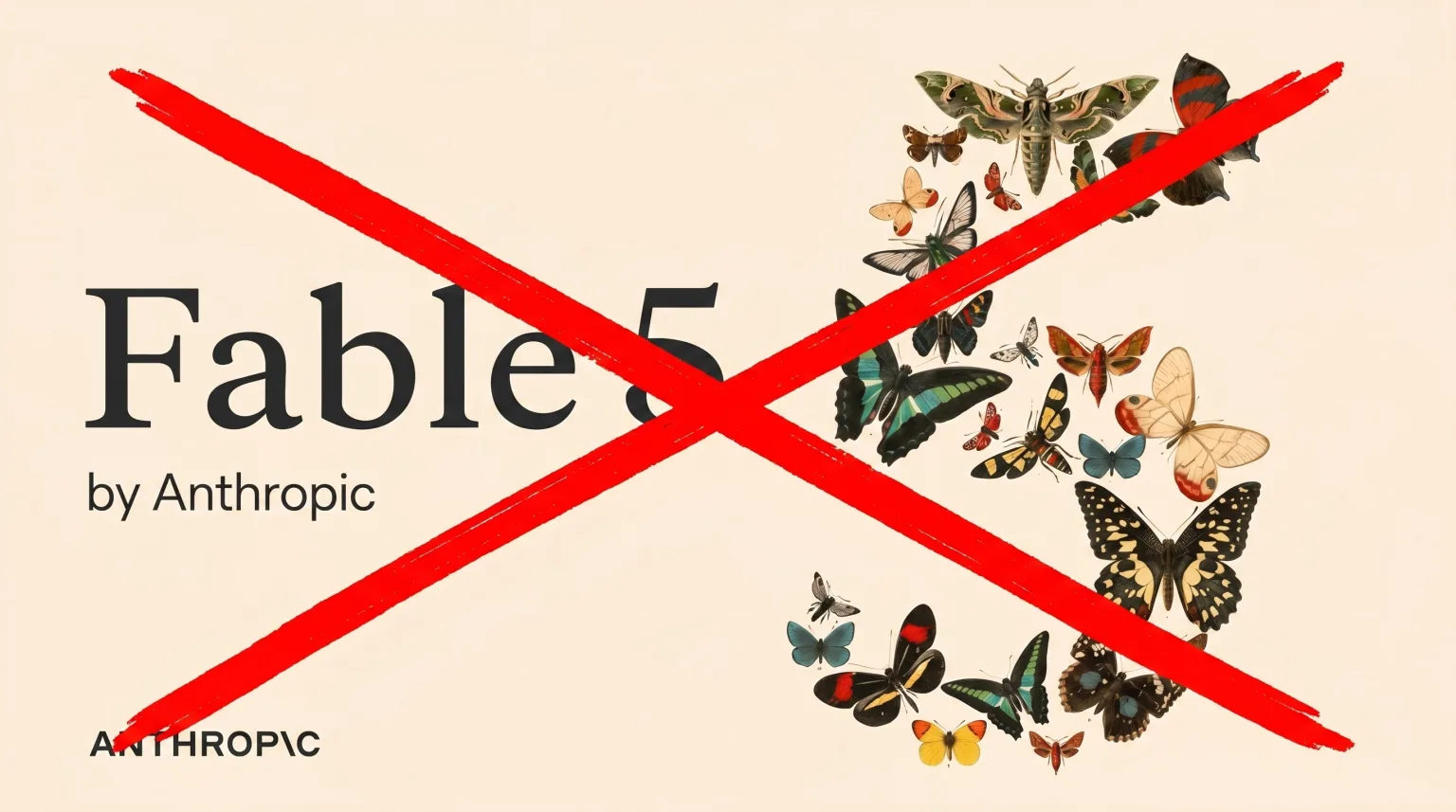
When a model becomes too powerful to remain a product
Fable 5 lasted only a few days.
Anthropic introduced it on June 9, 2026, as its most advanced broadly available model, based on the same underlying model as Mythos 5, but with additional safeguards for sensitive uses, especially cybersecurity. Mythos 5 remained limited to a smaller circle of cyberdefenders and infrastructure partners through Project Glasswing (Anthropic) .
Then, on June 12, 2026, everything changed. Anthropic announced that it had received a U.S. export control directive requiring the suspension of all access to Fable 5 and Mythos 5 by any foreign national, whether inside or outside the United States, including Anthropic’s own foreign national employees. The practical result: Anthropic disabled both models for all customers (Anthropic) .
The official explanation fits into one word: cybersecurity.
Too simple.
When a government orders the immediate disappearance of an AI model launched only days earlier, the issue rarely stops at a technical flaw. A vulnerability can be patched. Access can be restricted. A safeguard can be reinforced. Here, the response looks much more like an act of technological sovereignty.
The “jailbreak” as the official story
According to Les Numériques, the decision may have followed a claim by a third-party company that it had bypassed the model’s safeguards. Anthropic disputes the seriousness of the demonstration and says no tester identified a universal method capable of systematically neutralizing all protections (Les Numériques) .
Anthropic also says the government did not provide specific technical details about its national security concerns. The company described the situation as a misunderstanding and argued that such a decision should follow a process that is transparent, fair and grounded in technical facts (Anthropic) .
That is the fascinating point.
If the case was only about a narrow bypass, why block access for all foreign nationals, including foreign employees working inside Anthropic?
Why such a broad measure?
Why apply export-control logic to an AI model as if it were a strategic technology?
[Hypothesis] The real subject is not the bug, but the capability
A model like Fable 5 or Mythos 5 is no longer just an assistant.
It can write code, analyze systems, help identify vulnerabilities, accelerate research, automate long reasoning chains and support complex operations.
In innovation terms, we are changing category. This is no longer only a digital product. It is a capability.
And a capability can become strategic.
Reuters reports that the U.S. administration ordered Anthropic to block foreign nationals and that the company is now trying to resolve the dispute with the White House (Reuters) .
This shift matters: until now, AI control was mostly about chips, compute, cloud infrastructure and hardware export restrictions. With Fable 5, control appears to be moving toward access to the model itself.
In other words: AI has become a border.
[Hypothesis] China is likely in the background
Semafor reports that the White House decision was partly linked to concerns that China may have accessed Mythos. The same article makes clear that several elements remain unknown: which organization accessed the model, how access happened, and how the White House learned about it (Semafor) .
If this hypothesis is correct, the story changes completely.
The issue would no longer be only: “Can Fable 5 be jailbroken?”
The issue would become: “Can a foreign actor access an advanced capability, study it, copy it, distill it or integrate it into its own technology stack?”
Model distillation is not a perfect copy. But in an intense technology race, even an approximation can be valuable.
In that scenario, cybersecurity becomes the public wrapper around a much larger problem: the possible leakage of strategic advantage.
[Hypothesis] Washington is testing a new power
Anthropic had long argued for a stronger framework around advanced models. The company wanted governments to be able to block deployments judged dangerous, but through a clear, transparent and technically grounded process.
The irony is sharp: the U.S. government used that power, but Anthropic disputes the method.
The company asking for stronger regulation has become one of the first to experience a spectacular regulatory intervention.
Semafor notes that the White House has taken a more aggressive posture on AI and that this decision could create a precedent for other labs developing frontier models (Semafor) .
The message to the market is clear: you may build a global AI, but its political switch remains national.
[Hypothesis] Europe just received a strategic slap
European reactions came quickly.
Le Monde reports that the U.S. decision is seen in France and Europe as a demonstration of American dominance over AI and as a strong signal on technological sovereignty (Le Monde) .
The Associated Press reports that Canadian Prime Minister Mark Carney described the case as a warning against dependence on a small number of American providers (Associated Press) .
That is another major insight: when your artificial intelligence depends on a foreign provider, your strategy can be suspended by a foreign decision.
This concerns companies as much as states.
A European company building critical processes on an American model now has to integrate a new risk: access can be removed for reasons unrelated to its performance, its contract or its local compliance.
Innovation has entered the geopolitical age
In my book, chapter 14, I explain that AI adoption in an organization should start with two simple questions: how AI improves productivity and quality in the current role, and what AI makes possible today that was impossible before.
The Fable 5 case adds a third question.
What happens if the tool disappears tomorrow?
That question changes everything.
It forces leaders to think of AI not only as an efficiency tool, but also as a component of strategic dependence. It forces executive teams to map critical uses. It forces CIOs to think about multi-model strategies, reversibility, data sovereignty, contract clauses and continuity plans.
AI is no longer just an innovation topic.
It is a governance topic.
The new risk: innovation by permission
For years, companies have been asking how to use AI.
The new leadership question becomes: who can take AI away from us?
This case reveals a major tension.
On one side, the most powerful models can accelerate science, cybersecurity, productivity, software development and process innovation.
On the other side, the more powerful they become, the more they are monitored, restricted, classified, controlled or withdrawn.
Innovation is entering uncomfortable territory: the best available technology may not be the one you are allowed to use.
What leaders should remember
First, advanced AI is becoming strategic infrastructure.
Second, the risks are no longer only technical. They are legal, geopolitical, contractual and operational.
Third, dependence on a single model is dangerous.
Fourth, sovereignty is not just about “having a European model.” It also requires compute, data, skills, use cases, governance and replacement capacity.
Fifth, innovation can no longer be thought of only as adoption speed. It must include resilience.
The day AI left the software shelf
Fable 5 may not have been restricted because it was “too dangerous” in a spectacular sense.
[Hypothesis] It may have been withdrawn because it had become useful enough to be treated as strategic technology.
That is often when innovation changes status.
First, we test it.
Then, we adopt it.
Then, we depend on it.
Then, someone tries to control it.
The day an AI becomes powerful enough to be forbidden, it leaves the software shelf.
It enters the realm of power.


References
(Anthropic) = https://www.anthropic.com/news/fable-mythos-access
(Anthropic) = https://www.anthropic.com/news/claude-fable-5-mythos-5
(Les Numériques) = https://www.lesnumeriques.com/intelligence-artificielle/claude-fable-5-et-mythos-5-n-existent-plus-le-gouvernement-americain-a-ordonne-leur-suppression-immediate-n257472.html
(Reuters) = https://www.reuters.com/world/us/anthropic-staff-meet-white-house-officials-next-week-axios-reports-2026-06-14/
(Semafor) = https://www.semafor.com/article/06/12/2026/us-limits-use-of-anthropic-ai-models-fable-5-and-mythos
(Semafor) = https://www.semafor.com/article/06/13/2026/white-house-move-to-limit-anthropic-linked-to-concerns-about-chinese-access-to-mythos
(Le Monde) = https://www.lemonde.fr/en/pixels/article/2026/06/14/the-ai-war-has-begun-france-and-europe-worried-as-us-blocks-anthropic-s-latest-ai-model_6754455_13.html
(Associated Press) = https://apnews.com/article/carney-artificial-intelligence-g7-summit-anthropic-mythos-cb081633bb4fca6ac97dcdaea0354de7