Karim stares at the screen. Midnight. The deployment has failed for the third time this week. He writes the ticket, marks it “server error,” assigns it to the infrastructure team, closes his laptop. The following Friday, the same error returns. Then again the month after. Nobody gets particularly upset, and nobody asks the uncomfortable question: why does this specific bug refuse to die?
That’s the question I want to put to you today, not just about a server. About your decisions, your professional fears, the habits that keep resurfacing despite your best intentions. The 5 Whys method isn’t one more tool in your management toolbox. It’s a tool that stops you from lying, to your team and mostly to yourself.
The symptom is never the problem
You know this reflex. A project fails, you find a quick culprit or a convenient excuse, you patch the surface, and you move to the next task. The fuse blew, so you replace the fuse. An employee stayed silent in a meeting, so you note that they lack confidence. The fix feels obvious, it relieves the discomfort of not knowing, and it fixes nothing.
Psychologists call this cognitive closure: faced with an ambiguous situation, the mind prefers a fast answer, even a wrong one, over sitting with uncertainty. It’s comfortable. It’s also the surest way to see the same problem return in six months, at a higher cost.
The 5 Whys were built to interrupt that reflex. They force you to stay in discomfort for one more question, then another, until the root cause surfaces. And once it surfaces, the fix usually becomes obvious on its own.
Where this tool actually comes from
The story starts in weaving looms, not in boardrooms. Sakichi Toyoda, a Japanese industrialist and inventor, developed this approach in the 1930s to understand why his machines kept failing (MindTools). His son Kiichiro would later found Toyota Motor Corporation, and it was Taiichi Ohno, the architect of the Toyota Production System, who formalized the method and made it famous with a line that became gospel in manufacturing circles: by repeating why five times, the nature of the problem and its solution become clear (FlowFuse).
Ohno’s own example became a classic of quality management. A machine stops. Why? There was an overload and a fuse blew. Why the overload? The bearing wasn’t sufficiently lubricated. Why wasn’t it lubricated? The lubrication pump wasn’t pumping enough. Why not? The pump’s shaft was worn and rattling. Why was it worn? There was no strainer, and metal scrap got into the system.
Five questions. And the root cause has nothing to do with a fuse: it’s a missing filtration part, a preventive maintenance gap nobody had addressed. Fixing the fuse would have solved the problem for two days (Atlassian).
The number five isn’t magic. It’s an empirical rule of thumb, not a fixed law. Some problems resolve in three questions, others need eight. What matters isn’t the count, it’s refusing to stop at the first answer that lets you off the hook.
How I actually use this tool, far beyond the factory floor
In my book, I devote a full chapter to root-cause understanding, within the section on the individual’s lived experience inside the Innovational Intelligence™ System (My book). There, the 5 Whys become an instrument of professional introspection, not just an engineer’s tool.

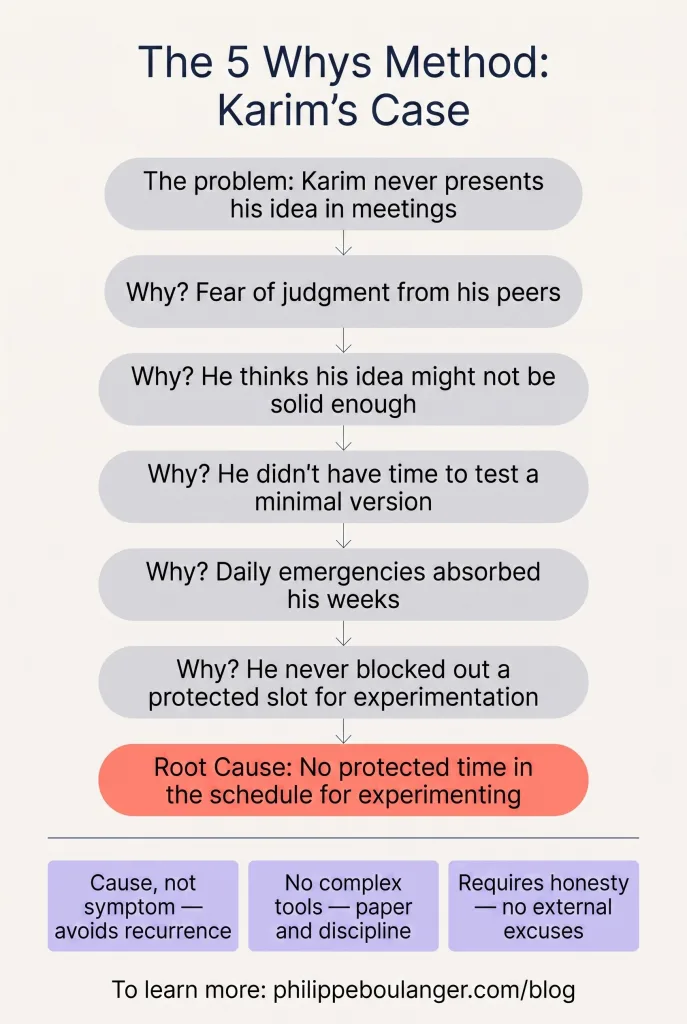
Here’s how it plays out in practice. Take Karim again. His idea to automate part of the deployment pipeline could save his team hours every week. He’s never brought it up in a meeting.
Why not? He’s afraid of his peers’ judgment.
Why that fear? He suspects his idea isn’t solid enough.
Why that suspicion? He never had time to test a minimal version before a meeting.
Why not? He let daily urgencies eat up his weeks.
Why did he let that happen? He never blocked protected time on his calendar for experimentation.
The root cause is neither Karim’s shyness nor the quality of his idea. It’s a calendar allocation problem, not a character flaw. The fix becomes concrete: block two non-negotiable hours a week to test an idea before presenting it.
That’s where the tool becomes powerful. It turns a diffuse emotion (fear, hesitation, frustration) into a chain of causation you can actually correct. You stop treating an assumed personality trait. You start treating a verifiable fact.
The trap that makes the exercise useless
There’s a bias that sabotages the 5 Whys more often than people realize: the fundamental attribution error. It’s our tendency to explain our own failures through external circumstances, and other people’s failures through their character.
If every “why” you write down points to a colleague, your manager, or an external factor, the exercise stops dead. Not because external causes never exist, they do, but because the analysis loses its value if you never dig down to something you, personally, can influence.
Honesty with yourself isn’t optional here. It’s the entry price. A leader who uses the 5 Whys to justify past decisions rather than to understand mistakes isn’t using the tool, they’re weaponizing it (ASQ).
A method that left the factory floor long ago
What began as a way to understand why a weaving loom kept breaking down is now used in healthcare, education, product management, and software incident analysis (Tulip). The reason for that longevity fits in one sentence: the tool requires no statistical training, no software, no certification. It requires discipline and honesty, two resources often scarcer than the tools themselves.
You can start today, on paper, with a single situation that irritated you this week. State the problem in one sentence. Ask why. Write down the answer. Ask why to that answer. Keep going until you hit something you can change directly. If you land on a cause outside your control, step back one level and look for the decision that exposed you to that cause in the first place.
The essentials
Remember three things:
- The visible symptom of a problem is almost always different from its root cause, and fixing the symptom guarantees its return.
- The 5 Whys method, born at Toyota in the 1930s, works as well on a production line as on a professional fear or a habit holding you back.
- The tool only works if you’re willing to dig down to a cause you can genuinely act on, which requires an honesty most people don’t practice naturally.



References
- (My book) https://philippeboulanger.com/book/
- (MindTools) https://www.mindtools.com/pages/article/newTMC_5W.htm
- (Atlassian) https://www.atlassian.com/incident-management/postmortem/5-whys
- (FlowFuse) https://flowfuse.com/blog/2025/12/five-whys-root-cause-analysis-definition-examples/
- (ASQ) https://asq.org/quality-resources/five-whys
- (Tulip) https://tulip.co/blog/five-whys/