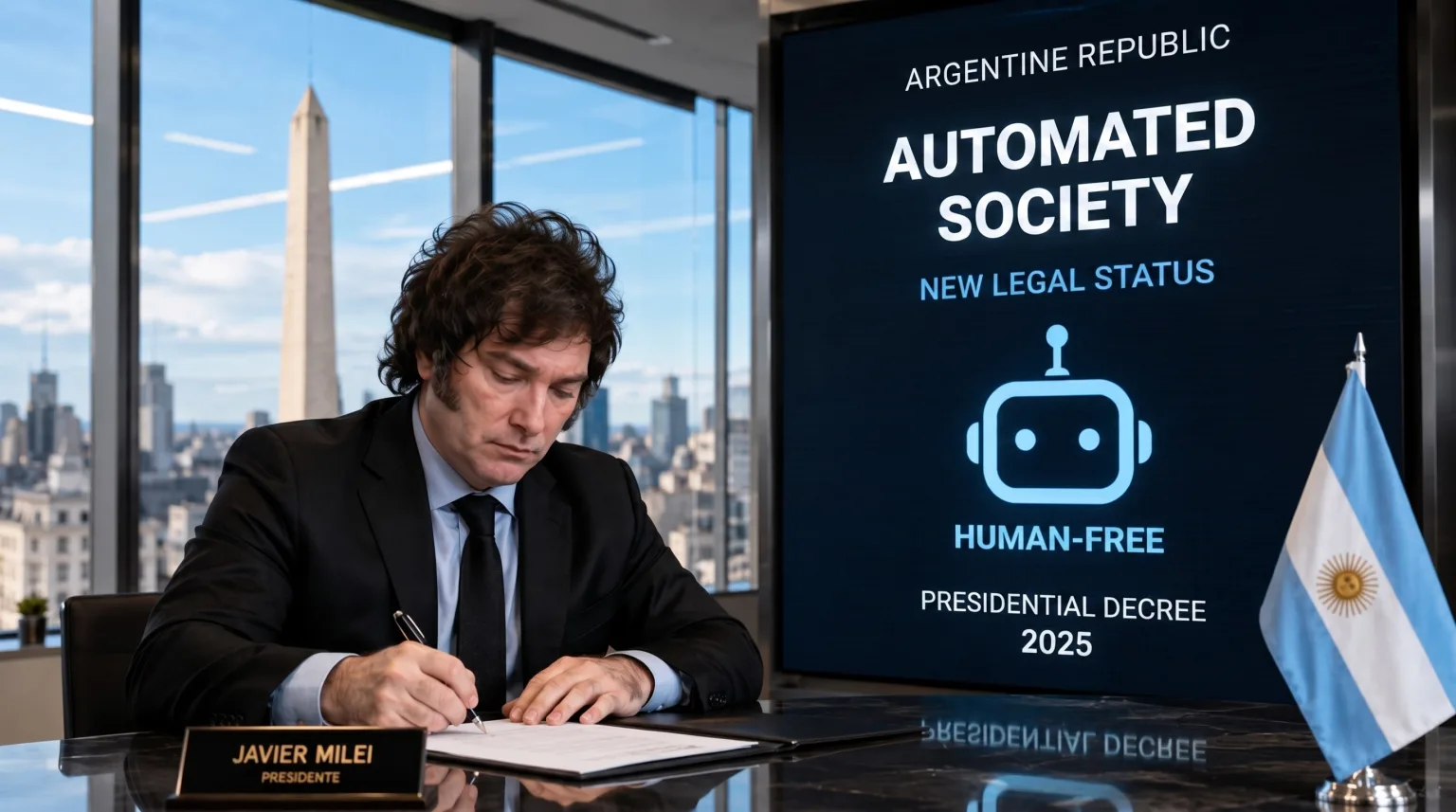
What if the utopia was not universal basic income, but the company without humans?
On one side, some people want to tax artificial intelligence.
Tax robots.
Tax automation.
Tax productivity gains.
Tax the capital that replaces labor.
Then redistribute.
The idea is elegant, almost reassuring: if machines work in our place, they should help finance our existence.
In this vision, AI becomes a new fiscal cow. It produces, replaces, concentrates wealth, and therefore must pay.
This is the compensation narrative.
Part of Silicon Valley itself, long fascinated by deregulation, now seems to be looking toward redistribution mechanisms: universal basic income, AI sovereign wealth funds, capital taxes, shared ownership of machine-generated wealth. Sam Altman proposed an “American Equity Fund” funded by an annual tax on large companies and privately held land. Bill Gates defended the idea of a robot tax to slow human job displacement and fund socially useful work. (Sam Altman, World Economic Forum)
The other utopia says: since AI will create wealth, let us organize redistribution before the fracture becomes explosive.
It is coherent.
It is defensible.
It is humanly understandable.
But Javier Milei is taking the opposite road.
Argentina does not want to slow the machine down
According to Le Figaro, the Argentine president wants to create a new status for automated companies without humans, managed by AI or robots. In an opinion piece published by the Financial Times, Milei presents the idea as a legal rupture comparable to the invention of the limited liability company: every major productivity revolution requires a new legal architecture. (Le Figaro, Financial Times)
His reasoning is simple.
AI should not merely be used by companies.
It should be able to become a new form of company.
A company operated by AI agents.
A company able to enter contracts.
A company able to produce.
A company able to manage assets.
A company able to act in uncertain environments.
A company whose human beneficiaries would be identified, while its daily operations could be largely automated.
The proposal rests on three pillars: little or no prior AI regulation, the creation of a legal category for non-human corporations, and an attractive tax environment. WIRED also refers to the notion of a “sociedad anónima autónoma”, designed for entities operated by AI agents or robots. (WIRED)
This is the ideological shock.
While some want to tax AI to repair the future, Milei wants to free AI to attract the future.
Two visions of the world
The first vision says: AI will destroy part of human work, so let us prepare a social safety net.
The second says: AI will create a new form of economic activity, so let us prepare a playing field.
The first thinks protection.
The second thinks jurisdiction.
The first thinks redistribution.
The second thinks attraction.
The first sees AI as a social risk.
The second sees AI as productive infrastructure.
And this is precisely where the debate becomes fascinating.
Because both visions contain a utopian dimension.
The utopia of universal basic income assumes we will be able to tax wealth that is increasingly mobile, software-based, international, and tax-optimized.
The utopia of the automated company assumes we will be able to create value without blowing up responsibility, trust, safety, competition, and social cohesion.
One wants to tame the wave.
The other wants to surf it before everyone else.
Where is the utopia?
Universal basic income rests on one promise: partially decoupling income from work.
It is a powerful idea. It responds to a very real anxiety: what happens when the machine becomes faster, cheaper, more available, and sometimes more capable than the human?
The London School of Economics notes that universal basic income often appears in AI and automation debates, especially as a response to job insecurity, wage inequality, and potential worker displacement. (LSE Business Review)
But this utopia has a blind spot: it often assumes value will be created somewhere else, then redistributed afterward.
In other words: production first, compensation later.
Milei reverses the proposition: first create the legal and fiscal conditions for that value to come to us.
Argentina is not only entering the moral debate. It is entering the geopolitical debate.
Who will write the rules of the autonomous company?
Who will attract capital?
Who will become the Delaware, Singapore, or Amsterdam of agentic AI?
Who will capture the first generations of companies where software is no longer a tool, but an operating structure?
At this level, innovation is no longer technological. It becomes institutional.
Is the humanless company a provocation or an anticipation?
The Argentine project is easy to caricature.
It can be seen as libertarian fantasy.
It can be seen as a leap into the unknown.
It can be seen as an ideal grey zone for abuse.
It can be seen as a dream of automated capitalism freed from human friction.
Criticism is already emerging in Argentina. The Buenos Aires Herald reports concerns from politicians and technology experts about the implications of non-human corporations operating with low regulation and low taxes. (Buenos Aires Herald)
Those concerns are legitimate.
Who answers if an automated company causes harm?
Who bears responsibility if an AI agent signs an absurd contract?
Who is liable if an algorithmic decision chain creates a massive loss?
Who controls the opacity of a system that learns, adapts, and acts?
Who checks that real beneficiaries are not hiding behind automated structures?
A legal status without clear responsibility would be a time bomb.
But the absence of a framework can also become a time bomb.
Because these automated companies will exist, with or without a suitable legal status.
AI agents can already search, write, code, sell, analyze, negotiate, generate content, drive workflows, trigger payments, interact with APIs, and produce contractual documents. Leaders waiting for a perfect definition of the automated company may discover too late that use cases have already outrun the law.
This is often how innovation moves.
First usage.
Then scandal.
Then regulation.
Then normalization.
Milei wants to reverse the sequence: create the framework before entrepreneurs go elsewhere.
Europe regulates, Argentina experiments
The contrast with Europe is striking.
The European Union presents the AI Act as the first comprehensive legal framework on AI, with a risk-based approach. The European goal is to foster trustworthy AI, especially by regulating uses considered unacceptable or high-risk. (European Commission)
This is normative power.
Europe says: we want AI to be acceptable.
Argentina says: we want AI to come here.
Both strategies can be defended.
Both strategies can fail.
Overly heavy regulation can discourage experimentation.
Overly aggressive deregulation can create systemic risks.
The difference lies in the bet.
Europe bets on trust.
Argentina bets on attraction.
And in a period of technological shift, institutional bets matter as much as technical breakthroughs.
AI as process innovation
In my book, chapter 14, I explain that AI makes it possible to redefine how things are done, thereby enabling process innovation.
This point is central.
Many companies still see AI as an individual productivity tool.
Saving time on an email.
Summarizing a meeting.
Creating an image.
Producing a draft.
Automating a task.
But the stakes go further.
AI transforms processes: producing, deciding, selling, recruiting, analyzing, contracting, training, governing.
The Argentine project pushes this logic to its limit: if AI transforms processes, then it can transform the very form of the company.
The classical company was designed to organize human work, human capital, human responsibilities, and human decisions.
What happens when a growing share of these functions becomes software-based?
We can respond with fear.
We can respond with tax.
We can respond with prohibition.
We can respond with law.
Argentina is attempting a legal and fiscal response.
Tax the future or organize it?
The debate is not simply about being for or against Milei.
It forces us to confront a tension many countries prefer to avoid.
Taxing AI too early may slow down still-immature uses.
Not taxing it may concentrate wealth even further.
Regulating too early may freeze technologies we still poorly understand.
Not regulating may transfer risks to citizens, customers, and institutions.
There is no comfortable answer.
But one thing is clear: AI will not only be a productivity issue. It is becoming a sovereignty issue.
Countries will no longer ask only: “How do we protect our citizens from AI?”
They will also need to ask: “How do we attract, frame, and capture the value created by AI?”
This second dimension is often missing from the European public debate.
We talk a lot about risks.
We talk a lot about ethics.
We talk a lot about protection.
We talk less about legal competitiveness.
We talk less about fiscal attraction.
We talk less about jurisdictional competition.
Yet tomorrow’s companies will go where the law allows them to exist.
The country that writes the status wins a battle
The corporation, limited liability, holding companies, stock options, investment funds, software licenses, digital platforms: every major economic wave has needed legal innovation.
Law is not only a constraint.
Law can become innovation infrastructure.
This is probably the most interesting bet in Argentina’s initiative.
Milei is not merely saying: “Come pay less tax.”
He is saying: “Come exist legally here before others understand what you are.”
That is strategically powerful.
The question becomes less moral than operational: can a state become attractive by creating a legal category for companies other countries do not yet know how to name?
Economic history shows that words matter.
When an activity receives a legal name, it becomes fundable, transferable, auditable, taxable, contestable, and exploitable.
Without a name, it remains an anomaly.
With a name, it becomes a market.
What now?
Argentina is taking a considerable risk.
It may become a global laboratory for autonomous companies.
It may also become a field of uncontrolled experimentation.
But those who laugh should be cautious.
Innovation history loves proposals that appear excessive at first, then obvious ten years later.
The company without humans sounds absurd today.
Global commerce without physical stores once sounded absurd.
Money without a central bank once sounded absurd.
The car without a driver once sounded absurd.
Software that writes, codes, translates, and reasons with us once sounded absurd.
Today’s absurdity sometimes becomes tomorrow’s standard.
So, where is the utopia?
In the idea that we can tax AI enough to finance a post-work society?
Or in the idea that a country can reinvent itself by becoming the global jurisdiction for autonomous companies?
I do not have a definitive answer.
But I have one conviction: countries that merely comment on the wave will end up buying the technologies, standards, and legal models designed by those who dared to experiment.
Between taxing the future and organizing the future, there may be an entire continent of delay.



References
(Le Figaro) = https://www.lefigaro.fr/conjoncture/en-argentine-le-libertarien-javier-milei-cree-un-nouveau-statut-de-societe-automatisee-sans-humain-20260604
(Financial Times) = https://www.ft.com/content/f93022fe-43f7-437d-abd8-06c457c0a43c
(Buenos Aires Herald) = https://buenosairesherald.com/business/tech/mileis-proposal-to-allow-non-human-corporations-run-by-ai-causes-concern-in-argentina
(WIRED) = https://es.wired.com/articulos/milei-apuesta-por-una-ia-sin-regulacion-para-atraer-inversiones-millonarias-a-argentina
(World Economic Forum) = https://www.weforum.org/stories/2017/02/bill-gates-this-is-why-we-should-tax-robots/
(Sam Altman) = https://moores.samaltman.com/
(LSE Business Review) = https://blogs.lse.ac.uk/businessreview/2025/04/29/universal-basic-income-as-a-new-social-contract-for-the-age-of-ai-1/
(European Commission) = https://digital-strategy.ec.europa.eu/en/policies/regulatory-framework-ai