The day Berkeley looked in the mirror
The degree has just met its natural predator: the “Generate” button.
At Berkeley, one of the world’s symbolic temples of computer science, a weak signal has turned into a fire alarm.
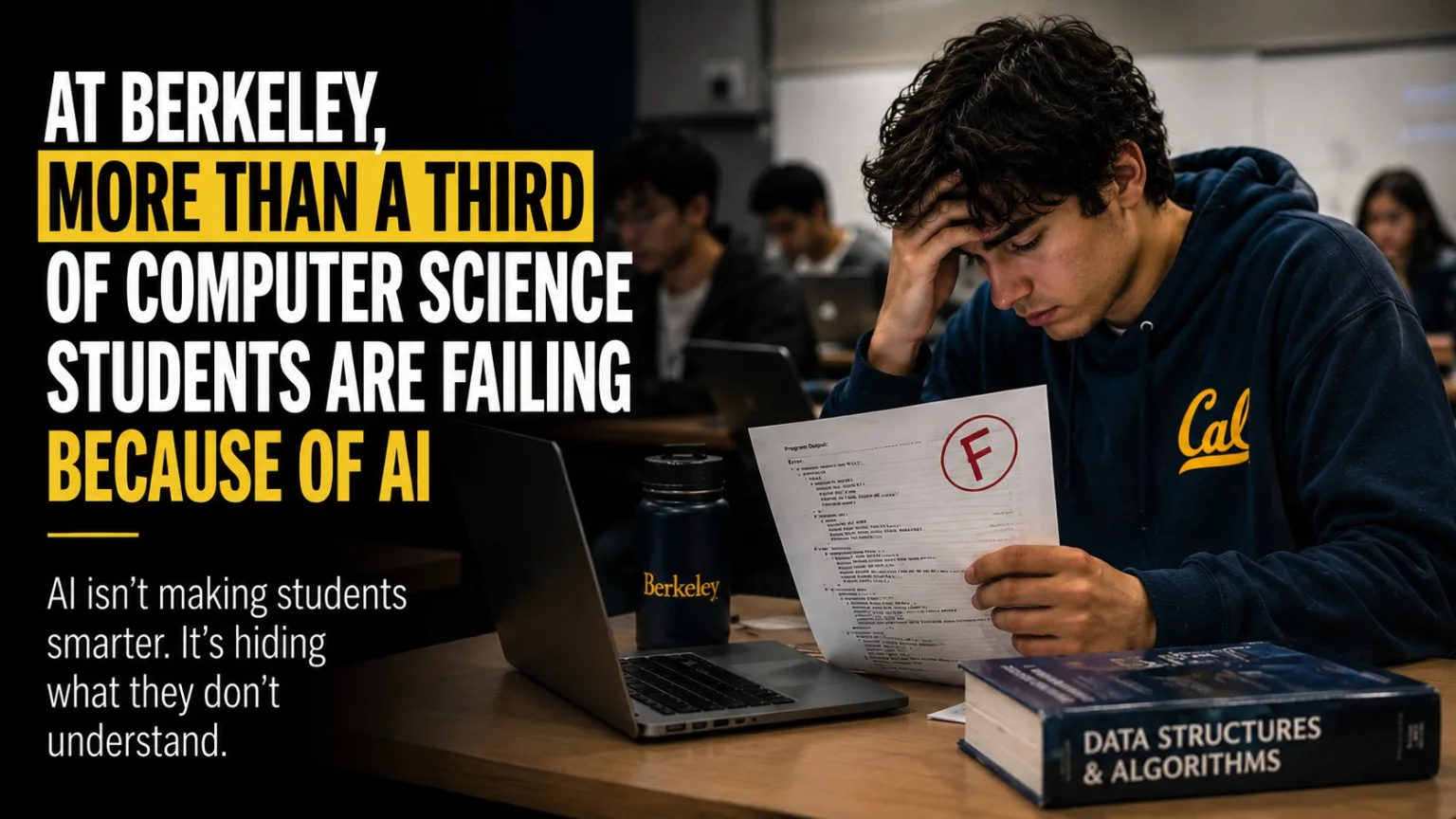
In CS 10, an introductory computer science course, Next reports that 35.3% of students received an F in spring 2026, compared with 6.8% the previous year. The same article reports a +419% increase in failing grades in that course, along with sharp increases in CS 61A and EECS 127. (Next)
Not in a dusty institution.
Not in a school lagging behind.
At Berkeley.
The kind of place where you imagine students coding in their sleep, dreaming in Python and taking their coffee with a pinch of linear algebra.
Except AI has now planted a silent bomb under the education system.
Students did not only use AI to learn faster. Some used it to avoid the effort of learning.
It did the homework.
It gave the answers.
It produced the illusion of competence.
Then the exam arrived.
And suddenly, no magic prompt.
No copilot.
No safety net.
Only the brain, reasoning, foundations, mathematics and understanding.
The mask came off.
AI did not make those students bad.
It revealed those who had outsourced their learning before building it.
The illusion of competence is the new danger
The problem goes far beyond Berkeley.
A 2026 Science study, relayed by Berkeley’s Center for Studies in Higher Education, analyzed responses from 95,513 students across 20 major U.S. public research universities. It found that regular generative AI use is particularly high in computer science, with 62% of students in that field using it monthly or more often. It also estimated that 9% of student AI users had used it to cheat, rising to 26% among daily users, compared with 7% among monthly users. (CSHE Berkeley)
Cornell summarizes the issue clearly: assessment reform is necessary and urgent because AI misuse undermines assessment validity and, therefore, the credibility of university credentials. (Cornell Chronicle)
That is the core of the issue.
AI does not only threaten homework.
It threatens the signal.
A degree is supposed to signal competence.
An exam is supposed to signal understanding.
A project is supposed to signal problem-solving ability.
When AI produces the assignment, the signal becomes blurred.
When a student can no longer explain the reasoning behind the code, the signal becomes dangerous.
When a grade reflects the efficiency of a tool rather than the student’s competence, education enters a zone of ambiguity.
And in an economy where the degree still acts as a hiring filter, that ambiguity will become expensive.
Knowledge outsourced too early becomes a debt
AI can be a remarkable learning accelerator.
It can explain a concept.
It can rephrase an idea.
It can propose exercises.
It can challenge an answer.
It can simulate a patient tutor, available and tireless.
But when used too early, too often and too directly, it becomes something else: outsourced reasoning.
That is where the trap closes.
The student thinks they have learned because they obtained an answer.
They think they understand because they recognize the solution.
They think they have mastered the topic because the assignment has been submitted.
But recognizing an answer is not the same as being able to produce it.
Reading an explanation is not the same as rebuilding the reasoning.
Submitting working code is not the same as understanding why it works.
In the old world, effort was painful, but it built the muscle.
In the new world, the “Generate” button removes the pain too early.
Yet part of learning comes from that friction.
Trying.
Failing.
Searching.
Starting again.
Getting stuck.
Reading again.
Asking.
Testing.
Then understanding.
AI can support that process. It can even improve it. But when it jumps straight to the answer, it turns learning into express delivery.
And competence delivered without effort is often only an illusion.
Cognitive prosthesis or permanent crutch?
Here is the essential distinction.
When AI becomes a cognitive prosthesis, it augments the human.
When it becomes a permanent crutch, the muscle weakens.
A 2025 study by Michael Gerlich in Societies analyzed 666 participants and found a negative correlation between frequent AI tool use and critical thinking skills, with cognitive offloading as a mediating mechanism. The study also found that younger participants showed higher dependence on AI tools and lower critical thinking scores. (MDPI)
A 2025 Frontiers in Psychology article frames the dilemma differently: AI can reduce unnecessary cognitive load, but overreliance may also reduce the useful cognitive load needed for deep learning and higher-order thinking. (Frontiers in Psychology)
This is exactly what many organizations underestimate.
AI does not only remove tasks.
It relocates effort.
And depending on where that effort is relocated, it creates power or fragility.
A student who uses AI to understand a mistake learns.
A student who uses AI to avoid the mistake bypasses learning.
A developer who uses AI to accelerate code they can review saves time.
A developer who does not understand the generated code creates risk.
A manager who uses AI to challenge their reasoning improves a decision.
A manager who delegates judgment to AI gives up part of their responsibility.
The degree must change its role
The easy answer is to say: ban AI.
It is reassuring.
It gives the impression of control.
It preserves the scenery.
But the professional world will not operate without AI.
Tomorrow, many jobs will require people to know how to use these tools. Refusing AI in education would mean training students for a world that has already disappeared.
The opposite answer is to say: allow everything.
It pleases techno-enthusiasts.
It sounds modern.
It avoids difficult debates.
But if everything is allowed without structure, assessment loses value.
So the subject is not “AI or no AI.”
The subject is: when does AI intervene in the learning process?
Before effort?
During effort?
After effort?
To produce?
To explain?
To challenge?
To correct?
To replace?
This is where schools, universities and professional training programs must become much more precise.
A homework assignment completed at home with open AI access no longer measures the same thing as an oral exam, live problem-solving, a defense, an explanation of reasoning or a project documented step by step.
Value will no longer sit only in the final output.
It will sit in the trace of reasoning.
In the ability to explain.
In the ability to correct.
In the ability to critique AI output.
In the ability to say: “This answer is seductive, but wrong.”
What humans must keep in their brains
The most uncomfortable issue for education is no longer: “Should AI be allowed?”
The decisive issue becomes: which skills must remain in the human brain at all costs?
Here is my view.
Foundations must remain human.
Not out of nostalgia.
Not out of romantic love for chalkboards.
Not because the past is always right.
But because you cannot intelligently pilot a tool whose foundations you do not understand.
In computer science, that means understanding data structures, logic, algorithms, complexity, mathematics, errors and limits.
In law, it means understanding legal reasoning before asking AI to draft a memo.
In medicine, it means understanding diagnosis before using an assistant.
In management, it means understanding human dynamics before automating decisions.
In innovation, it means understanding the problem before generating solutions.
AI can help us move faster.
It should not become the elegant way to avoid building the foundation.
AI as process innovation
This is exactly what I address when I speak about AI as process innovation.
In my book, chapter 14, I explain that AI can redefine how things are done and therefore foster process innovation. This adoption must follow a structured logic, with vision, communication, exploration, deployment, measurement and attention to how people feel about AI entering the organization.
Schools are now experiencing what companies are already experiencing.
A technology arrives.
It promises better, faster, cheaper.
Everyone rushes toward it.
Then the side effects appear.
In companies, people discover that AI used without strategy produces useless files, average content, approximate decisions and sometimes dangerous dependence.
In universities, people discover that AI used without pedagogy produces clean assignments, weak competence and catastrophic exams.
Same cause.
Same mechanism.
Same blindness.
The tool changes the process.
But the process must be redesigned.
Otherwise, the tool amplifies existing weaknesses.
Teaching AI does not mean letting AI do everything
The future of education will not be anti-AI.
It must be anti-intellectual laziness.
That nuance matters.
Teaching with AI means learning to ask better questions.
It means asking students to compare two answers.
It means making them detect an error.
It means asking them to document their reasoning.
It means having them explain what they accept, what they reject and why.
It means turning AI into a sparring partner, not a ghostwriter.
Students must learn to use AI as a demanding mirror.
Not as a machine that submits homework in their place.
The best student will not be the one who uses AI the most.
It will be the one who knows when to use it, when to challenge it and when to close the laptop and think.
Education can no longer afford ambiguity
The worst option would be to remain vague.
Every professor with their own rules.
Every assignment with its own tolerance.
Every student with their own interpretation.
Every institution with its own panic.
The Science study specifically emphasizes the need for discipline-specific assessment reform rather than blanket bans or universal detection regimes. (CSHE Berkeley)
That makes sense.
You do not assess a future developer like a future lawyer.
You do not assess a future doctor like a future designer.
You do not assess a mathematics student like a marketing student.
Each discipline must determine what AI can accelerate without damaging foundational learning.
And each discipline must define what should be assessed in a controlled environment.
Without AI.
Without the internet.
Without a copilot.
Only the human facing their competence.
The degree will survive if it becomes proof again
The degree is not dead.
But it must become proof again.
Not proof of presence.
Not proof of conformity.
Not proof of the ability to submit a clean assignment.
Proof of reasoning.
Proof of understanding.
Proof of judgment.
Proof of autonomy.
Proof of the ability to use AI without becoming dependent on it.
Berkeley may have just shown what awaits every institution that confuses technological adoption with real learning.
AI is not the enemy of education.
The enemy is the illusion of competence.
The enemy is the successful assignment without understanding.
The enemy is the perfect answer placed on an empty brain.
That is exactly why this subject belongs in schools, universities, companies, conferences and executive committees.
Because the problem is not only about students.
It concerns everyone who is starting to confuse producing faster with thinking better.
👉 At what point does AI stop being a learning accelerator and become an intellectual anesthetic?



References
- (Next) = https://next.ink/241126/a-berkeley-plus-dun-tiers-des-etudiants-en-informatique-sont-recales-a-cause-de-lia/
- (Berkeley News) = https://news.berkeley.edu/2026/05/21/the-largest-study-of-ai-use-by-undergrads-is-in-revealing-disparities-in-access-and-in-cheating/
- (CSHE Berkeley) = https://cshe.berkeley.edu/news/study-finds-widespread-generative-ai-use-among-college-students-signaling-urgent-need
- (Cornell Chronicle) = https://news.cornell.edu/stories/2026/05/widespread-ai-misuse-means-higher-ed-must-rethink-assessment
- (CSHE Berkeley) = https://cshe.berkeley.edu/publications/generative-ai-use-and-misuse-call-assessment-reform-higher-education-science-392818
- (MDPI) = https://www.mdpi.com/2075-4698/15/1/6
- (Frontiers in Psychology) = https://www.frontiersin.org/journals/psychology/articles/10.3389/fpsyg.2025.1550621/full