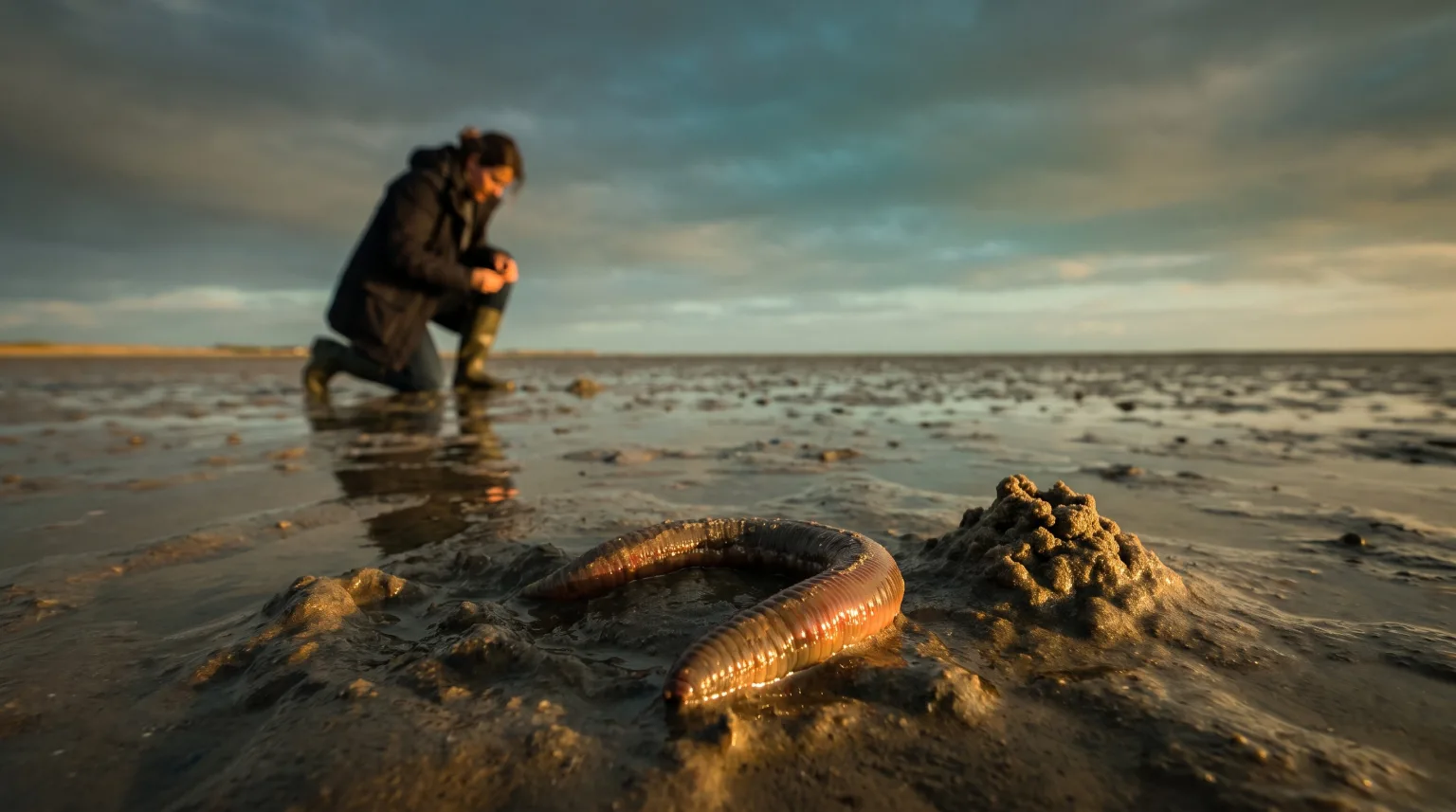
While laboratories poured fortunes into manufacturing synthetic blood, one man crouched down at low tide and picked the solution out of the mud. The story of Franck Zal and his marine worm is one of the finest illustrations I know of a simple principle: real breakthroughs don’t hide where everyone is digging, but in whatever we’ve declared insignificant.
Bait Nobody Bothered to Look At
On the island of Noirmoutier, with every tide, a small worm burrows under the sand. It’s called the lugworm, the arenicola. Fishermen have known it forever, they use it as bait, they sell it by the bucket, and nobody grants it the slightest attention. A slimy, invisible little thing with no prestige. The kind of creature you look away from.
Franck Zal, a marine biologist, did the opposite. He actually looked at it. He spent years studying an animal the entire planet judged worthless, and he asked a question no one else was asking: how does this worm manage to breathe while buried under the sand, cut off from oxygen, between two tides?
The answer was in its blood. The lugworm’s hemoglobin is an extracellular molecule, two hundred and fifty times smaller than a human red blood cell, able to bind forty times more oxygen than ours. And here is the decisive detail: it is compatible with every blood group. Where the pharmaceutical industry chased the answer in prohibitively expensive synthetic molecules, the answer had been waiting in the mud for hundreds of millions of years (Sorbonne Université).
From the Mud to the Operating Room
A researcher’s intuition is worth nothing as long as it stays in a notebook. Franck Zal founded Hemarina and made an industrial bet many considered unreasonable: farming marine worms at scale. In Noirmoutier, his aquaculture farm now produces up to thirty tonnes of lugworms a year, a marine operation that turns humble bait into biomedical raw material (L’Usine Nouvelle).
The resulting product has a name: HEMO2life. It is a universal oxygen carrier added to the solutions used to preserve organs for transplant. Its job is to oxygenate the organ from the moment it is retrieved to the moment it is transplanted. The benefit is considerable. Where a kidney graft used to hold for one or two days, it can now be preserved far longer, and medical teams gain precious hours on organs that would otherwise degrade before their eyes.
These promises were put to the test. The OxyOp clinical trial, run with the Brest University Hospital, showed an excellent safety profile and promising results on kidney graft recovery. Physicians observed that HEMO2life cut delayed graft function by nearly three (Caducée). The follow-up study, OxyOp2, involving several hundred patients across French transplant centres, extended that momentum. The technology earned its CE marking, crossing the line that separates promising research from real-world care.
Berlin, July 2026
In July 2026, in Berlin, the European Patent Office presented Franck Zal with the European Inventor Award in the SMEs category. Continental recognition for a man who had started his career with his boots in the mud, watching a creature everyone trampled over (EU Reporter). Hemarina, for its part, hailed a distinction crowning two decades of stubbornness (Hemarina).
The distance travelled deserves a moment. On one side, pharmaceutical giants spending billions to synthesise blood substitutes, with disappointing results and costly molecules. On the other, a Breton researcher who understood that nature had already solved the problem, and that all it took was knowing where to look. Life has been running experiments for hundreds of millions of years. It has produced solutions of an elegance our laboratories still struggle to match (Wikipedia).
The Bias That Blinds Us
Here is the point that truly interests me, and it reaches far beyond the case of one marine worm. If the lugworm waited so long, it wasn’t for lack of technical means. It was because our gaze was biased. We had filed this worm under “worthless,” and that label literally kept us from seeing what it contained. The treasure was available to anyone willing to dig it up, provided they accepted getting their hands dirty in a substance intellectual fashion deemed contemptible.
That is exactly the heart of innovational intelligence® (my book, chapter 6): relearning how to see value where our biases order us to move along. Our sectors, our companies, our trades are full of these “worms in the mud.” Data nobody analyses, customers nobody listens to, processes deemed outdated, materials treated as waste, skills relegated to folklore. Consensus has decided all of it is worthless, and consensus is often wrong, because everyone is looking in the same place.
Disruptive innovation rarely consists of finding what no one has seen. More often, it consists of truly looking at what everyone has already seen without paying attention. Franck Zal didn’t invent the lugworm. He observed it with fresh eyes, stripped of the prejudice that made it invisible to others.
What Is Your Worm in the Mud?
So I hand the question straight back to you. In your sector, in your organisation, what have you declared ordinary simply because everyone declared it ordinary before you? What is that detail you trample over every day at low tide, convinced it holds no value, only because no one around you took the trouble to crouch down and look at it?
That kind of treasure is what I dig up at low tide and in the middle of a storm, in my talks, my workshops and my coaching. The first step costs nothing: suspend the collective verdict long enough to see what is really hiding beneath your feet.



References
- (Hemarina) = https://www.hemarina.com/dr-franck-zal-founderof-hemarina-wins-the-2026-european-inventor-award-2026?utm_source=philippeboulanger.com
- (EU Reporter) = https://www.eureporter.co/education/science/2026/07/02/european-inventor-award-2026/?utm_source=philippeboulanger.com
- (L’Usine Nouvelle) = https://www.usinenouvelle.com/editorial/grace-a-des-vers-marins-hemarina-ameliore-la-conservation-des-organes-transplantes.N2228105?utm_source=philippeboulanger.com
- (Sorbonne Université) = https://sciences.sorbonne-universite.fr/actualites/un-ver-marin-sauveur-de-vie?utm_source=philippeboulanger.com
- (Caducée) = https://www.caducee.net/actualite-medicale/13964/greffe-de-reins-hemo2life-permet-de-diviser-quasiment-par-trois-les-retards-dans-la-reprise-de-fonction-du-greffon.html?utm_source=philippeboulanger.com
- (Wikipedia) = https://fr.wikipedia.org/wiki/Hemarina?utm_source=philippeboulanger.com