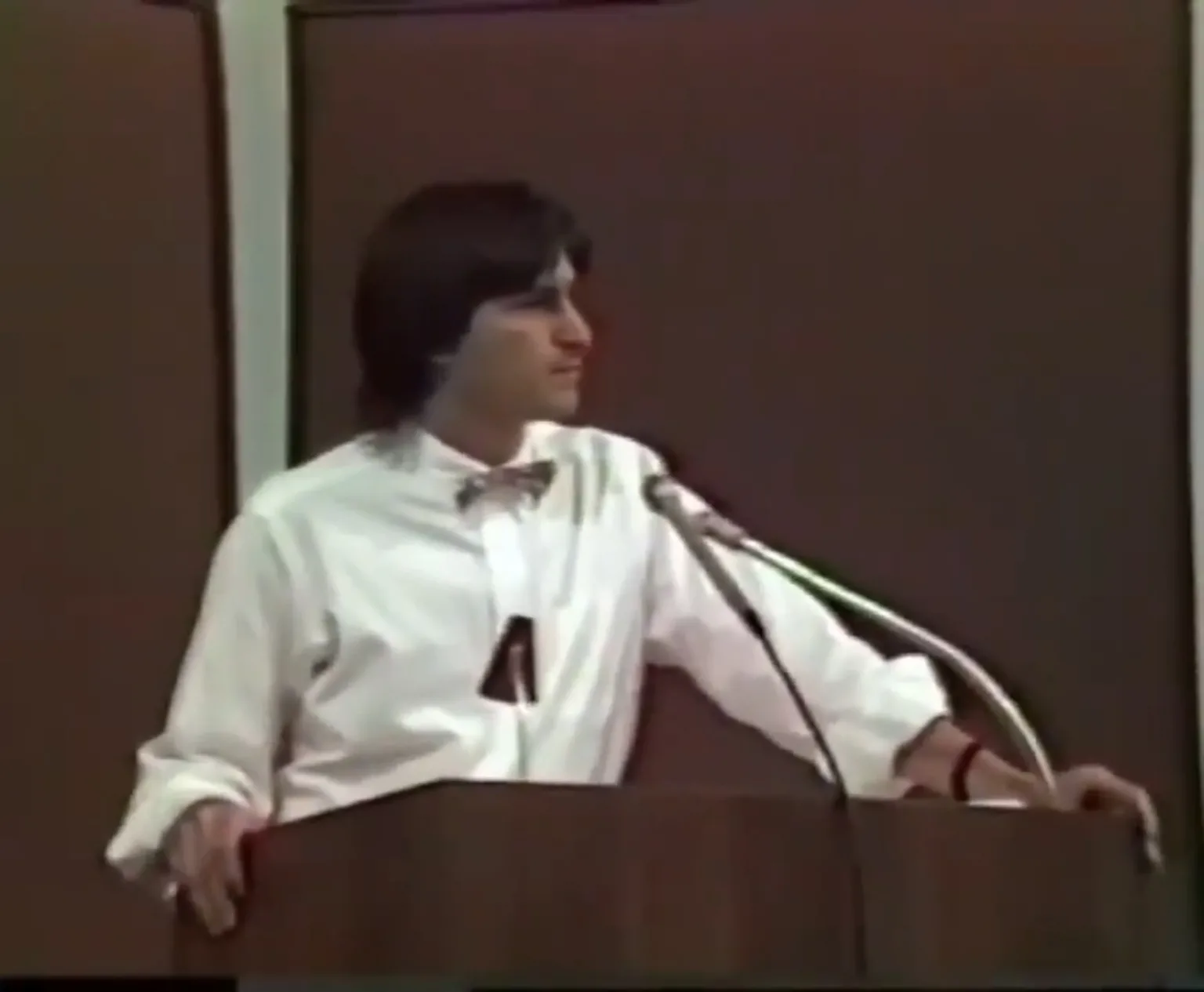
In June 1983, in a conference room in Aspen, a 28-year-old tells a room full of designers that one day we’ll be able to question the dead. Nobody laughs, and nobody quite takes him seriously either. Forty-three years later, the sentence reads like a technical specification.
What Steve Jobs Actually Said in Aspen
International Design Conference in Aspen, June 15, 1983. The recording sat in a drawer for decades before resurfacing, and the passage that matters runs a few lines.
Jobs starts with school: a few great teachers, many mediocre ones. Books saved him, because a book lets you read Aristotle or Plato without an intermediary. He adds that a book is a phenomenal object, a direct transmission from source to reader. Then he states the problem: you can’t ask Aristotle a question.
And he continues: “If we really can come up with these machines that can capture an underlying spirit, or an underlying set of principles, or an underlying way of looking at the world, then when the next Aristotle comes around, maybe if he carries around one of these machines with him his whole life and types in all this stuff, then maybe someday, after this person’s dead and gone, we can ask this machine, hey, what would Aristotle have said? And maybe we won’t get the right answer. But maybe we will.” (Singju Post) (CNBC)
He specifies the horizon: 50 to 100 years.
The Gap Between the Statement and the Available Technology
In 1983, nothing holds up. The Macintosh is not yet on sale, it ships in January 1984. Available computing power is measured in fractions of a MIPS. Digitized corpora do not exist. Deep neural networks are a fringe concept and will stay that way for another twenty-five years.
Above all, the architecture that makes the idea technically feasible is published on June 12, 2017, in a paper titled “Attention Is All You Need,” signed by eight Google researchers. Thirty-four years after the Aspen talk. (arXiv)
That gap is worth pausing on, because it defines precisely what an operational vision is. Jobs describes a use, not a technology. He says nothing about the how. He states a desirable state of the world and attaches a deadline to it.
A Vision Doesn’t Have to Be Accurate, It Has to Filter
The most common error is judging a vision by its completion rate. A vision that nails the timeline and misses the direction is worthless. A vision that is fuzzy on the timeline and right on the direction structures twenty years of decisions.
Because a vision’s function is mechanical: it cuts. Faced with an idea, an acquisition, a hire, a partnership, it asks a single question and produces a binary answer. Does this move us closer to the north star?
The precision of the horizon Jobs announced, 50 to 100 years, pulls the statement out of the register of prophecy. A prophecy merely asserts. A direction carries a date, so it can be assessed, so it commits.
Amazon, or a Vision Built on What Doesn’t Move
The best-documented counterexample to steering by feel comes from Jeff Bezos. In 2012, during a public exchange, he explains that people constantly ask him what will change in the next ten years, and almost never what will stay the same. He adds that the second question is the more useful of the two, because you can build a business strategy around things that are stable over time.
Then he lists them: customers want low prices, they want fast delivery, they want vast selection. And he closes with a now-famous image: it is impossible to imagine a customer saying “I love Amazon, I just wish the prices were a little higher” or “I just wish you’d deliver a little more slowly.” (Quote Investigator)
Amazon has run on those three requirements for over twenty years. The flywheel Brad Stone describes in The Everything Store follows directly: lower prices bring more visits, which bring more volume, which spreads fixed costs further, which enables lower prices still. Any initiative aligned with that cycle gets attention and resources. The others die quickly and without drama (my book, chapter 8).
The value of the arrangement lies in its arbitration power. An organization that knows what will not change about its customers holds a permanent sorting criterion, independent of technology fashions and budget cycles.
The Cost of a Fuzzy Vision Is Measurable
The argument rarely survives an executive committee as long as it stays qualitative. There are numbers, though.
Donald Sull and his coauthors surveyed executives at more than 300 companies for MIT Sloan Management Review. The result: given five tries, only 29% of managers could name three of their own company’s strategic priorities. (MIT Sloan Management Review)
Another body of work, relayed by London Business School, shows the same pattern across a sample of 124 organizations: roughly one in four executives tasked with executing the strategy can name three of its pillars. Two thirds of the senior managers surveyed cannot. (London Business School)
Translate that. In an average company, seven managers out of ten make trade-offs every week without knowing what they are trading off toward. They are not deciding randomly, though: they decide on local criteria, department budget, quarterly target, team comfort, internal relationships. Individually rational, collectively destructive.
Why Transmission Loss Feeds Status Quo Bias
The chain is tight. When direction is illegible, the least risky option becomes renewing what already exists. Nobody gets sanctioned for doing this year what they did last year.
That reflex has a name and has been documented since 1988. William Samuelson and Richard Zeckhauser published in the Journal of Risk and Uncertainty a series of experiments showing that individuals cling disproportionately to the incumbent option, including when a superior alternative is presented to them. Their data on health plan and retirement program choices confirm the effect on real, high-stakes decisions. (Springer)
Combine the two and you get the physiology of gridlock: fuzzy vision, therefore no shared arbitration criterion, therefore default preference for the existing, therefore a structural inability to challenge what is already in place.
The Symptoms Are Always the Same
An organization suffering from a fuzzy vision emits recognizable signals.
Projects that contradict each other, carried by different departments, each defensible in isolation.
Trade-offs replayed every quarter, with the same arguments and varying conclusions depending on who speaks loudest.
Teams optimizing local indicators with great seriousness while the overall trajectory drifts.
A strategy committee that spends most of its time on execution decisions, for lack of a framework that would make those decisions obvious.
And the final symptom, the most expensive: resources scattered across fifteen mediocre initiatives instead of concentrated on three decisive ones.
Vision and Strategy Are Not the Same Thing
The distinction is simple and it is constantly ignored.
Vision rarely changes. It describes the state of the world the organization wants to help create, over a long horizon, and it outlives changes of leadership.
Strategy is tested, measured and corrected. It describes the path chosen at a given moment, given the resources and the terrain.
Confusing the two means changing course every time the wind shifts. An organization that revises its vision every eighteen months has no vision, it has a succession of marketing plans. An organization that refuses to revise its strategy because it mistakes it for its vision drives into the wall holding the wheel firmly.
Jobs never deviated from the idea of a tool that amplifies individual capability. Apple’s strategy, meanwhile, changed a dozen times between 1983 and 2011.
What the Aspen Sequence Teaches Today’s Leaders
Forty-three years separate the statement from its partial realization. No three-year plan would have survived that delay. No quarterly dashboard would have validated the idea.
What survived was a direction clear enough to be repeated without distortion and ambitious enough to attract people who only half believed in it.
Test yours with three quick checks.
First, can an employee picked at random in your organization state it in one sentence, without notes and without hesitation?
Second, does it let you say no? A vision that validates every project is a decorative statement of intent.
Third, does it hold on a horizon that outlasts its author’s mandate? If it expires with you, it orients nobody.
👉 In your organization, how many of last year’s decisions would survive that filter?
I run this filter live on your own projects in my talks, workshops and advisory work.



References
- (Singju Post) https://singjupost.com/full-transcript-steve-jobs-speaks-at-the-1983-international-design-conference/?utm_source=philippeboulanger.com
- (CNBC) https://www.cnbc.com/2024/07/20/steve-jobs-describes-generative-ai-in-newly-released-1983-clip.html?utm_source=philippeboulanger.com
- (arXiv) https://arxiv.org/abs/1706.03762?utm_source=philippeboulanger.com
- (Quote Investigator) https://quoteinvestigator.com/2021/03/03/not-change/?utm_source=philippeboulanger.com
- (MIT Sloan Management Review) https://sloanreview.mit.edu/article/turning-strategy-into-results/?utm_source=philippeboulanger.com
- (London Business School) https://www.london.edu/news/two-thirds-of-senior-managers-cant-name-their-firms-top-priorities?utm_source=philippeboulanger.com
- (Springer) https://link.springer.com/article/10.1007/BF00055564?utm_source=philippeboulanger.com