A data center has learned to breathe
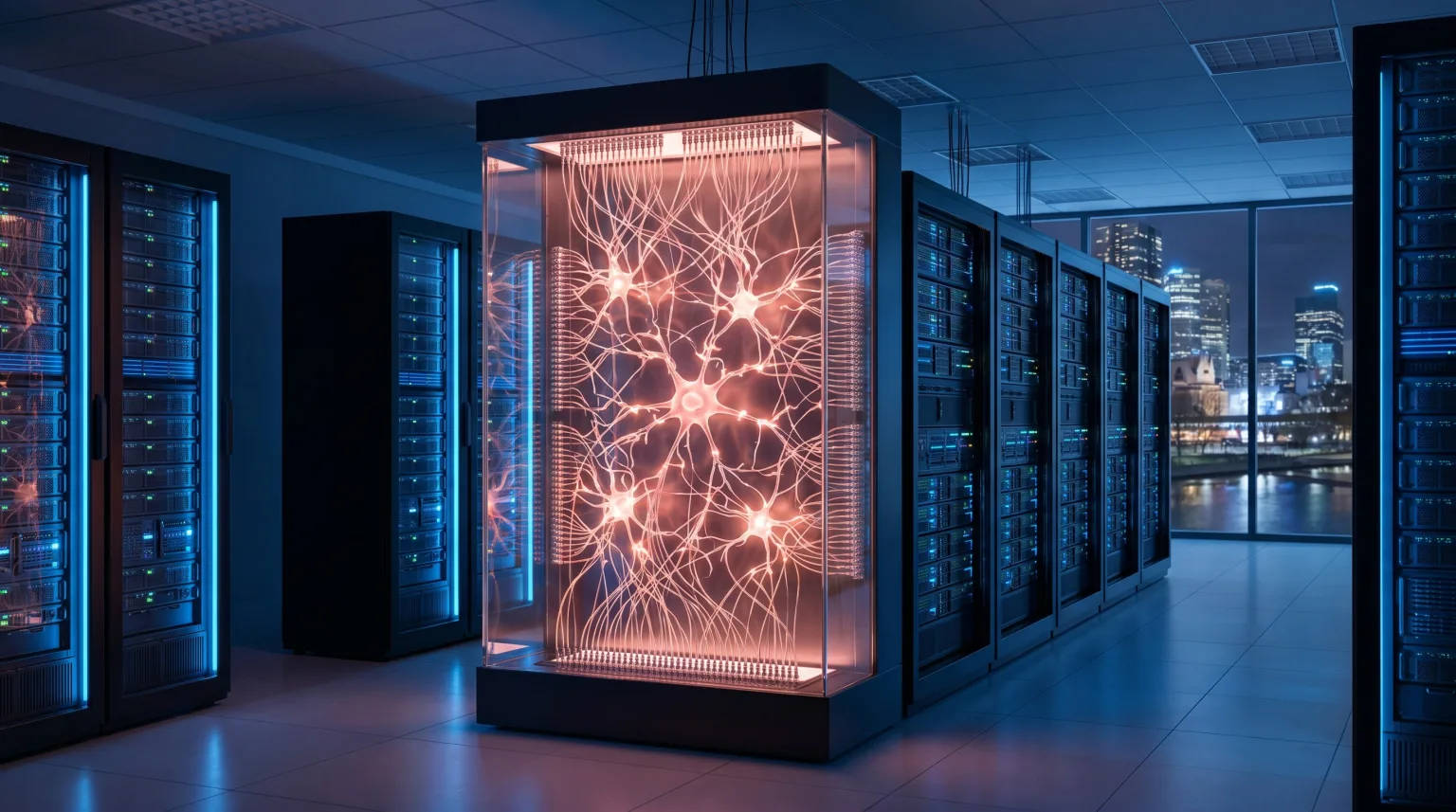
A data center has learned to breathe.
In Melbourne, Cortical Labs has opened a door many people would rather observe from a safe distance: an infrastructure partially based on human neurons grown in a laboratory.
Not brains in jars.
Not a forgotten scene from a cheap science-fiction show.
Human cells, connected to silicon, kept alive in a controlled environment, capable of participating in information processing inside a hybrid system.
Cortical Labs presents its CL1 as a programmable biological computer in which neurons grown on a chip can process signals, learn and interact with code through a software interface. The company also offers Cortical Cloud, a form of remote access to this biological infrastructure. (Cortical Labs)
The key word here is not only “computer”.
The key word is “biological”.
For decades, we tried to build machines that imitate the brain. Today, one company is asking a far more disturbing question: why imitate the brain when we can begin to integrate it into the machine?
That is the vertigo.
From silicon to living tissue
Generative AI had already forced us to rethink the boundary between creation, work, automation and intellectual property.
Biocomputing adds a deeper layer: the boundary between living tissue and infrastructure.
In this new technological imagination, the living being is no longer only the user of the machine. It may become part of the machine.
A component.
An accelerator.
An interface.
A computational material.
Cortical Labs had already attracted attention in 2022 with DishBrain, a system in which human and animal neurons grown in vitro were placed in a simulated environment inspired by Pong. The study published in Neuron described a system where neuronal cultures received signals and adapted their activity through feedback. (Neuron)
Nature summarized the issue with a striking idea: neurons in a laboratory dish learning to play Pong. (Nature)
Since then, the narrative has shifted.
We are no longer only talking about a fascinating experiment in a Petri dish.
We are talking about a commercial biological computer, cloud access, racks, infrastructure, and even a bio data center in Melbourne. Information Age reports that Cortical Labs has built several racks of Internet-connected CL1 devices to power its Cortical Cloud business. (Information Age)
The phrase “biological data center” carries enormous narrative power.
It is spectacular.
It is unsettling.
It may be exaggerated.
Above all, it is useful, because it forces us to look innovation in the eye.
Innovation loves to disturb categories
In my book, I explain that innovation is not a brilliant idea sitting on a slide. Innovation begins when an idea enters friction with reality, fears, biases, organizations and human decisions. I also explain that artificial intelligence, generative or not, is a major source of process innovation in companies (my book, chapter 14).
Here, everything is present.
Technological fascination.
Ethical fear.
Excessive storytelling.
The need for governance.
Confusion between promise, prototype, product and infrastructure.
And above all, one obvious signal: the technological future will not only be digital. It will be hybrid.
Hybrid between software and biology.
Hybrid between cloud and laboratory.
Hybrid between data processing and living tissue.
Hybrid between engineering and philosophy.
The trap of spectacle
Faced with this kind of announcement, two reactions usually dominate.
The first is to applaud without thinking.
The second is to panic without understanding.
Both are wrong.
Applauding too quickly means confusing demonstration with industrial maturity. Biological systems remain difficult to stabilize, standardize, maintain, measure and deploy at scale. A GPU can be replaced. A neuronal culture must be maintained, fed, monitored and renewed.
Panicking too quickly means projecting science-fiction fears onto these systems. A network of neurons grown on a chip is not a miniature human brain with a hidden will. Experts quoted by ABC Science urge caution about the real capabilities of such devices and about overly ambitious interpretations. (ABC Science)
The most immediate danger is not the emergence of consciousness inside a laboratory rack.
The most immediate danger is more ordinary: overselling a technology before understanding its real uses, limits, risks, business model and ethical framework.
Technology history is full of grand promises that arrived too early.
The difference here is that the promise touches living matter.
A new definition of brain-machine interface
When people talk about brain-machine interfaces, they often think of electrodes, implants and devices able to restore motor function or interpret brain activity.
Here, the perspective changes.
The interface does not only connect a human brain to a machine.
It connects cultivated living tissue to a computing system.
The brain is no longer only a source of signal.
It becomes a computing environment.
This nuance matters.
It changes the vocabulary.
It changes responsibilities.
It changes imaginaries.
It changes investment committees.
It changes ethics committees.
IEEE Spectrum described the CL1 as a biocomputing platform combining human neurons with a silicon chip for neuroscience and biotechnology research, with an announced price of 35,000 dollars per unit. (IEEE Spectrum)
The goal is not necessarily to replace traditional data centers.
The goal may be to create a new category of computation, useful for specific problems: adaptation, learning, drug testing, neurological disease modeling and exploration of cellular behavior.
In other words: not “the brain versus silicon”.
Rather: living tissue with silicon.
Leaders facing the hybrid age
Executives who still look at AI only as a productivity tool are already short on imagination.
Because what is coming is not merely one more piece of software.
It is no longer only: “How can we automate a task?”
It is also:
How do we decide when infrastructures become hybrid?
How do we govern systems that partly rely on living tissue?
How do we evaluate risk when technology exceeds usual legal categories?
How do we train teams when innovation intersects AI, biology, cloud, medicine, ethics and cybersecurity?
How do we keep marketing from outrunning maturity?
Biocomputing is not only a research topic.
It is a general management topic.
A strategy topic.
An HR topic.
A legal topic.
A communication topic.
A trust topic.
That is exactly what makes this innovation fascinating: it does not remain confined to a laboratory. It forces the whole organization to reposition itself.
Ethics cannot arrive at the end
In many companies, ethics arrives too late.
After the proof of concept.
After the pilot.
After the fundraising.
After the communication campaign.
After everyone realizes the subject has become sensitive.
With living matter, this logic becomes dangerous.
The ethical framework must be integrated from the design stage. Not as a brake. As a navigation system.
Who provides the cells?
What consent?
What traceability?
What lifespan for the cultures?
Which uses are acceptable?
Which uses are forbidden?
What transparency for customers?
What safeguards against commercial drift?
How do we avoid confusion between “human neurons” and “human brain” in public communication?
The Guardian noted that Cortical Labs’ work around neurons playing games such as Pong or Doom triggers both fascination and concern about the boundaries between scientific experimentation, popular imagination and ethical responsibility. (The Guardian)
These concerns should not block exploration.
They should structure exploration.
Hybrid innovation requires hybrid maturity
Modern organizations love certain words: transformation, disruption, AI, sovereignty, productivity, automation.
Biocomputing forces us to add a less comfortable word: maturity.
Scientific maturity: knowing how to distinguish lab result, commercial product and scalable infrastructure.
Ethical maturity: integrating limits before the incident.
Managerial maturity: giving teams permission to ask uncomfortable questions.
Strategic maturity: accepting that some technologies may not be immediately profitable, while already changing the representation of the future.
Narrative maturity: communicating without turning every advance into prophecy.
This is where many companies fail.
They want the image of innovation.
They want the inspiring keynote.
They want the spectacular press release.
They want the feeling of modernity.
But they do not always want the friction.
Real innovation begins precisely there: in the friction.
The living as a mirror of our organizations
This biological data center tells another story beyond neurons.
It tells the story of our difficulty in thinking through gray zones.
We love clean categories.
Natural or artificial.
Human or machine.
Research or industry.
Science or business.
Infrastructure or organism.
But innovation loves to break these compartments.
Biocomputing places one thing in front of us: the boundaries that shaped our decisions are becoming porous.
And when boundaries become porous, poorly prepared organizations become rigid.
They block.
They deny.
They delegate to legal.
They wait for a competitor to move.
They ask for a summary note.
Then they discover that reality has already moved.
Experiment without losing the compass
The professional challenge is not to applaud or panic.
The challenge is to build organizations capable of experimenting without losing their compass.
This requires three reflexes.
First, understand. Not comment. Not react instantly. Understand the technology, its limits, possible uses and blind spots.
Then, frame. Define principles, forbidden uses, decision criteria, responsibilities and risk thresholds.
Finally, experiment. With method. With humility. With feedback loops. With data. With people able to say no.
Biocomputing will probably not replace traditional data centers tomorrow. This is based on the current sources available, which describe a technology that is still experimental and limited in scale. But it may open new uses in research, biological modeling, adaptive systems and the exploration of computing that is not exclusively based on silicon.
Sometimes, an innovation does not need to replace the old world to change the way we think about the next one.
How far will we let the living enter?
The issue is disturbing because it goes beyond technology.
It touches our relationship with the body.
Identity.
Consent.
Performance.
Responsibility.
The boundary between what we manufacture and what we cultivate.
The story of Cortical Labs is therefore not only the story of a biological computer in Melbourne.
It is a signal.
A signal saying that the purely digital era may be reaching the limits of its own imagination.
A signal saying that the next infrastructures may not be made only of cables, servers, GPUs and liquid cooling.
They may also contain living tissue.
And then, leaders will need to do far more than request a benchmark.
They will need to think.
Decide.
Govern.
And sometimes take a deep breath before realizing that innovation has rung the doorbell again while the ethics committee was on a coffee break.
👉 How far are you willing to let living tissue enter our technological infrastructures?


References
(Cortical Labs) = https://corticallabs.com/cl1
(Cortical Labs) = https://corticallabs.com
(Information Age) = https://ia.acs.org.au/article/2026/this-melbourne-data-centre-runs-on-human-brain-cells.html
(Data Center Dynamics) = https://www.datacenterdynamics.com/en/news/australian-startup-cortical-labs-unveils-worlds-first-commercial-biological-computer/
(Nature) = https://www.nature.com/articles/d41586-022-03229-y
(Neuron) = https://www.cell.com/neuron/fulltext/S0896-6273%2822%2900806-6
(IEEE Spectrum) = https://spectrum.ieee.org/biological-computer-for-sale
(ABC Science) = https://www.abc.net.au/news/science/2025-03-05/cortical-labs-neuron-brain-chip/104996484
(The Guardian) = https://www.theguardian.com/games/2026/mar/16/petri-dish-brain-cells-playing-doom-cortical-labs