The next rival to a capital city could be a ship
The next rival to a capital city could be a ship.
Freedom Ship is not merely a maritime project. It is a full-scale stress test for the way we think about systemic innovation.
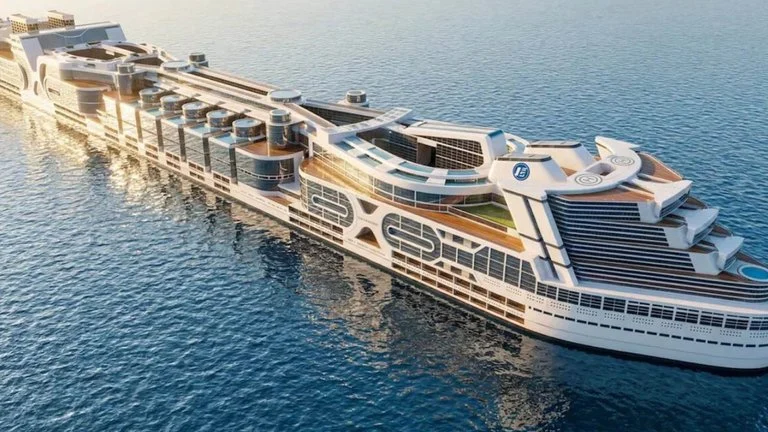
On paper, the project attempts to assemble what companies, cities and governments too often separate: housing, mobility, energy, healthcare, education, commerce, security, governance and user experience. Its promoters present it as a permanently mobile city, designed for everyday life rather than tourist cruising (Freedom Ship)
A traditional city is often a stack of inherited systems.
A floating city forces everything to be reimagined as an integrated platform.
And this is where the subject becomes fascinating for leaders.
Making a city float is not enough
Freedom Ship claims an extraordinary ambition: approximately 1.6 km long, up to 80,000 people on board, including 50,000 permanent residents, with schools, hospitals, offices, shops, cultural spaces and leisure infrastructure (Jeuxvideo.com)
But a floating city is not just a giant hull.
Building an object of this scale does not only require engineering excellence. It requires the coordination of an economy, a community, critical infrastructure, a commercial promise, an insurance logic, a safety doctrine, an energy model and a governance system.
The difficulty is not only to make a city float.
The difficulty is to hold together interests that already contradict each other every day on land.
The urban planner wants quality of life.
The financier wants a profitable model.
The engineer wants robustness.
The insurer wants controlled risk.
The resident wants freedom.
The regulator wants to know who is in charge.
That is where the real work of innovation begins.
A floating city is a total enterprise
Freedom Ship is fascinating because it compresses into one object the tensions that leaders already face inside their organizations.
A company is also a miniature city.
It has its flows, rules, infrastructure, territories, rivalries, promises, narratives, beliefs, dead zones and energy districts.
Every executive committee believes it is leading an organization. In practice, it is often leading an archipelago.
Marketing talks about customer experience.
Finance talks about margin.
Operations talk about constraints.
HR talks about engagement.
IT talks about security.
Legal talks about compliance.
Every function is right within its own perimeter. The problem appears when every perimeter becomes a principality.
Freedom Ship pushes this logic to the extreme. It turns the old dream of the ideal city into a massive operational problem.
That is precisely where innovation stops being a slogan.
Innovation begins when the brochure meets maintenance
It is easy to draw a floating city in a 3D video.
It is harder to manage the waste of a permanent community at sea.
It is easy to imagine parks suspended above the ocean.
It is harder to maintain water, energy, security, health, communication and transportation systems for decades.
The official website describes Freedom Ship as a city-scale system, with interdependent networks for energy, water, waste, communications and transport (Freedom Ship)
This matters.
Innovation is not only found in the spectacular shape of the vessel. It is found in the ability to make the system livable, maintainable, reliable and acceptable.
An innovation is not a spectacular idea. It is an implementation that creates a new or significantly improved use, market or process. This is the point I make in my book, chapter 3, by clearly distinguishing creativity, invention and innovation.
The OECD also emphasizes this implementation requirement: an innovation must be introduced on the market or brought into actual use within the organization (OECD)
As long as Freedom Ship remains a promise, it is a vision.
The day the first residents live there sustainably, we can begin to speak about innovation.
Between the two lies everything brochures often avoid: financing, trade-offs, risks, maintenance, conflict, safety, energy, waste, regulation and trust.
The dream is already thirty years old
This topic deserves caution.
Freedom Ship is not a brand-new idea. The project has existed in different forms since the 1990s. Several recent articles note that the concept regularly returns to the headlines, but without confirmed funding or construction started at this stage (The Next Web)
This changes everything.
In innovation, the longevity of a vision does not prove its viability. It only proves its narrative power.
Some ideas survive because they answer a deep tension.
Freedom Ship answers several contemporary tensions: urban saturation, global mobility, taxation, desire for freedom, tech imagination, climate challenge, search for autonomy and fascination with megaprojects.
But a tension does not create a market.
A market appears when actors agree to pay, live, insure, finance, regulate and trust.
That is the true passage from utopia to system.
The regulator also comes on board
One of the most sensitive subjects is governance.
Who governs a mobile city?
The captain?
The operating company?
The flag state?
The residents?
The investors?
A land-based court?
A maritime authority?
A floating city immediately raises questions of law, taxation, safety, visas, liability, insurance and environmental responsibility. Tomorrow.City had already noted that several points remained difficult to clarify: jurisdiction, taxation, visas, safety and effective responsibility (Tomorrow.City)
The sea is not a magical space without rules.
The SOLAS convention sets minimum standards for the construction, equipment and operation of ships to protect life at sea (IMO)
The MARPOL convention covers the prevention of marine pollution from ships, whether from operational or accidental causes (IMO)
In other words, systemic innovation always meets a world that is already structured.
No one floats entirely above the rules.
The megaproject trap
Megaprojects have one virtue: they awaken imagination.
They also have one flaw: they can hypnotize.
The more beautiful the 3D rendering, the greater the risk of confusing visual desirability with operational feasibility.
Freedom Ship has everything required to seduce: gigantic scale, a promise of freedom, offshore living, an autonomous city, a soft form of secession from terrestrial weight.
But for leaders, the interesting subject is not whether the image is seductive.
The useful subject is this: what conditions must be met to transform such an extreme vision into an operational system?
It requires architecture.
It requires governance.
It requires compatible business models.
It requires clear responsibilities.
It requires fast decision loops.
It requires a culture capable of making trade-offs.
It requires the ability to say no to some ambitions in order to preserve the whole.
This is where organizations often fail.
Not in the idea.
In the trade-offs.
A strategy must also know how to float
Freedom Ship forces us to look at our own organizations with new clarity.
Many companies dream of becoming floating cities: agile, autonomous, connected, international, desirable, resilient.
Then they discover they have the governance of an old ocean liner.
Silos.
Incompatible budgets.
Slow decisions.
Legacy systems.
Territory wars.
Marketing promises that never meet operational constraints.
Before building a floating city, one must already learn how to make a strategy float.
A strategy floats when it holds despite the waves.
It floats when functions agree to work together.
It floats when the vision does not remain stuck to a meeting-room wall.
It floats when trade-offs are owned.
It floats when maintenance, security, customers, talent, partners and financing are thought through together.
The future is not won by those who draw the biggest ship.
It is won by those who can turn a utopia into an operational system.
Is Freedom Ship an avant-garde vision or the ultimate symptom of our flight from terrestrial problems?
I address this kind of issue in my keynotes, workshops and advisory work because behind this impossible or possible vessel lies a much closer question for leaders: how do we hold together human, technical, financial and political systems that each pull in a different direction?

References
- (Jeuxvideo.com) = https://www.jeuxvideo.com/news/2090599/pres-de-1-6-kilometre-de-long-et-80-000-personnes-a-bord-bienvenue-dans-la-premiere-ville-flottante-de-la-planete.htm
- (Freedom Ship) = https://freedomship.com/vision/
- (Freedom Ship Design) = https://freedomship.com/design/
- (Freedom Ship Technology) = https://freedomship.com/vision/technology-and-infrastructure/
- (Euronews) = https://www.euronews.com/travel/2026/06/04/freedom-ship-could-this-giant-floating-city-become-the-worlds-biggest-cruise-ship
- (The Next Web) = https://thenextweb.com/news/freedom-ship-floating-city-megaproject
- (Tomorrow.City) = https://www.tomorrow.city/freedom-ship/
- (OECD) = https://www.oecd.org/en/publications/2018/10/oslo-manual-2018_g1g9373b/full-report/component-9.html
- (IMO SOLAS) = https://www.imo.org/en/about/conventions/pages/international-convention-for-the-safety-of-life-at-sea-%28solas%29%2C-1974.aspx
- (IMO MARPOL) = https://www.imo.org/en/about/conventions/pages/international-convention-for-the-prevention-of-pollution-from-ships-%28marpol%29.aspx