A tiny beak, a major linguistic slap
A bird has just put humanity in linguistic distress.
For centuries, we looked at animals as if they lived in a charming but inferior soundscape. They sang, cried, called and chirped, while we enjoyed the comfortable arrogance of calling it noise.
Then a researcher truly listened.
Not like a sentimental walker in front of a cage.
Like a scientist facing an enigma that our species had treated with far too much condescension.
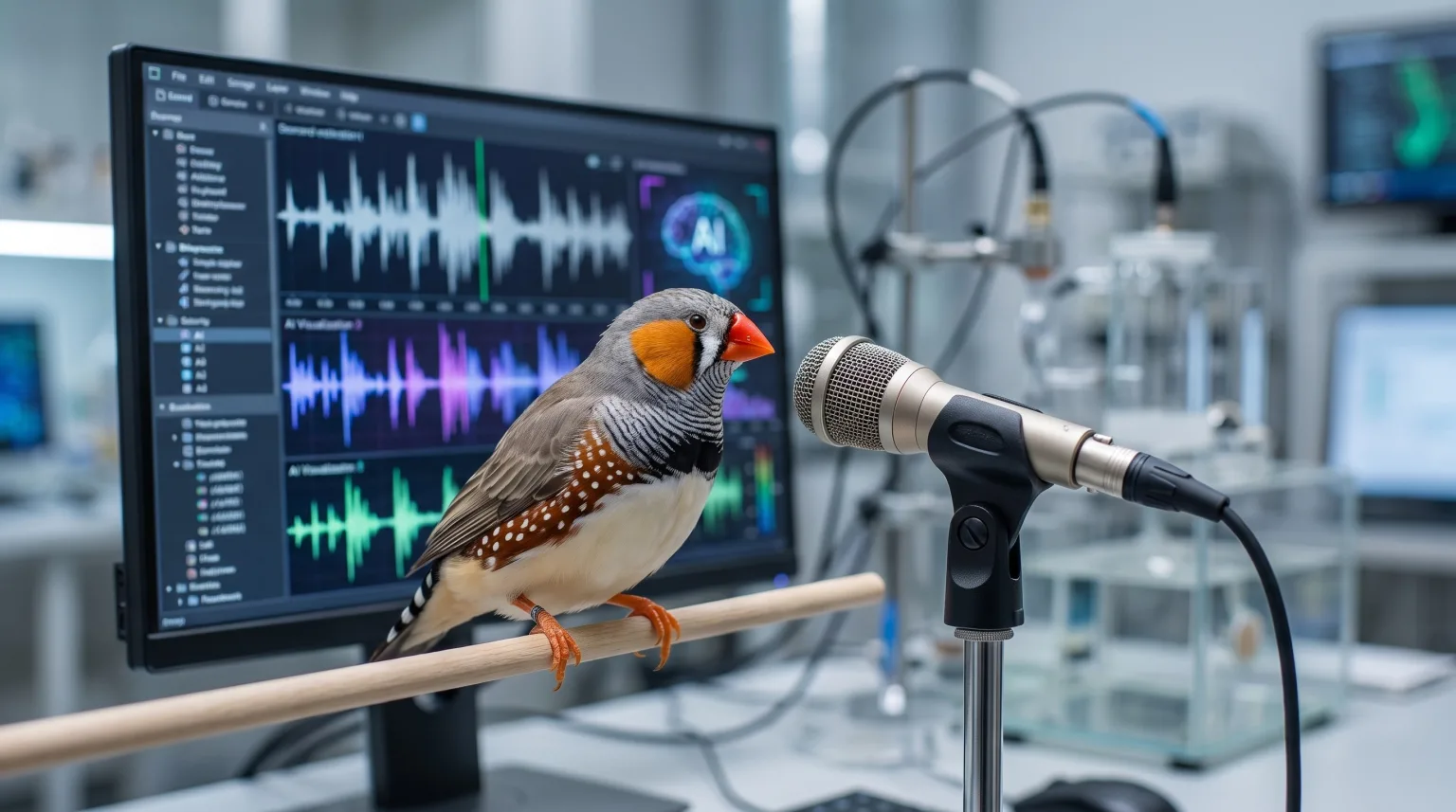
Dr Julie Elie, a researcher at the University of California, Berkeley, received the 2026 Coller-Dolittle Prize for her work on zebra finch vocalisations. Her research focuses in particular on eleven types of calls, linked to contexts, behaviours, identities and tested through behavioural experiments. (The Guardian)
The zebra finch has not yet asked for a pay rise. It has not launched a podcast on avian leadership. It has not posted on LinkedIn about its resilience after a pair-bonding crisis.
But it transmits information.
That already changes everything.
The animal is not making noise, it is sending signals
The zebra finch is a highly vocal small bird. This makes it a powerful scientific model: it produces many sounds, therefore many exploitable data points.
Julie Elie’s work shows that these birds use calls associated with states, intentions or needs. They can also recognize individuals through vocal signatures, even when call types change. A Nature Communications study describes this ability to identify individuals across the vocal repertoire. (Nature Communications)
The most disturbing point is not simply that the bird “speaks”.
The disturbing point is that it seems to classify some sounds by meaning.
Research published in Science and presented by UC Berkeley indicates that zebra finches do not react only to acoustic form. During tests, they more often confused calls close in meaning than calls merely close in sound. (Science)
This is where the story becomes far less cute.
An animal is not merely producing a sound signal.
It organizes part of its social world through information we have long underestimated.
AI as a semantic microscope
The strongest angle here is not “we will talk to animals tomorrow morning”.
That angle is too easy. Too marketable. Too Hollywood.
The stronger angle is different: AI is becoming an interface between species.
An interface, not a magic wand.
It helps connect sounds, behaviours, situations, responses and statistical repetitions. It can reveal patterns that our ears, our patience and our ego do not always detect.
Earth Species Project says it uses an AI-first approach to study animal communication, with large-scale models, multimodal learning and massive datasets. Its stated goal is to better understand communication across the living world, not merely identify pleasant vocalisations. (Earth Species Project)
Project CETI also applies machine learning and advanced robotics to sperm whale communication, with a crucial logic: collect acoustic and behavioural data, process it, train models, then validate hypotheses through controlled playback studies. (Project CETI)
This is exactly where innovation becomes interesting.
Not in the spectacular promise.
In the method.
Observe.
Classify.
Connect.
Test.
Let the living system respond.
Then correct.
The danger of the magic translator
The word “translation” is risky.
It gives us the impression that tomorrow we will simply point a smartphone at a bird, a dog, a whale or a cat and receive a neat sentence:
“Hello human, I would like more premium seeds and fewer useless meetings.”
That vision is seductive, but it crushes the complexity of the subject.
An animal vocalisation is not necessarily a human sentence hidden beneath feathers, fur or scales. A call can carry information about identity, alert, emotional state, position, intention or social relationship without fitting our grammatical categories.
The Coller-Dolittle Prize specifies that the challenge concerns interspecies communication and non-invasive approaches based on organisms’ natural signals, with measurable responses. (Coller-Dolittle Prize)
This is the real change in posture.
We do not impose our language on the animal.
We first try to understand what the signal does in its own world.
The end of a very human arrogance
This story holds up an uncomfortable mirror.
For too long, we confused the absence of human language with the absence of informational intelligence.
That is a classic error.
When a form of intelligence does not look like ours, we tend to minimize it. When a communication does not fit our grammar, we put it in the “noise” category.
The same mistake happens in companies.
A quiet employee becomes “not engaged”.
A complaining customer becomes “difficult”.
A recurring irritant becomes “a detail”.
A team tension becomes “a passing mood”.
A drop in energy becomes “lack of motivation”.
A weak signal becomes “background noise”.
Then one day, reality invoices our deafness.
Organizations are full of zebra finches
In an organization, weak signals sing all the time.
They do not always sing with clear words.
They sing in delays.
In silences.
In meetings where nobody challenges anything anymore.
In projects that seem to move forward but are losing meaning.
In employees who say “yes” too quickly.
In managers who no longer ask questions.
In customers who no longer complain because they have already mentally left.
Artificial intelligence can help detect some of those signals. It can analyze verbatims, spot recurring themes, summarize customer feedback, identify anomalies, group irritants and make hidden patterns visible.
But AI does not replace the essential human posture: curiosity.
And that curiosity is not passive.
It requires observation.
It requires questioning.
It requires the courage to ask: “What have I not understood yet?”
This is precisely what I develop in my book, chapter 6, around curiosity, observation and questioning as foundational skills of innovational intelligence®.
Innovation begins with less arrogant listening
In many companies, we talk endlessly about innovation.
We run workshops.
We fill walls with sticky notes.
We launch idea platforms.
We buy tools.
We appoint leaders.
Then we continue not to listen.
We do not capture real frustrations.
We do not process objections.
We do not observe actual usage.
We ask teams to be creative while refusing them the right to name what is broken.
We want to innovate with closed ears.
The zebra finch reminds us of something simple: before claiming to translate, we must listen.
Before concluding, we must observe.
Before fantasizing, we must test.
Before deciding that “it means nothing”, we must accept the uncomfortable hypothesis that we may not yet have the right interpretation model.
Birds, bonobos, sperm whales and us
The topic is not limited to birds.
Recent work on bonobos suggests that their vocal system includes forms of compositionality, meaning the ability to combine vocal units to produce meanings linked to the combination. (Science)
Other research on sperm whales explores the structure of their codas, the click sequences used in their social communication. Project CETI is building an interdisciplinary effort to collect, analyze and validate these structures. (Project CETI)
Each advance forces us to become more humble.
The living world has not been waiting for us to communicate.
We are simply building finer instruments to perceive what was already there.
That difference matters.
AI does not suddenly give animals a voice.
It can help us hear a voice we did not know how to decode.
The interface between species becomes an interface between silences
The parallel with business is immediate.
The most useful role of AI will not only be to produce faster.
It will also be to make invisible information visible.
Not to automate listening, but to make it more demanding.
In a team, AI can summarize anonymized feedback.
In customer relationships, it can spot weak irritants before they become massive churn.
In transformation programs, it can detect the gap between official messaging and field signals.
In an organization, it can help distinguish a one-off noise from a recurring pattern.
But for this to truly serve innovation, the culture must be able to hear what the system reveals.
Otherwise, AI will merely amplify an already established deafness.
The weak signal you refuse to hear
The zebra finch has not solved the mystery of animal communication.
It has done something more useful: it has cracked our certainty.
It forces us to reconsider our relationship with signals.
Signals from the living world.
Signals from teams.
Signals from customers.
Signals from the market.
Signals already in front of us, but too quickly classified as “noise”.
Innovation often begins there.
In a detail we do not yet understand.
In an anomaly that disturbs us.
In a behaviour nobody takes seriously.
In a faint call announcing a deep shift.
Tomorrow, AI may help us better understand animals.
Today, it should already help us better understand the humans around us.
In your organization, what weak signal are you currently treating as mere noise?
I address this topic in my keynotes, workshops and advisory work, often with fewer feathers, but with just as much human chirping.

References
- (The Guardian) = https://www.theguardian.com/science/2026/jun/26/human-animal-communication-step-closer-scientist-wins-prize-for-decoding-birdsong
- (Science) = https://www.science.org/doi/10.1126/science.ads8482
- (Nature Communications) = https://www.nature.com/articles/s41467-018-06394-9
- (UC Berkeley) = https://vcresearch.berkeley.edu/news/finch-chirps-are-more-mindless-chatter
- (Earth Species Project) = https://earthspecies.org/what-we-do/
- (Project CETI) = https://www.projectceti.org/
- (Coller-Dolittle Prize) = https://coller-dolittle-24.sites.tau.ac.il/