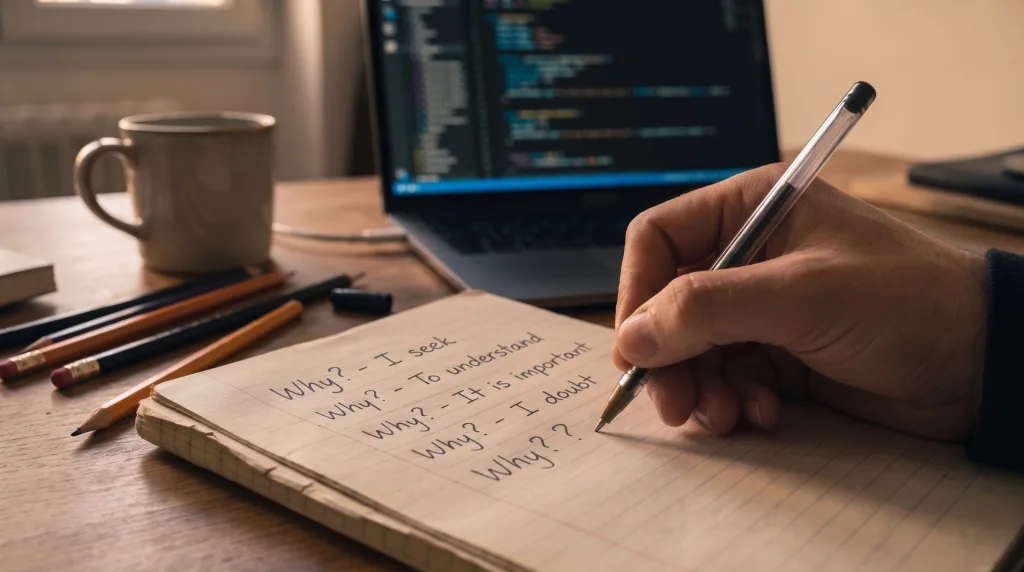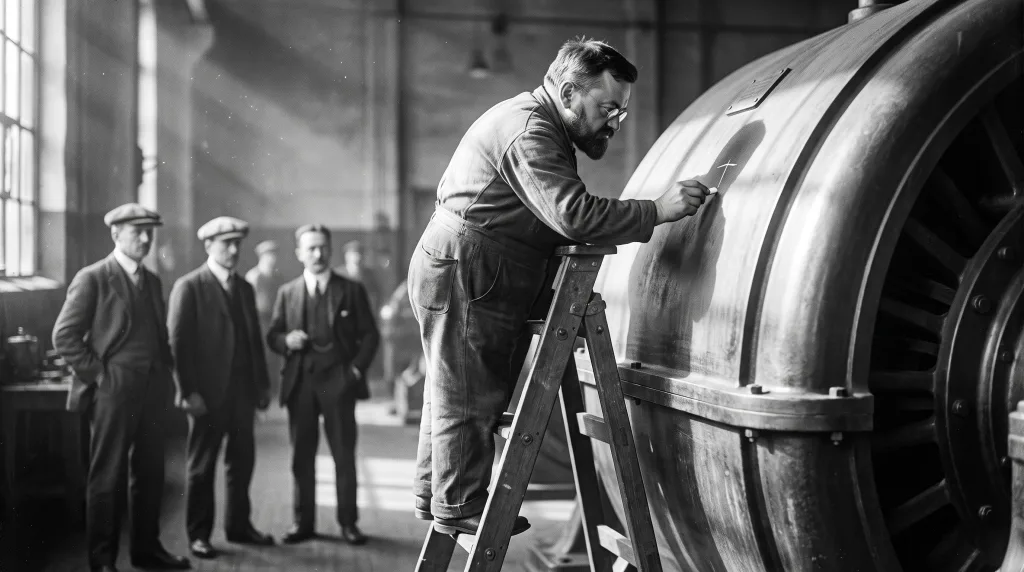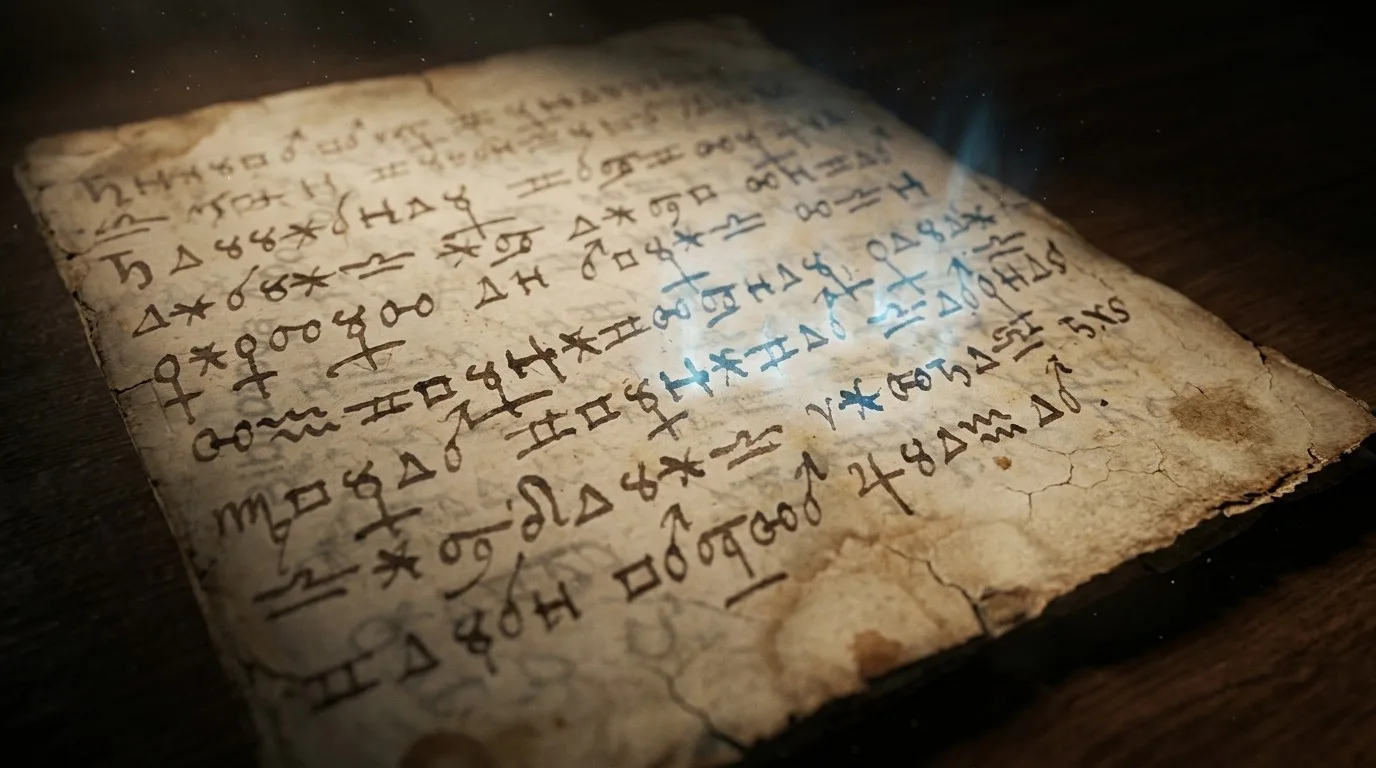
Picture an archivist bent over a yellowed page since dawn. A magnifying glass in one hand, a notebook in the other. In front of him, 34 signs that mean nothing, drawn four hundred years ago by someone who wanted, above all, not to be read. He copies two pages. It takes the whole day. Four hundred and six remain. This character existed, in one form or another, in every generation since the seventeenth century. And in every generation, he eventually closed the volume. In 2026, an artificial intelligence did in twenty-nine minutes what he would not have finished in a lifetime.
I find this story irresistible, and not for the obvious reason. The decryption interests me less than what it reveals about us, about our organizations, and about how we welcome a machine that suddenly does in half an hour what resisted for centuries.
Four centuries of silence in the Vatican archives
The manuscript has a name: the Borg Cipher, or Borg codex. Four hundred and eight pages held in the Vatican Library. A cover that looks like Arabic, pages covered with 34 obscure symbols, and no key to unlock their meaning (Stockholmsuniversitet). The author’s method was simple on paper: a substitution cipher, one symbol per letter. The difficulty did not come from the sophistication of the code. It came from time. Faded ink, cut or water-damaged pages, uncertain strokes. Transcribing by hand became painstaking work with no guarantee of a result (Wikipedia).
Here is the archivist’s real enemy: time. It is estimated today that about 1 % of all textual materials stored in the world’s libraries and archives remain encrypted and never read in the modern era (Schneier). Thousands of manuscripts sleep this way, for lack of eyes and hours to spend on them.
Where a human needs six months, the machine needs twenty-nine minutes
One example measures the gap. French cryptologist Cécile Pierrot, a researcher at INRIA, spent close to six months decoding a three-page letter written by Emperor Charles V, packed with a hundred and twenty different symbols. Her finding: one of the most powerful men of his time lived in terror of being assassinated (ScienceNorway). Six months for three pages.
The new tool analysed, translated and explained a key 500-symbol extract of the Borg Cipher in a little over twenty-nine minutes (TheNews). The same work, done the old way, kept teams busy for months, sometimes years. I will add a point the headlines tend to forget, for honesty’s sake: the Borg Cipher had already been broken once around 2016 by a research team. What is new in 2026 is the tool, its speed, and its ability to chain image, transcription and decryption with no manual step in between.
How the AI actually worked
This is where the mechanics interest me, because they look like sound engineering. The international team of the Descrypt project, which includes Professor Beáta Megyesi of Stockholm University and Professor Michelle Waldispühl of the University of Oslo, dropped the sequential trial-and-error approach (DECRYPT). Instead of moving symbol by symbol like a human, the tool attacks several fronts at once.
The flow has two stages. First, image-recognition algorithms read the handwritten annotations and convert the symbols into usable characters. Then the system applies its language models and decryption algorithms to compute the frequency and distribution of the signs. No manual pre-transcription was asked of the researchers. One point deserves emphasis for skeptics like me: an anti-hallucination guardrail was built in. The AI did not guess a plausible translation, it documented its mathematical reasoning to prove the plausibility of its solution (TaylorFrancis).
This is exactly the discipline I demand everywhere, in my book in the chapter where I argue that the invariant of innovation was never technology but the human being, their fears and their biases (Book). An AI that shows its reasoning is worth a thousand times an AI that asserts. Assumptions are dangerous, they must be killed by experimentation and measurement as early as possible.
Cryptic remedies to dodge the stake
Then comes the revelation, almost comical. By breaking the code, the researchers found the text was in Latin. Even the front page, which looked Arabic, was in fact transliterated Latin: “naturalis observationis illuminati.” No plot, no state secret. A book of medicinal recipes. Among the prescriptions: nutmeg fermented in dough, or the idea of letting a mole die in your hand facing the sun to treat pain (Stockholmsuniversitet).
Why encrypt remedies? Because at the time these practices were frowned upon, and such a collection could draw the suspicion of religious authorities and lead to an accusation of witchcraft, explains Professor Beáta Megyesi (Wikipedia). The cipher was not a scholar’s vanity, it was life insurance. There is an organizational lesson here, centuries early: people hide what can cost them dearly. In a company, real information rarely travels in the open when psychological safety is missing.
What this changes for you, as a leader
Let me be direct, that is my signature. This feat will trigger two opposite reactions, and both are traps. The first: “AI does everything, just plug in the machine.” The second: “That is a lab case, it does not concern me.” Both will cost you.
Look at the numbers with clear eyes. Everyone quotes the elegant BCG-Harvard study: 758 consultants, 25.1 % faster on eighteen tasks. Appealing. Another study, covering about 25,000 workers across 7,000 workplaces, brings us back to reality: the average time saved sits between 2.8 % and 3 %. The gap between the promise and the field is exactly where disillusionment lives. The Borg Cipher is an ideal case: a well-bounded task, a closed corpus, a clear goal. Your organization is full of fuzzy tasks and people who are not full-time cryptologists. What worked at the Vatican does not transfer with a snap of the fingers.
AI acts here as a real productivity accelerator. It handles scale, speed and pattern detection at volumes beyond human reach. Yet the decoder remains the human, with their goals, their corrections, their judgment. The Vatican tool even includes continuous learning that improves by absorbing expert corrections. The loop closes: the machine computes, the human validates, the machine relearns. So ask two questions for every activity you hand to AI: are the expected gains realistic, and are they verifiable? Measure before, during and after. Without that discipline, you are buying a dream.
The essentials
Remember three things:
- The speed of AI has value only if it serves a goal that you, and you alone, have chosen and framed.
- Proof matters more than performance: always require the machine to show its reasoning, as at the Vatican.
- The invariant stays human: your experts give meaning, correct errors and avoid historical nonsense.
Researchers already dream of applying these algorithms to scripts whose very language is unknown, like the Phaistos disc, 4,000 years old, or Linear A, still undeciphered (Wikipedia). The mystery is retreating. It is up to you to decide whether you watch the machine advance, or pick up the magnifying glass yourself. Innovate or agonize, the choice is yours.

References
- (Book) https://philippeboulanger.com/book/
- (TheNews) https://www.thenews.com.pk/latest/1404083-ai-decoded-400-year-old-vatican-cipher-in-29-minutes-flat
- (ScienceNorway) https://partner.sciencenorway.no/language-literature-society-and-culture/hidden-conspiracies-and-love-stories-researchers-use-ai-to-decode-centuries-old-encrypted-letters/2473994
- (Stockholmsuniversitet) https://www.su.se/english/research/research-catalogue/research-projects/d/decipherment-of-historical-manuscripts/the-borg-cipher
- (Wikipedia) https://en.wikipedia.org/wiki/Borg_cipher
- (DECRYPT) https://de-crypt.org/
- (Schneier) https://www.schneier.com/blog/archives/2026/06/ai-used-to-decrypt-medieval-ciphers.html
- (TaylorFrancis) https://www.tandfonline.com/doi/full/10.1080/01611194.2020.1716410