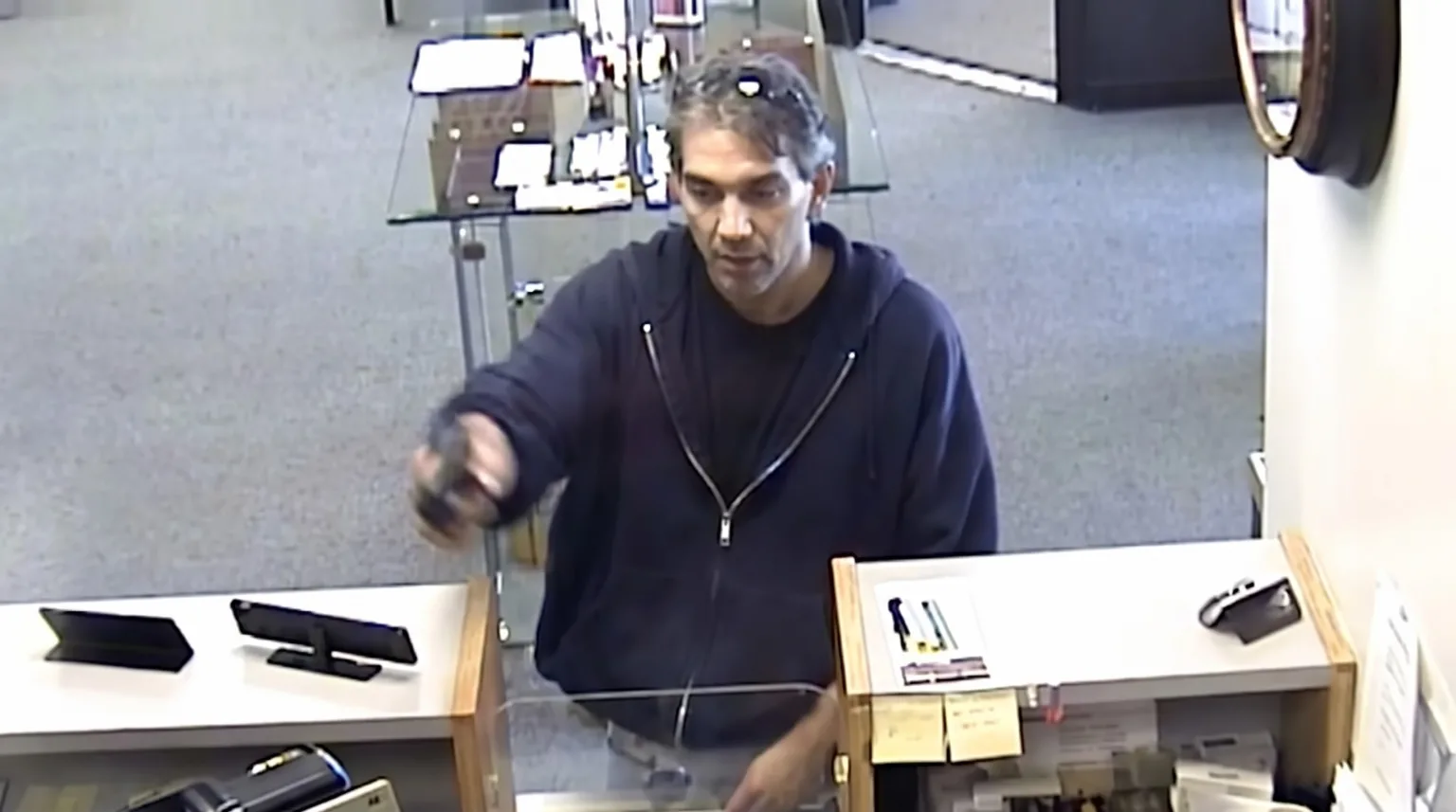
Pittsburgh, a January morning in 1995. A man walks into a bank, steps up to the counter, his face completely uncovered. He leaves with the cash, then repeats the performance at a second bank a few hours later. The security cameras record every move. A few weeks later his portrait airs on the 11 p.m. news, in a local call for witnesses. Less than an hour after the broadcast, police knock on his door. When the officers show him the footage, he stays honestly baffled and delivers a line that became famous: “But I wore the juice.”
The juice was lemon juice. McArthur Wheeler was convinced that coating his face with it would make him invisible to cameras, the same way lemon juice works as invisible ink on paper. An accomplice had planted the idea. Wheeler had even tested his hypothesis with a Polaroid: on the print, his face did not appear. The photo was simply botched, but he read it as proof. (Wikipedia)
Here is a man who killed his hypothesis with an experiment, then read the result upside down. Keep that image in mind, because it explains a good deal of what happens in your executive meetings.
When Stupidity Lands in an Almanac
The story appeared in the 1996 edition of The World Almanac, in the section on the least gifted criminals. It caught the eye of David Dunning, a psychology professor at Cornell University. A question gripped him. If Wheeler was unable to pull off a robbery, was he even able to gauge how unable he was? With his graduate student Justin Kruger, Dunning turned that hunch into a research protocol. (Quartz)
The question is anything but trivial. It touches the inner machinery of self-confidence, the same machinery that governs a clumsy robber and an executive committee approving a fifty-million project.
What the 1999 Study Actually Proved
In 1999, Kruger and Dunning published “Unskilled and Unaware of It” in the Journal of Personality and Social Psychology. They gave participants tests in logic, grammar and humor, then asked them to estimate their own performance. The result held across every test: the least competent people heavily overrated their level and ranked themselves above average almost every time. (APA)
The mechanism is fearsomely elegant. The skills you need to succeed at a task are often the same skills you need to judge whether you succeeded. When those skills are missing, the person fails the task, and also fails to see the failure. Incompetence removes the tool and the thermometer in one move. Wheeler had neither the knowledge to disappear, nor the knowledge to grasp that he never would.
The Paradox: You Need a Little Knowledge to Be Blind
A counterintuitive detail, and a central one: the effect needs a minimum base of knowledge to appear. Wheeler knew that lemon juice works as invisible ink. That half-knowledge was enough for him to build a false theory with total confidence. With no knowledge on the subject, he would have built no theory at all. With a poorly digested fragment of knowledge, he built one and believed it all the way to the teller’s window. (Wikipedia)
Transpose that into a company. The dangerous person is never the one who knows nothing about a file, because that person stays quiet and listens. The person to watch is the one who just grabbed three notions about artificial intelligence and walks away sure they hold a strategy. The little they know hides the vastness of what they ignore.
The Curve You See Everywhere, and What It Hides
You have surely met the famous Dunning-Kruger curve: a very high peak of confidence in the beginner, a dizzying drop when the person measures the size of the field, then a slow climb as they become an expert. That roller-coaster picture is a later popularization, often embellished online. The 1999 paper describes a steady overestimation among the least competent, not quite that spectacular slide. (Wikipedia)
I keep the general idea anyway, because it lights up a behavior I have watched for thirty years. The confident beginner decides with aplomb. The one who progresses doubts, turns cautious, compares accurately. The expert regains confidence, but a confidence calibrated on facts. The tragedy of organizations is that they often confuse the beginner’s aplomb with the expert’s assurance.
The Link with Innovation
Innovation runs on assumptions, and assumptions are dangerous. They should be killed with experimentation as early as possible, before they get expensive. The lemon juice robber ran an experiment, he simply refused to trust his thermometer. Many innovation teams do the same: they test, then read every signal as a confirmation of what they already wanted to hear. This is exactly the mechanism I describe in the chapter on cognitive biases in my book, where the word “biased” returns on every page because my whole system rests on it. (My book)
The Dunning-Kruger bias pairs with an even more toxic cousin inside companies: the status quo bias. A person with weak competence on a new technology has two good reasons to reject it. They cannot measure what they ignore, and they prefer the comfort of what they already master. You end up with a leader who blocks a transformation, not out of calculation, but because ignorance grants a false serenity. Our past success can be our greatest enemy: it convinces us that our old skills will do for a world that has changed its rules.
The Link with Management
Look at your hiring. In interviews, the most assertive candidate is not always the most competent, they are often the least aware of their gaps. The real specialist multiplies nuances, sets conditions, refuses to promise numbers they cannot verify. The first reassures a rushed panel, the second irritates it. You see the problem.
Look at your meetings. The phenomenon compounds with what research calls leadership overconfidence, a costly bias when it steers a high-stakes strategic decision. (Harvard Business Review) A senior person, sure of themselves and thin on a specific subject, will decide fast and proud. No one in the room dares to push back, for lack of psychological safety. The project starts on a false base, and everyone knew it except the one deciding.
Finally, look at the wave of self-proclaimed experts who surfaced with ChatGPT. Most master three prompts and think of themselves as strategists. Knowing how to generate a pretty image does not replace a vision. Half-baked technical knowledge produces exactly the assurance Kruger and Dunning described, and it costs those who listen to it. (InnerDrive)
How to Neutralize the Effect in Your Team
The good news: this bias corrects itself, provided you create the conditions. Three concrete levers you can pull starting Monday.
First, measure before, during and after. Wheeler went wrong because he trusted a single badly framed Polaroid. An innovation decision is judged on repeated data, not on one isolated signal that suits you. For each activity, ask two questions: is the expected gain realistic, and is it verifiable?
Second, install psychological safety. An employee has to be able to tell their boss “I think we are wrong” without risking their career. Trust boils down to a simple rule: I say what I do, and I do what I say. Without that alignment, the least competent person stays the loudest, and the most expert one goes silent.
Third, give precise and repeated feedback. The only way to pull someone out of their confidence bubble is to show them, with facts, the gap between what they think they know and what reality sends back. Kruger and Dunning verified it: when you train the weakest participants, their ability to self-assess improves along with their real competence. (Catalog of Bias)
The Essentials
Remember three things:
- The Dunning-Kruger bias strikes those who know a little, never those who know nothing: a fragment of knowledge is enough to manufacture a false certainty.
- In a company, this bias marries the status quo bias and leadership overconfidence, and it passes off the beginner’s aplomb as the expert’s assurance.
- You defuse it with repeated measurement, psychological safety and factual feedback: kill the assumption with experimentation before it kills the project.
McArthur Wheeler pleaded his case with lemon juice on his face. In your committees, the same scene plays out every week, in a suit, without the cameras. It is up to you to decide who holds the thermometer.



References
- (My book) https://philippeboulanger.com/book/
- (Wikipedia) https://en.wikipedia.org/wiki/Dunning-Kruger_effect
- (Wikipedia) https://en.wikipedia.org/wiki/1995_Greater_Pittsburgh_bank_robberies
- (APA) https://doi.org/10.1037/0022-3514.77.6.1121
- (Quartz) https://qz.com/986221/what-know-it-alls-dont-know-or-the-illusion-of-competence
- (Harvard Business Review) https://hbr.org/2011/06/the-big-idea-before-you-make-that-big-decision
- (InnerDrive) https://www.innerdrive.co.uk/blog/the-dunning-kruger-effect/
- (Catalog of Bias) https://catalogofbias.org/2018/03/22/twenty-years-of-bias-and-the-dunning-kruger-effect/