
Lucas, or the knowledge that stopped flowing
Lyon, a Tuesday in November, 9:40 a.m. Lucas sets his coffee down on the HR director’s desk and leans toward the screen. Twenty-two years with the company, principal software architect, the man who designed half the building blocks the business runs on. On the screen is a map of internal exchanges: hundreds of dots, thousands of lines. Each line is one person asking another for help to move their work forward.
Lucas looks for his name. He finds it at the very edge of the graph, attached by a few thin threads.
At the center, where the lines converge, sits a project manager who joined eighteen months ago. She could not write a line of code to save her life.
“Your data is wrong. I’m the one who knows,” he says.
“Nobody disputes that, Lucas,” the HR director replies. “The problem is that nobody comes to ask you anymore.”
Lucas leaves without a word. In the elevator, he does the math. The last time a young engineer came to see him unprompted was more than a year ago. He remembers the exchange clearly. He sighed, fixed the architecture in three minutes and added: “You could have figured that out yourself.” The young engineer never came back.
Lucas is a fictional character. Yet you have met a Lucas. You may even have one on your executive committee. And it is possible, I say this with kindness, that you are someone’s Lucas.
What 10,000 work relationships revealed
In 2005, two researchers, Tiziana Casciaro and Miguel Sousa Lobo, published in Harvard Business Review the results of a study covering about 10,000 work relationships in five organizations. Their starting point was a belief almost every executive shares: when you need help with a task, you go to the most competent person. Their data said something else. The choice of a work partner rests far more on likability than on competence (Harvard Business Review).
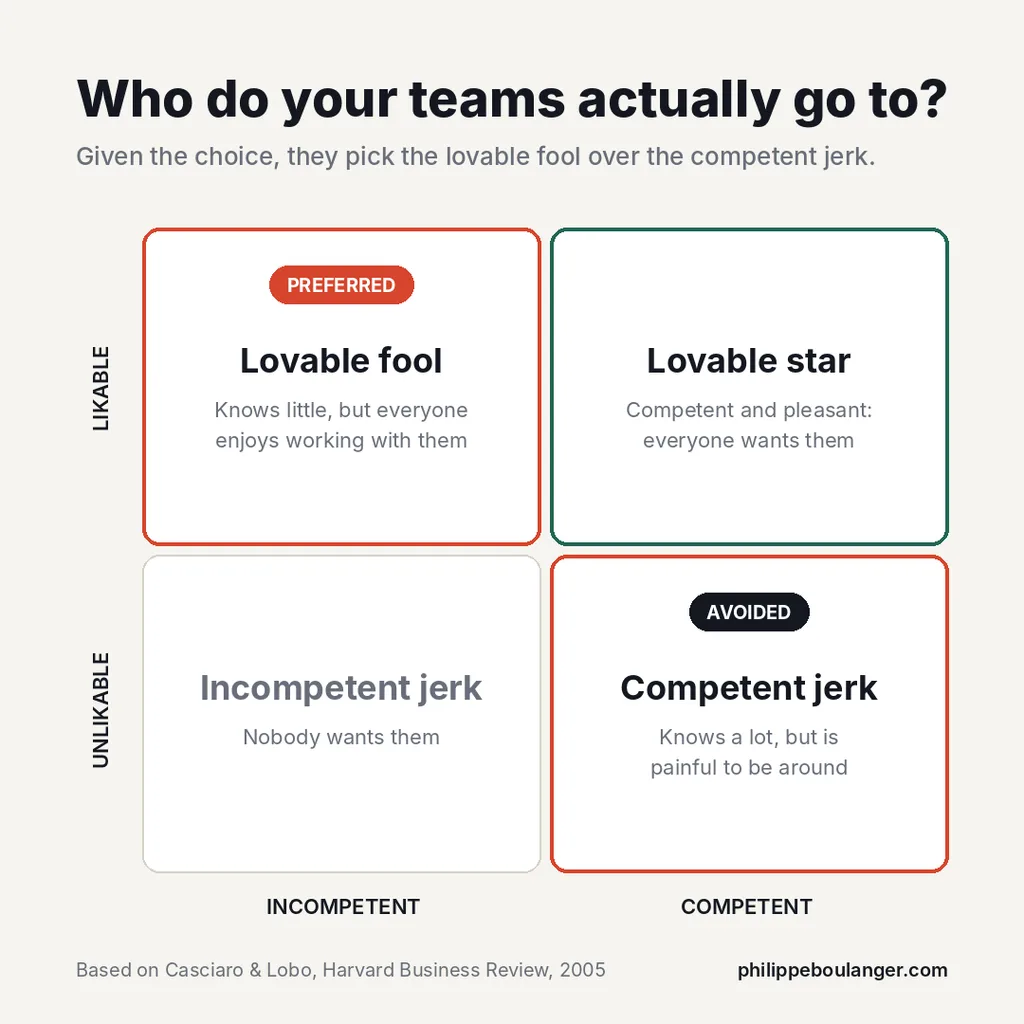
To make the result readable, the authors crossed two axes, competent or not, likable or not. Four archetypes came out:
- the competent jerk, who knows a lot but is unpleasant to be around;
- the lovable fool, who knows little but whom everyone enjoys working with;
- the lovable star, competent and pleasant;
- the incompetent jerk, whose portrait needs no comment.
Everyone wants to work with the lovable star. Nobody wants the incompetent jerk. So far, no surprise. The unsettling result lies between the two: given the choice, people prefer the lovable fool to the competent jerk (Harvard Business Review).
Participants reported how often they interacted with each colleague, then rated each one on two criteria, likability and competence. Ask managers and they will tell you competence comes first. In practice, feelings draw the real work network (HBS Working Knowledge).
Affect, the gatekeeper nobody sees
Three years later, Casciaro and Lobo published a finer analysis in Administrative Science Quarterly, based on the social networks of three organizations: an entrepreneurial computer technology firm, academic staff personnel and a large IT corporation. Their conclusion fits in one image. When you dislike a colleague, their competence has almost no bearing on whether you go to them for help. When you like someone, on the other hand, you rely more on their skills when choosing whom to ask (Administrative Science Quarterly).
Affect works as a gatekeeper. It decides who gets into the room. Competence is assessed only once you are through the door.
The authors go further: even without open dislike, a colleague’s competence can go unused. To make full use of the knowledge available in their organization, people seem to need to actively like the person who holds it (Administrative Science Quarterly).
Read that sentence again with your own company in mind. You pay experts. You fund their training and their certifications. And part of that capital sits idle, because access to that knowledge runs through an emotion nobody measures.
In innovation, that emotion is a bottleneck. An idea rarely starts in a single head. It starts where two kinds of expertise that never met finally meet. If Lucas’s knowledge stays locked behind his sigh, the idea that should have come from his encounter with the project manager will never exist. And nobody will know it was missing.
The price of the competent jerk
I know the objection, I have heard it a hundred times in executive committees: “Fine, he’s unpleasant, but he delivers.” A chief information officer interviewed by the researchers summed up this view by saying you can train someone pleasant, but you cannot train someone incompetent (HBS Working Knowledge).
The authors do not dismiss the argument. Avoiding the competent jerk can be a mistake, because his knowledge is sometimes worth the unpleasantness. But they also note that colleagues have good reasons to steer clear. It is hard to get information out of him, and risky to show him a weakness (HBS Working Knowledge).
Another line of research sheds light on what these behaviors cost when they go further. Dylan Minor, of Harvard Business School, and Michael Housman studied nearly 60,000 employees across eleven firms. The workers they classed as toxic were, on average, more productive than the others. Yet replacing one of them cost the company about $12,489, against a gain of about $5,303 brought by an employee in the top 1%. Avoiding a toxic hire is therefore worth almost twice as much as landing a superstar (HBS Working Knowledge).
Careful not to blur the two. Casciaro and Lobo’s competent jerk is unpleasant; he is not necessarily toxic in the sense used by Minor and Housman, who looked at serious misconduct leading to dismissal. Yet both studies converge on one point: individual productivity tells you nothing about what a person costs the group.
Why we run from the unpleasant genius: fear
Back to the young engineer who never returned to Lucas. Why did he prefer to grope around alone for days rather than face three minutes of irritation?
Because humans are wired to avoid rejection. In the era of hunter-gatherers, being cast out of the tribe meant death. That fear is still with us. It keeps us from contradicting, from questioning, from admitting we do not know. Around it orbit its cousins, the fear of judgment and the fear of feeling vulnerable (My book, chapter 6).

Going to see the competent jerk means exposing your ignorance to someone likely to point it out. The brain runs a simple calculation: the immediate emotional cost outweighs the future technical benefit. So it turns to the lovable fool, who may not know the answer but will not make you feel like a fool.
Amy Edmondson, a Harvard professor, gave a name to what is missing in these situations: psychological safety, a shared belief within a team that it is safe to take interpersonal risks. In her study of 51 teams in a manufacturing company, psychological safety is associated with learning behavior, and learning behavior links psychological safety to team performance (Harvard DASH).
The competent jerk attacks this mechanism with a mundane gesture: he makes asking expensive. And a team where asking is expensive stops learning, and therefore stops innovating. Top management carries direct responsibility here, because psychological safety is built through exemplary behavior and destroyed by tolerating those who trample it (My book, chapter 9).
The opposite trap: hiring only people you like
I can see where you are heading. You might conclude that the fix is to fill the company with pleasant people. That would be a mistake as costly as the first.
Casciaro and Lobo themselves warn against two drifts: homogeneous teams lacking different perspectives, and groups that have a great time together while getting nothing done. A venture capitalist quoted in their work put it bluntly: “If you keep hiring only people you like, you can kill a company” (HBS Working Knowledge).
The lovable fool has real value. Because he is liked by a disproportionate number of people, he can bridge groups that would otherwise never talk to each other (Harvard Business Review). He also shares what little he knows more freely, without seeking an advantage (HBS Working Knowledge). But a bridge is no substitute for what lies on the other side of the river. If every question in the company goes through pleasant people who do not know the answer, you are building a warm, slow organization.
When I launched VAIO PCs at Sony Europe in Brussels, we hired forty people from twenty-five nationalities in three months. That diversity allowed us to outperform equivalent teams in Asia and North America by two to four times. But it would have produced nothing without an open and caring spirit in the team. For me, psychological safety became a key factor in retaining talent (My book, chapter 13). Diversity brings the skills. Psychological safety makes those skills accessible.
What you can do on Monday morning
Managers do not control informal networks the way they control an org chart. They can, however, shape them, and those networks are often the ones through which work actually gets done (HBS Working Knowledge). Here are four levers.
Map before you judge. Do what Lucas’s HR director did. Ask your teams whom they actually turn to in order to move forward. You will find isolated experts and invisible connectors. Make no decision before you have seen the map.
Make expertise accessible without going through likability. If your competent jerk is indispensable, do not count on others to cross the emotional barrier. Set up open question sessions and pair him with a well-liked connector. Knowledge must flow through structure when it does not flow through affect. Tiziana Casciaro notes that many people experience reaching out to others as uncomfortable, almost self-serving, and suggests seeing it as a chance to learn and to help others learn (Rotman School of Management).
Treat the behavior as a performance issue. An expert who discourages questions degrades collective performance, even if his individual metrics are excellent. Tell him so. Use the five whys to understand where his behavior comes from. Often, behind Lucas’s irritation hides a fear of his own: becoming useless if his knowledge spreads.
Hire on both axes. Measure competence, of course. Also measure the ability to make that competence available to others. A brilliant candidate who humiliates the junior interviewer gives you a precious piece of information, for free.
What if the jerk is you?
Here is an uncomfortable exercise. On a scale of 0 to 5, how willing are the people on your team to ask you a question they think has an obvious answer?
Then ask yourself a second question: when did you last receive a “stupid” question from a junior team member?
If you cannot remember, be wary: it is unlikely your teams know everything.
I have my own confession to make. I am direct by signature, and that frankness did not always serve me when I was an employee. I was surely, for some colleagues, an expert people avoided on Friday afternoons. The difference between frankness and being a jerk lies in the intent and in the gesture that follows. Being hard on the problem is respect. Being hard on the person asking the question closes a door you will pay dearly for later.
The essentials
Remember four things:
- In real work networks, likability filters access to competence: a disliked expert sees much of his knowledge go unused.
- The competent jerk is costly without showing up on dashboards, because he makes questions expensive and slows the team’s learning.
- Filling the company with pleasant people solves nothing: the lovable fool connects groups but does not replace expertise.
- Your lever as a leader is psychological safety, built through exemplary behavior and protected by structure.
Lucas is not condemned to stay at the edge of the graph. He only needs to understand that his knowledge is worth something only if it flows. Your organization’s map is waiting for you. Go look at it before your best ideas die in a sigh.



References
- (My book) https://philippeboulanger.com/book/
- (Harvard Business Review) https://hbr.org/2005/06/competent-jerks-lovable-fools-and-the-formation-of-social-networks
- (HBS Working Knowledge) https://www.library.hbs.edu/working-knowledge/fool-vs-jerk-whom-would-you-hire
- (HBS Working Knowledge) https://www.library.hbs.edu/working-knowledge/hazard-warning-the-unacceptable-cost-of-toxic-workers
- (Administrative Science Quarterly) https://academicnewsletter.sufe.edu.cn/info/367290
- (Harvard DASH) https://dash.harvard.edu/entities/publication/13a7b031-0fdd-45ec-a7e0-2b80e2bc679f
- (Rotman School of Management) https://cd-www.rotman.utoronto.ca/FacultyAndResearch/Research/NewThinking/TizianaCasciaro-Networking