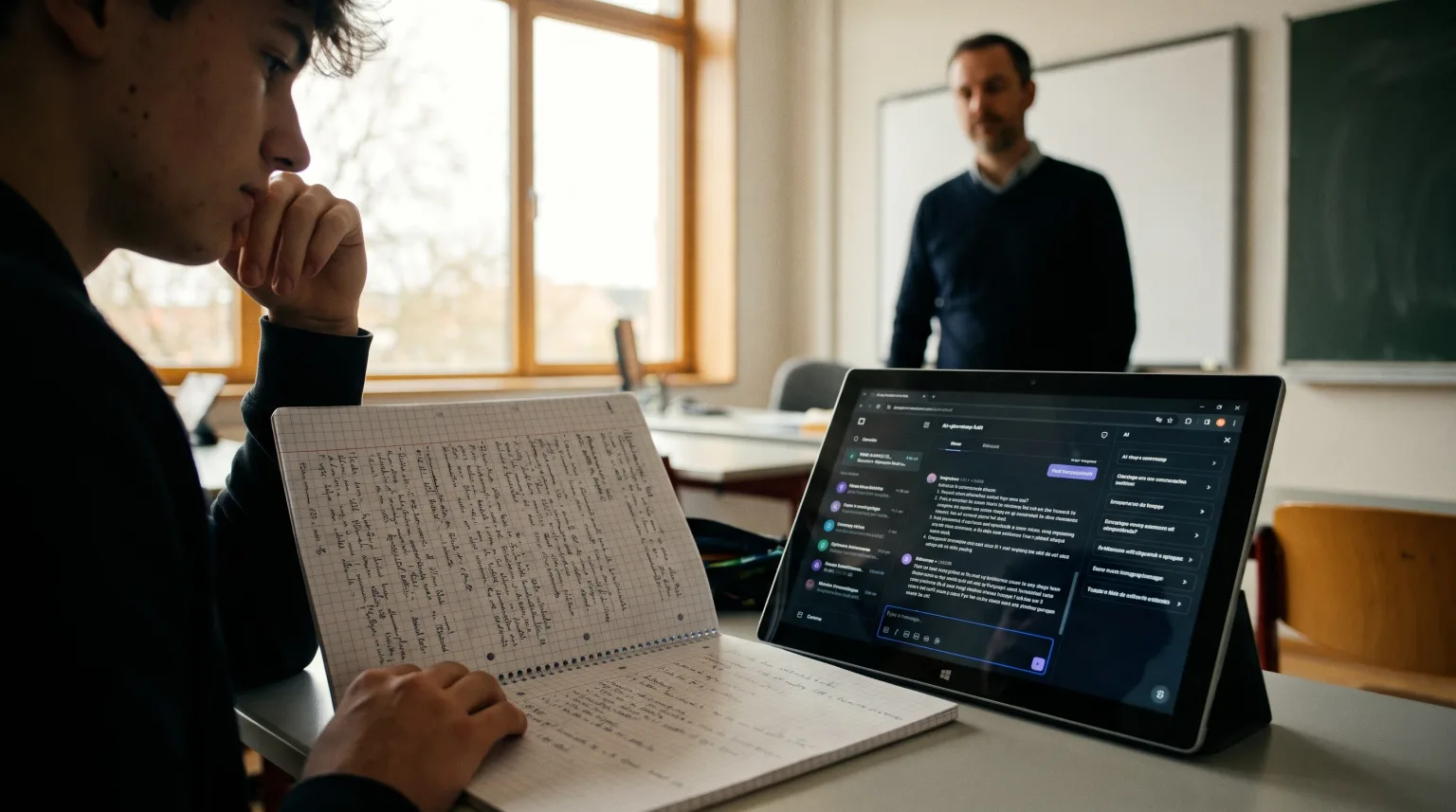
The discomfort AI reveals
AI in school is not only a technological issue. It is a biological one.
A digital tool can accelerate access to information.
Generative AI can accelerate access to an answer.
But human learning is not just access.
It requires attention, working memory, deep reading, inference, error, active retrieval, and productive frustration.
That is exactly where AI becomes both fascinating and dangerous.
Used too early, it can turn a student into the passive supervisor of an output they are not yet able to judge.
Used at the right moment, it can become a comprehension accelerator, a tutor, a simulator, an intellectual sparring partner.
The difference is not the tool.
The difference is pedagogical design.
In his written testimony before the U.S. Senate, Dr. Jared Cooney Horvath states that children’s cognitive development has stalled or reversed in several areas, including literacy, numeracy, attention, and higher-order reasoning, despite increased school attendance and public investment. He identifies the rapid expansion of educational technology in classrooms as one major structural change. ([U.S. Senate Committee])
His point is disturbing because it challenges a comfortable belief: more technology in school automatically creates more learning.
The recent history of educational technology tells a more ambiguous story.
The OECD notes, based on PISA 2012 data, an “inverted-U” relationship between technology use and learning: both lower-than-average and higher-than-average ICT use were correlated with weaker performance, while high levels of ICT use may also replace other learning activities better suited to the intended goal. ([OECD])
So the screen itself is not the core problem.
The problem begins when the screen replaces cognitive effort instead of supporting it.
We confused access with learning
For two decades, part of the education narrative has been shaped by a simplistic equation:
more devices = more modernity = better performance.
That equation reassures policymakers, vendors, schools, parents, and sometimes students themselves.
It produces flattering dashboards.
Number of tablets distributed.
Number of connected classrooms.
Number of software licenses activated.
Number of exercises completed on a platform.
But learning is not clicking.
Learning is not receiving an answer.
Learning is not watching a video until the end.
Learning requires internal transformation. Information becomes knowledge when the brain has worked on it, tested it, connected it, partially forgotten it, retrieved it, reformulated it, and challenged it.
This is where generative AI changes the equation.
Before, a student could copy an answer.
Now, a student can obtain an answer that is fluent, structured, convincing, and sometimes false.
Before, a teacher could detect the gap between the student’s real level and the quality of the submitted work.
Now, that gap can be hidden behind impeccable prose.
Before, the difficulty appeared in the writing.
Now, the difficulty can disappear from the screen without disappearing from the brain.
The trap of the student as supervisor
One of the major risks of AI in school is making students believe they can already evaluate what they do not yet understand.
To use AI well, one must know how to ask a good question.
To ask a good question, one must already have a minimum mental structure in the subject.
To correct an answer, one must distinguish accuracy from plausibility.
To request a reformulation, one must perceive what is unclear.
To detect a hallucination, one must possess a foundation of knowledge.
A student without that foundation becomes dependent on the machine that claims to help.
Research reported by Wharton on nearly 1,000 high-school math students shows this paradox: using a GPT-4-like interface during practice improved immediate performance, but the group using the tool without safeguards performed worse when the assistance was removed. A tutored version, designed with hints and pedagogical limits, mitigated the problem. ([Wharton])
That point matters.
AI that gives the answer can weaken learning.
AI that guides students toward the answer can amplify it.
Same technology.
Different pedagogical design.
Different cognitive outcome.
The SAT as a symptom of surrender
In his intervention, Dr. Horvath refers to a striking example: the evolution of the American SAT.
The College Board officially states that the digital SAT lasts a little over two hours instead of three, includes shorter reading passages with one question tied to each, and allows calculators throughout the math section. ([College Board])
This change can be defended through the lens of candidate experience, stress reduction, or logistics.
But it raises a deeper issue: are we adapting assessment to the cognitive capacity we want to develop, or to the dominant use pattern of digital tools?
Reading a long text.
Holding an idea.
Comparing several arguments.
Inferring what is not said.
Tolerating ambiguity.
Resisting the urge to move on.
These abilities are not decorative.
They form the foundation of complex thinking.
When we slice reading into ultra-short fragments, we may still measure a useful skill: quickly identifying information.
But we are no longer measuring exactly the same thing as deep reading.
The risk is renaming lower cognitive demand as modernization.
The screen is not always the enemy
It would be too easy to conclude that all technology should be removed from school.
The OECD itself emphasizes that technology effectiveness depends on context, activity type, pedagogical quality, teacher competence, and how tools are used. ([OECD])
Recent research also shows that a well-designed AI tutor can produce learning gains in specific settings. A Scientific Reports study found that students learned more in less time with a structured AI tutor than in a traditional active-learning class, while reporting higher engagement and motivation. But the study also emphasizes design based on pedagogical best practices, including scaffolding, cognitive-load management, targeted feedback, and accuracy control. ([Scientific Reports])
That is the turning point.
AI can be a tutor.
It can also become a crutch.
It can provoke reflection.
It can also replace it.
It can ask the student to explain their reasoning.
It can also deliver a ready-to-submit reasoning chain.
It can help the teacher differentiate learning paths.
It can also industrialize the illusion of learning.
Technology is not the center of the debate.
The center of the debate is the cognitive capacity we want to train.
Build before delegating
That is why “should AI be used in school?” is too poor a question.
A better one would be: which cognitive capacities do we want to develop before delegating part of the work to AI?
Read before summarizing.
Search before asking.
Reason before generating.
Write before optimizing.
Understand before automating.
Memorize before externalizing.
Argue before polishing.
Doubt before publishing.
In the Innovational Intelligence® system, the tool does not come before the intention. Innovation starts with the human objective, and only then with the selection of means. This is one of the points I develop in my book, chapter 14.
Applied to school, this creates a simple rule: do not start by asking which AI tool to use.
Start by defining the cognitive function to protect, develop, or amplify.
Do we want to train attention?
Then AI must not further fragment the work.
Do we want to train memory?
Then AI must not immediately provide the answer.
Do we want to train critical thinking?
Then AI can deliberately produce two conflicting answers to analyze.
Do we want to train writing?
Then the student must first write without AI, then use the tool to compare, improve, question, and justify changes.
Do we want to train comprehension?
Then the student must explain before receiving an explanation.
The brain learns through effort, not magic
The biology of learning is almost irritating for our age.
We want fluidity.
The brain also learns through friction.
We want instantaneity.
The brain consolidates through repetition.
We want answers.
The brain progresses through active retrieval.
We want to avoid frustration.
The brain sometimes turns frustration into understanding.
The promise of effortless educational AI should therefore make us cautious.
Good educational AI should not remove all difficulty.
It should calibrate difficulty.
Too easy: no learning.
Too hard: disengagement.
Difficult enough: progress.
A good tutor is not the one who answers instead of the student.
A good tutor is the one who knows when to remain silent.
The political risk: measure what declines, then call it progress
UNESCO notes that smartphone bans in schools have spread worldwide as governments raise concerns about classroom distraction and student well-being. ([UNESCO])
In the United States, NAEP data show that 13-year-olds did not significantly improve in reading or mathematics between 2023 and 2025, and that 2025 scores remained below pre-pandemic 2020 levels. The 2025 reading score for 13-year-olds was not significantly different from the 1971 score. ([NAEP])
These numbers must be handled carefully.
They do not, by themselves, prove that screens or AI caused the problem.
They do signal that a naive narrative of automatic progress through technology no longer holds.
The danger now would be moving the criteria.
If students read for shorter periods, shorten the texts.
If they write less well, celebrate assisted editing.
If they calculate less, authorize the tool everywhere.
If they memorize less, declare memory obsolete.
If they struggle to reason, assess their ability to operate a machine that reasons in their place.
That is when modernization becomes surrender.
Educational AI should be a gym, not an armchair
An intelligent school does not have to choose between analog nostalgia and digital fascination.
It must prioritize.
Paper may remain superior for some phases of reading, memorization, slow writing, and concentration.
Digital tools can be useful for simulation, repetition, visualization, personalization, and testing.
AI can be valuable for questioning, reformulating, creating scenarios, generating counterarguments, adapting exercises, and helping teachers differentiate.
But schools must reject AI that replaces foundational effort.
A student must learn to produce before learning to supervise.
A student must learn to judge before learning to delegate.
A student must learn to think before learning to automate.
Otherwise, we are creating a generation of pilots without flight hours.
The non-negotiable skill
To me, the central skill to preserve is autonomous thinking.
Not isolated thinking.
Not arrogant thinking.
Not thinking disconnected from tools.
Thinking that can function without assistance, then return to the tool with discernment.
AI can become an educational revolution.
It can also become premium cognitive anesthesia.
The difference will be measured in ten years, when we discover whether our children can still think without assistance.
👉 Which skill should remain non-negotiable before allowing large-scale student use of AI?
This is a topic I address in my keynotes, workshops, and advisory work, especially when an organization still believes that adding AI to a process is enough to create intelligence.