A first post, and the ground shifts
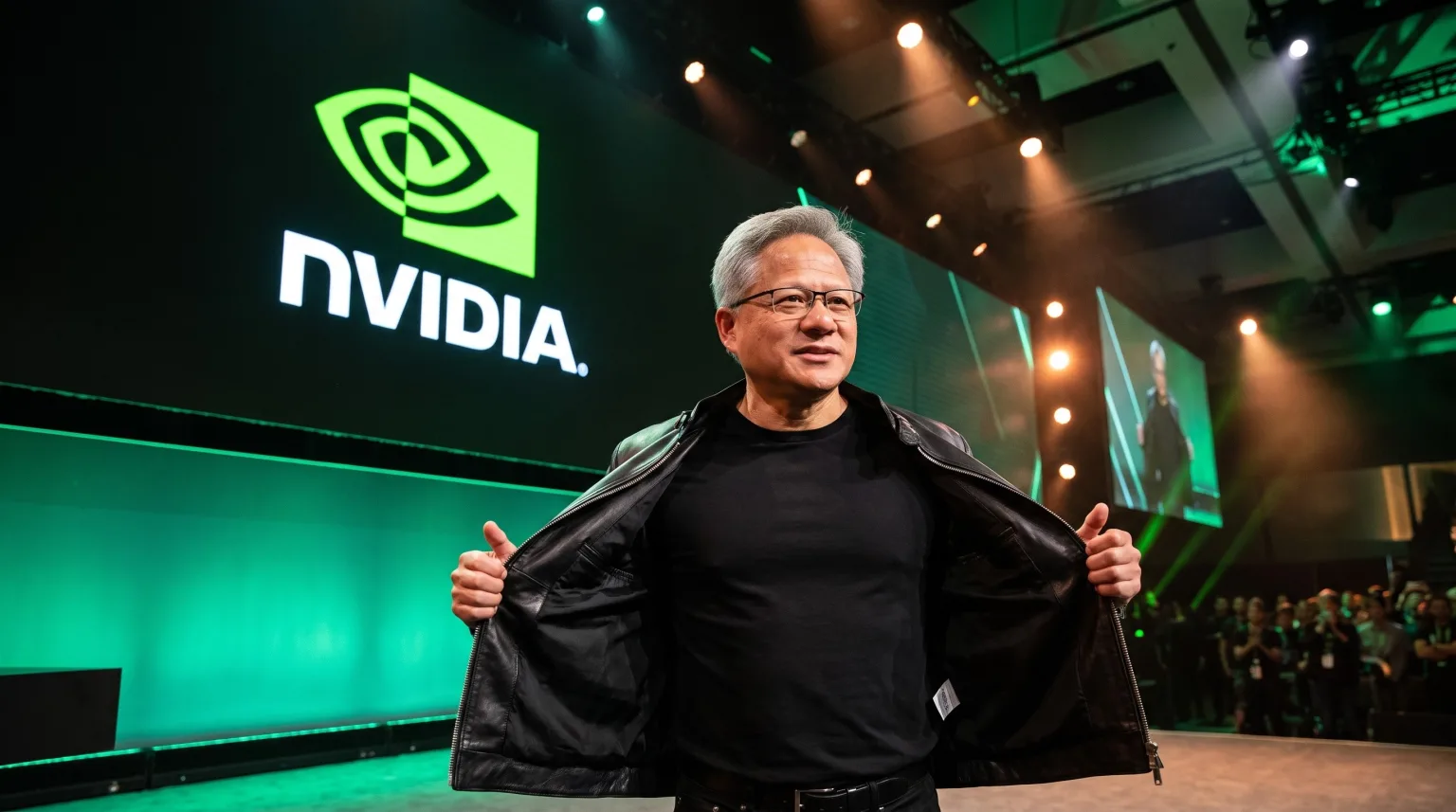
Friday. A man who had never published a single thing on social media in his life opens an account and hits “post.” That man runs the most valuable company on the planet. His very first message is neither a holiday photo nor an inspirational quote. It is an open letter to Washington defending an idea his own CFOs should hate: giving away the engine of his artificial intelligence, for free, to the entire world, competitors included. (Fortune)
Jensen Huang is no stray idealist. He is one of the most clear-eyed industrialists of his generation. If he chose his first public word to defend openness, it is because he is playing a game. And that game is worth billions.
Around him, the letter “Open Weights and American AI Leadership” first gathers twenty-five companies, then doubles in a single day to pass fifty: Nvidia, Microsoft, Meta, IBM, Dell, Mistral, Hugging Face, the Linux Foundation, Andreessen Horowitz, Y Combinator. (Forbes) Such an alignment of rivals behind a single cause should raise a flag. When fierce adversaries suddenly defend the same thing, look for the interest before you applaud the virtue.
Let’s put the numbers before the emotions
I have a rule I repeat in my book and on every stage I step onto: a seductive assumption must be killed by experimentation before it is carved into law (my book, chapter 14). So let’s look at the facts, not the slogans.
Open-weight models, the ones anyone can download, run, and modify on their own machine, have caught up with the most advanced closed models far faster than the consensus predicted. Where the gap was once measured in years, it is now measured in weeks. (OpenRouter) And while the price of proprietary solutions stays captive, the cost of open weight is collapsing: some of these models were trained for a fraction of the budget of the big American labs while rivaling them on many benchmarks.
A detail that is anything but minor: four of the five best open models today come from Chinese labs. (OpenRouter) That is why Washington is nervous. And that is why this fight reaches far beyond the technical question alone. Behind the bytes lies a question of sovereignty, and behind sovereignty, a question of power.
The case for a ban fits in one word: safety
Those who favor the lock have a coherent argument, and I refuse to caricature it. Once an open model is released, it cannot be recalled. You cannot revoke access, you cannot update the guardrails after the fact, you cannot stop malicious use of a file already downloaded a million times. (Axios) Dario Amodei, the head of Anthropic, has held this line since 2019, back when he already refused to release certain models in the name of risk.
That concern is legitimate and I will not wave it away. I always name dangers plainly. But naming a danger and being paralyzed by it are two different things. The problem is not acknowledging the risk. The problem is believing that a ban makes it disappear.
Banning does not remove the risk, it moves the power
Here is the point few dare to say out loud. Closing the market does not make AI safer. It concentrates AI among three or four labs that will set prices, access, and terms of use on their own. (CNBC)
The risk itself does not evaporate, it changes hands. Bad actors will download models hosted elsewhere anyway, beyond the reach of American law. (Tom’s Hardware) You then get the worst of both worlds: a locked domestic market and capabilities thriving abroad, in the very hands you claimed to keep at bay. Declared safety turns into a disguised barrier to entry.
I always distrust success more than failure. And I distrust even more the safety arguments that, by happy coincidence, protect the margins of whoever waves them. Horses did not ban the automobile to protect themselves; they simply vanished from the road. History never rewards those who lock the door, only those who build.
Blue Ocean strategy, not morality
The companies defending open weight are not choirboys. They are running a strategy I describe in my book: Blue Ocean (my book, chapter 8), the search for a market space where head-on competition becomes simply irrelevant.
The mechanism is formidably elegant. By making the model abundant and free, you destroy value where your rivals want to capture it, the sale of the model itself, and you move it to where you are strongest: infrastructure, chips, cloud, services, integration. Nvidia does not sell models. Nvidia sells the picks and shovels of the gold rush. The more open AI becomes, the more it spreads, the more the whole world digs, and the more Nvidia collects on every stroke. (Fortune)
Free is not a gift, then. It is a shift of value, calculated to the last cent. Those who confuse generosity with strategy have not read the map of the game being played.
The only major lab still refusing to open
One signal deserves your full attention. After the initial surge, OpenAI and Google ended up joining the movement. One major player holds firm in its refusal: Anthropic. (Axios)
Anthropic is preparing a public listing that could come as soon as this year, just like OpenAI. When a lab defends the lock at the exact moment it is about to ask the markets to value it near a trillion dollars, ask yourself a simple thing: who is protecting whose market? Safety is a sincere argument. It is also, at times, a moat dug around a castle.
I condemn no one by name and I assume no bad intent from anyone. I observe an alignment of interests, and I invite each of us to look at it head-on rather than dress it up in grand principles.
What is really at stake: distribution, not power
The future of AI will not be decided on the raw power of a model. It will be decided on the control of its distribution. Those who understood this are already building on open ground, while the others pay for their seat at the counter.
And this regulatory decision reaches far beyond Silicon Valley. It will shape Europe’s digital sovereignty, the degree of dependence of your suppliers, the real cost of your own experiments. More suppliers means lower prices, innovation distributed across the whole economy, and reduced dependence on a handful of dominant players. A closed market produces exactly the opposite, for you and for your customers. You are not a spectator of this game. You are already one of its stakes.
The essentials
- Giving away your model is Blue Ocean strategy, not generosity: make head-on competition irrelevant and shift value toward infrastructure and services.
- Banning openness does not remove the risk, it exports it abroad and concentrates power among three or four players.
- A seductive assumption, here, “closing equals securing”, must be killed by experimentation before it is carved into law.
- When one player defends the lock while its peers open the doors, look for the interest behind the displayed virtue.
- The power is not in the model. It is in the control of its distribution.
In your sector, does openness threaten your margins, or is it the only way to escape the dependence waiting for you? Ask yourself before someone else answers in your place.
I explore this kind of strategic bet without spin in my keynotes, workshops, and advisory work: data first, certainties second. Think further. Be different.



References
- (Fortune) https://fortune.com/2026/07/24/jensen-huang-open-source-letter-nvidia-kimi/?utm_source=philippeboulanger.com
- (Forbes) https://www.forbes.com/sites/sandycarter/2026/07/25/huangs-open-weights-letter-doubled-to-50-without-amazon-and-anthropic/?utm_source=philippeboulanger.com
- (CNBC) https://www.cnbc.com/2026/07/24/nvidia-microsoft-meta-open-weight-ai-models.html?utm_source=philippeboulanger.com
- (Tom’s Hardware) https://www.tomshardware.com/tech-industry/artificial-intelligence/nvidia-and-24-other-companies-sign-open-weights-letter-as-washington-weighs-chinese-ai-model-ban?utm_source=philippeboulanger.com
- (Axios) https://www.axios.com/2026/07/27/nvidia-anthropic-openai-open-weight-debate?utm_source=philippeboulanger.com
- (OpenRouter) https://openrouter.ai/blog/insights/the-open-weight-models-that-matter-june-2026/?utm_source=philippeboulanger.com