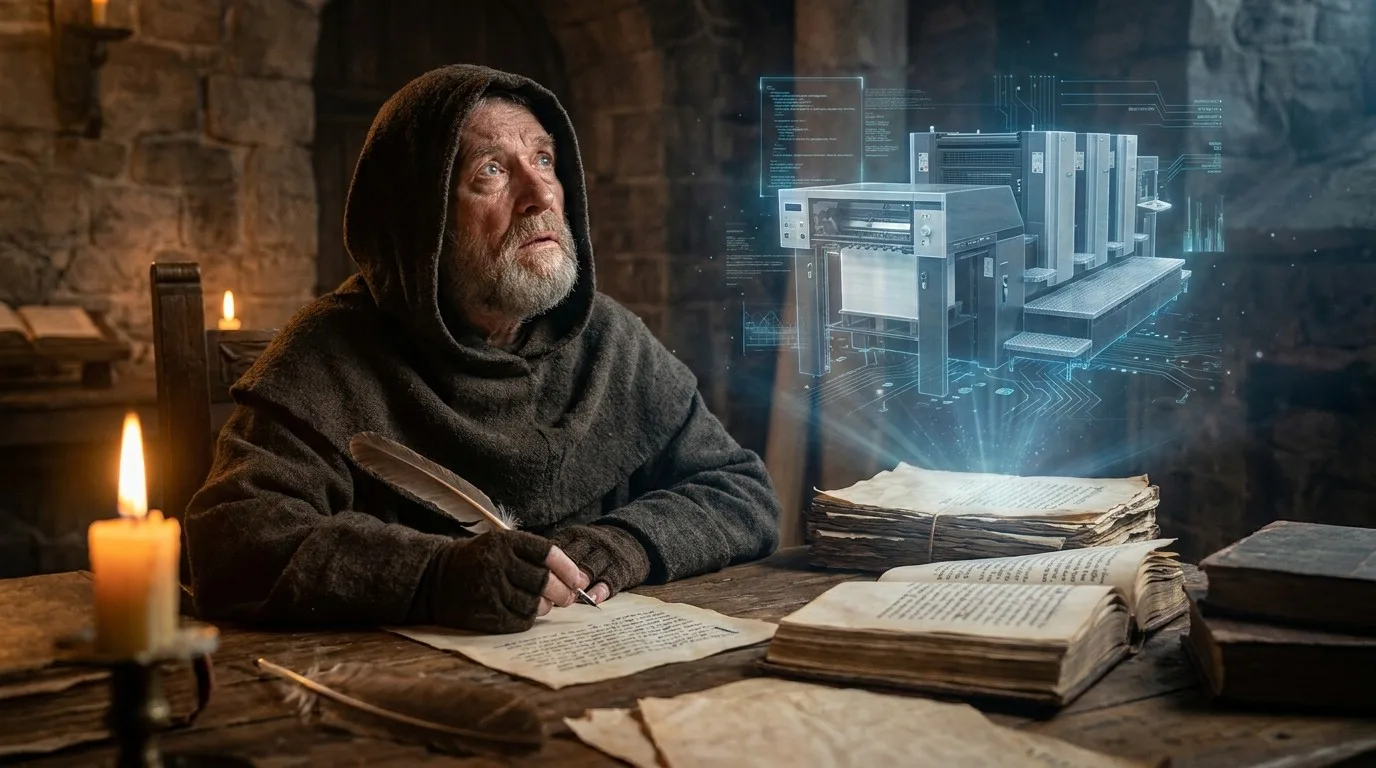
In 1492, a monk wrote an entire book to prove that the printing press was dangerous. Then he had it printed. If you have ever caught yourself thinking that AI threatens “other jobs, not mine,” you may be making exactly his argument. And history, unfortunately, has a taste for farce.
1492: A Monk Prints His Own Defeat
Johannes Trithemius, a Benedictine abbot, defended scribes with disarming sincerity. In his treatise De laude scriptorum, he praised the discipline of the hand, the nobility of parchment, that soul a machine could never transmit. He believed he was saving a world. Thirty years later, no one copied books by hand anymore, and a knowledge economy ten times larger employed authors, printers, binders and booksellers by the thousand. (Internet Archive)
Ask yourself the question right now, before reading on: what part of your working day feels like a gesture too noble to hand over to a machine? Keep that answer in mind. We will come back to it.
“Canned Music”
In 1906, John Philip Sousa, America’s most famous composer, published a pamphlet against the phonograph. He called it “mechanical music,” this “canned music” that would, he warned, silence mothers’ lullabies, extinguish amateur bands and turn children into “human phonographs, without soul or expression.” He was defending the living musician against the reproducing machine. (Smithsonian Magazine)
What he did not see coming: the record industry went on to support more musicians, sound engineers, producers and artists than every amateur band combined. The machine he feared expanded the market for the very thing he loved. Ask whether your fear resembles his: protecting the shape of a job, while forgetting that it is the need behind the job that never disappears.
The Man Who Pushed the Button for You
For decades, you did not ride an elevator alone. An operator worked the lever, called out the floors, opened the gate. The job seemed eternal: no one trusted automatic cars, which had existed since 1900 but stayed hopelessly empty. In 1945, fifteen thousand elevator operators and doormen went on strike in New York. The city ground to a halt; a million and a half office workers could not get to their desks. (NPR)
Chastened building owners then funded a campaign to make the automatic elevator finally acceptable. Within a decade, the operator vanished. Today you press a button without ever having known their name. Note the mechanism: the job was not swept away by a catastrophe, but by a quiet tipping point, once trust in the machine caught up with its price.
“Number, Please?”
There was a time when you did not dial a phone number yourself. You picked up, and an operator, almost always a woman, plugged in your connection by hand. In 1950, there were more than three hundred thousand of them just for the Bell system, and nearly one in thirteen working American women held the job. It was one of the most common openings for a young woman. (HISTORY)
Then the automatic dial spread. Within a few years, in each city that was “cut over,” the number of young women hired as operators fell by half, sometimes by 80%. The occupation melted away. And yet women’s unemployment did not explode: they spilled over into secretarial work, services, other jobs. The role disappeared; the people did not. The whole difference lies in how that transition is supported.
The Machine That Was Supposed to Bury the Bank Teller
Here is the counter-example that should haunt you. When automated teller machines spread across the 1970s to 1990s, everyone announced the end of the bank teller. The machine dispensed cash, took deposits, showed balances. The teller seemed doomed. The opposite happened. (IMF)
ATMs cut the number of tellers per branch from around twenty-one to thirteen. But because each branch cost less, banks opened far more of them. The result: between the 1980s and 2010, the total number of American tellers rose, from about five hundred thousand to nearly six hundred thousand. Their job changed in nature, less cash counting, more advising, selling, guiding. The machine moved the human toward what the machine could not do. Until the day the smartphone finally automated almost every remaining task. Displacement works as long as you move faster than the machine.
So Where Do You Fit In?
This is what obsesses me when I look at artificial intelligence. The danger was never the technology itself, but the reassuring story we tell ourselves in order to stay put. Every generation manufactures its inner Trithemius, that little voice whispering that your job, at least, is different, protected, irreplaceable.
That voice has a name, one I describe in my book: the fear of becoming obsolete (my book, chapter 6). It is not cured by waiting for the storm to pass. Economists capture it with Amara’s law: we overestimate a technology’s effect in the short term and massively underestimate it in the long term. (IEEE Computer Society) In other words, AI may disappoint you this year, and will almost certainly overtake you in ten. That very gap is what lulls, and what traps.
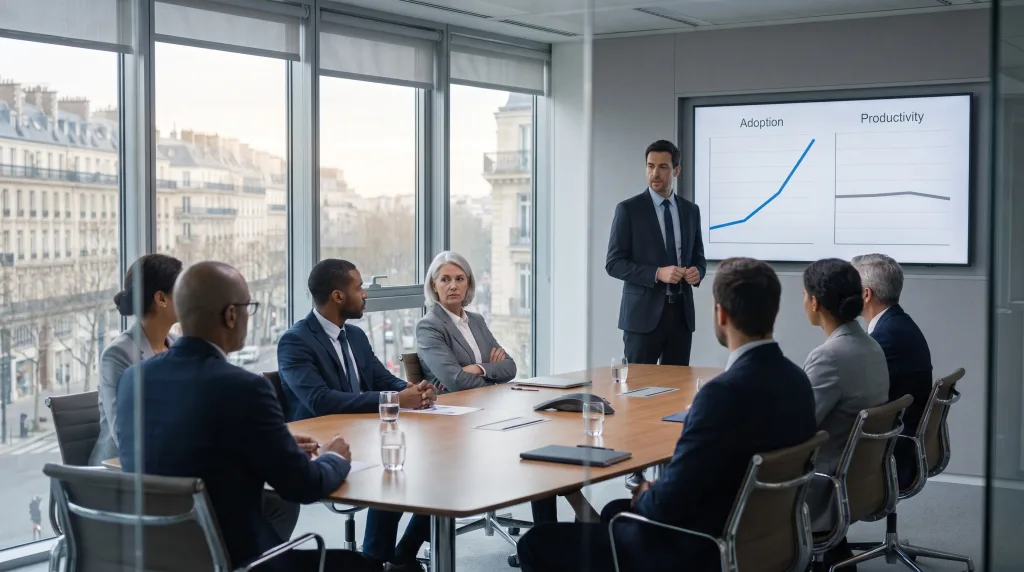
The productivity paradox is already at work: three years after large language models erupted, the macroeconomic impact remains discreet, exactly as it was for the internet before it came to weigh some twenty points of GDP. (Telos) That delay offers no reprieve, it is a window. The time you have left to become the person who tames the tool before everyone else.
The Noble Gesture You Still Refuse to Let Go
Back to the opening question. That “noble gesture” of your job, the one you deem too human for a machine, Trithemius’s parchment, Sousa’s brass band, the operator’s lever, the switchboard’s plug, is precisely where your blind spot will settle. Not because the machine will do it better, but because, while you protect it, a colleague will have made peace with the tool and rebuilt the job around it.
Your position will not vanish in a spectacular cataclysm. It will fade quietly, replaced by someone who tamed the machine while you were writing, in your own way, your personal praise of the scribes.
So tell me: what gesture of your job do you still refuse to hand over to AI, and are you sure it is nobility, and not fear?

References
- (Internet Archive) = https://archive.org/details/inpraiseofscribe0000trit?utm_source=philippeboulanger.com
- (Smithsonian Magazine) = https://www.smithsonianmag.com/smart-news/john-philip-sousa-feared-menace-mechanical-music-180967063/?utm_source=philippeboulanger.com
- (NPR) = https://www.npr.org/2015/07/31/427990392/remembering-when-driverless-elevators-drew-skepticism?utm_source=philippeboulanger.com
- (HISTORY) = https://www.history.com/articles/rise-fall-telephone-switchboard-operators?utm_source=philippeboulanger.com
- (IMF) = https://www.imf.org/external/pubs/ft/fandd/2015/03/bessen.htm?utm_source=philippeboulanger.com
- (IEEE Computer Society) = https://www.computer.org/publications/tech-news/trends/amaras-law-and-tech-future?utm_source=philippeboulanger.com
- (Telos) = https://www.telos-eu.com/fr/economie/la-grande-peur-des-technologies-de-rupture.html?utm_source=philippeboulanger.com