Two scenes, one signal
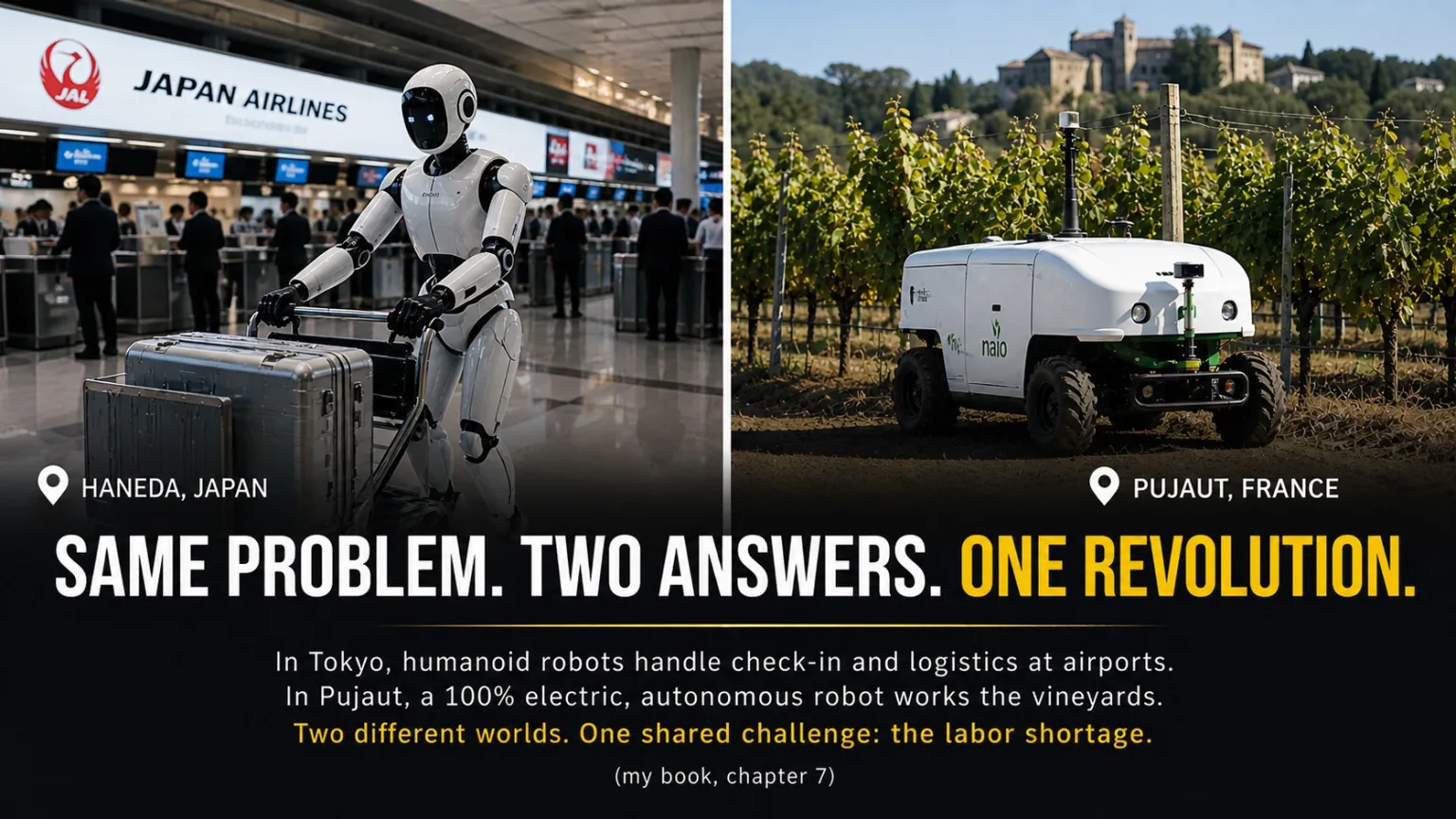
In Tokyo, a robot lifts a suitcase. In Pujaut, another one enters the vineyards.
Two images. Two continents. Two economies. Two worlds that rarely speak to each other.
On one side, Haneda’s tarmac, aircraft, luggage, precise schedules, rising tourism pressure, and human teams under strain.
On the other side, the vineyards of southern France, soil, rows, seasons that do not wait, repeated physical gestures, and the same sentence heard everywhere: there are not enough people.
So robots arrive.
Not like in the movies. Not with ominous music. Not to announce the theatrical disappearance of humans.
They arrive because reality has overtaken our debates.
In Japan, Japan Airlines is launching a May 2026 demonstration experiment using humanoid robots to complement human tasks in ground operations, explicitly aiming to reduce workload and respond to human-resource shortages in ground handling (JAL) . In Pujaut, a fully electric and autonomous robot is presented as a concrete answer to labor shortages in vineyards (Midi Libre).
Same diagnosis. Two local symptoms. One global shift.
The robot is not the point
The most interesting part is not the robot.
The most interesting part is what it reveals.
At Haneda, the humanoid is not appearing in a technology showroom. It is entering a constrained, high-pressure environment where operations must be precise, fast and safe. JAL says the experiment will first visualize and analyze airport operations to identify where humanoid robots can operate safely, before testing them progressively in airport-like conditions (JAL) .
In Pujaut, the agricultural robot is not erasing the image of the winemaker. It is entering an environment where tasks are physical, seasonal, repetitive, exposed to weather, and increasingly difficult to staff. A La Provence video about Vitisat’s autonomous robot in the Vaucluse mentions GPS guidance, electric autonomy and prolonged operating capability, with an ambition to launch for the 2026-2027 season (La Provence / Dailymotion) .
In both cases, technology does not arrive because an organization suddenly dreams of a spectacular future.
It arrives because the operating model is beginning to crack.
Same problem, two geographies
Japan faces a difficult mix: ageing, a shrinking working-age population, tourism pressure, and strong constraints on physical jobs. According to The Guardian, more than 7 million people visited Japan in the first two months of 2026, after a record 42.7 million visitors the previous year, increasing pressure on airport infrastructure (The Guardian) .
The Gard region shows another face of the same issue: farms and vineyards must operate with biological calendars, weather constraints and labor shortages on physical tasks. The robot is not a fascination with abstract automation. It answers a simple equation: how can production continue when available human labor is no longer enough?
Tokyo and Pujaut have almost nothing in common.
An international airport and a vineyard in southern France do not share the same codes, uniforms, margins or imagination.
Yet the signal is identical: when essential work no longer finds enough human hands, innovation stops being a comfortable option. It becomes operational breathing support.
The future sometimes carries tire tracks
For years, we have spoken about transformation, AI, automation and process innovation.
We discussed them in strategy committees, conferences, white papers, slide decks, panels and seminars.
Then, when the machine finally appears in physical jobs, we discover that the future does not always wear a hoodie.
Sometimes it carries dust.
Sometimes it pushes baggage.
Sometimes it moves between two rows of vines.
Sometimes it works at night, in the rain, on a plot no one sees from an open-plan office.
That is probably what disturbs us. We had accepted the idea of clean, invisible, almost abstract digital innovation. We were ready to see AI write, code, summarize, analyze, generate images or optimize spreadsheets.
We are less comfortable when innovation touches muscles, gestures, fatigue, and jobs still held together by human bodies.
Scarcity accelerates innovation
Labor scarcity acts as a revealer.
As long as an organization can compensate with overtime, difficult recruitment, managerial pressure, temporary workers, seasonal workers or goodwill, it delays transformation.
Then comes a moment when compensation is no longer enough.
The problem no longer belongs to internal communication. It belongs to business continuity.
That is when process innovation becomes serious.
The OECD Oslo Manual reminds us that an innovation must be implemented: a product must be made available to users, or a process must be brought into use by the organization (OECD) .
This definition is essential. It separates ideas from innovation.
A robot shown in a video is a promise. A robot integrated into an operational flow becomes an innovation.
In my book, chapter 3, I insist on this exact difference: innovation is not an elegant idea or an attractive prototype. It truly begins when it enters daily work, practices, processes and the organization.
Our discomfort says something
The discomfort triggered by these robots is more interesting than the technology itself.
It says we have not yet clarified our relationship with physical work.
We applaud innovation when it increases consumer comfort. We become more cautious when it transforms workers’ daily lives.
We like the idea of progress when it appears as a mobile app. We question it more when it arrives as an autonomous machine in a manual occupation.
This discomfort can be useful. It forces important questions.
Which tasks must remain human? Which tasks can be entrusted to machines? Who controls the system? Who benefits from the productivity gains? Who is trained? Who is repositioned? Who decides? Who carries the risk? Who explains the change to teams?
The mistake would be to reduce the debate to a simplistic opposition: human versus robot.
The strategic subject lies elsewhere: human with robot, organization with robot, business model with robot, managerial culture with robot.
Replacement is the wrong lens
The word “replacement” attracts clicks.
It simplifies a complex transformation.
In airport operations, JAL speaks of robots complementing human tasks and reducing workload, with special attention to safety (JAL) . The Guardian also reports that key tasks such as safety management will remain human responsibilities (The Guardian) .
In vineyards, the robot does not erase agricultural knowledge. It can shift the effort. It can take over part of the repetitive, precise, painful or hard-to-schedule work. It can make possible what was becoming economically or humanly difficult.
Total replacement is rarely the real starting point.
The starting point is work allocation.
What the machine can do better, longer, more regularly, without fatigue.
What the human can do better: arbitrate, sense, interpret, supervise, repair, adjust, transmit, decide.
The issue is not only technological. It is organizational.
The global signal from service robotics
These two examples are not isolated.
The International Federation of Robotics says nearly 200,000 professional service robots were sold in 2024, a 9% increase, and notes that staff shortages are a key driver of adoption (IFR) .
Transportation and logistics accounted for more than half of professional service robots sold in 2024, with 102,900 units, while agricultural robots represented close to 19,500 units according to the same report (IFR) .
That number tells a powerful story.
Robotics is leaving fantasy behind.
It is moving into warehouses, hospitals, hotels, airports, fields, vineyards, workshops, corridors and logistics zones.
It is reaching the places where work is indispensable and often invisible.
Innovation begins where the model gets tired
Organizations often like to believe that innovation is born in a lab, a hackathon, an incubator, a steering committee or a major strategic announcement.
Sometimes, yes.
Often, it starts elsewhere.
It starts when a team can no longer recruit.
It starts when a manager sees that schedules no longer hold.
It starts when a leader sees quality deteriorating.
It starts when a physical job no longer attracts candidates.
It starts when a business model still works, but with increasing internal tension.
It starts when the organization accepts to look at the exact place where it has been compensating for too long.
In Tokyo, that place is the tarmac.
In Pujaut, that place is the vineyard.
In your company, that place also exists.
It may be in logistics, customer support, maintenance, production, purchasing, finance, recruitment, IT, marketing, compliance or sales.
There is always a place where the system holds because people silently absorb the model’s limits.
Innovation often starts there.
The robot is a mirror
A robot in a vineyard or on a tarmac sometimes tells the story of innovation better than a strategy committee in an air-conditioned room.
It forces the organization to answer simple questions.
Which problem are we really trying to solve?
Labor shortage?
Physical strain?
Productivity?
Quality?
Safety?
Job attractiveness?
Business continuity?
Carbon footprint reduction?
Dependence on seasonal workers?
The answer may be multiple. It must be clearly formulated.
Technology without a precise problem becomes a gadget.
Technology connected to a vital problem becomes leverage.
Physical robotics changes the AI narrative
Artificial intelligence has occupied mental space since the arrival of generative AI. We have spoken about prompts, agents, models, copilots and cognitive automation.
Physical robotics adds another layer.
It gives AI a body.
It brings it into goods flows, agricultural gestures, industrial spaces and constrained environments.
It forces leaders to move beyond a purely software-based view of transformation.
The world ahead will not only be made of generated text, analyzed tables and summarized meetings.
It will also be made of autonomous machines that handle, move, observe, map, transport, clean, plant, weed and inspect.
This is a cultural shift. It requires more than technology budgets.
It requires collective learning capacity.
The provocation
The provocation is not that robots are arriving.
The provocation is that they are arriving first where we underestimated the fragility of human work.
Robots do not steal the future.
They reveal the places where we have refused to look at the present for too long.
They reveal invisible jobs.
They reveal our dependencies.
They reveal our blind spots.
They reveal our contradictions: we want fast services, on-time flights, reliable deliveries, accessible agricultural products, viable farms, controlled prices, yet we sometimes forget the physical reality that makes all of this possible.
In Tokyo, a suitcase must enter an aircraft.
In Pujaut, a vineyard must be worked.
In both cases, the future is not replacing a human conversation.
It is responding to an operational constraint.
The leaders’ choice
For leaders, the subject is not whether to like or dislike robots.
The subject is where the organization is already under pressure.
Where is physical strain becoming a risk?
Where is recruitment structurally difficult?
Where does quality depend on silent heroism?
Where are teams compensating through fatigue?
Where could technology complement human work without degrading safety, meaning and responsibility?
A good innovation strategy does not begin with technology.
It begins with an honest map of tensions.
Only then come the choices: robotics, AI, training, organization, new processes, new partnerships, new business models.
Conclusion
In Tokyo, a robot lifts a suitcase.
In Pujaut, another enters the vineyards.
Same silent cry.
There are not enough people. Not enough time. Not enough human energy available to maintain certain models as they are.
Autonomous robotics will not answer everything. It will trigger debates, mistakes, resistance, fears and adjustments.
But it already forces us to look at innovation differently.
Not as a show.
Not as a buzzword.
Not as a trade-show promise.
As real implementation, inside gestures, jobs, flows and everyday constraints.
Which physical job do you see shifting first under the effect of autonomous robotics?
Of course, I address this topic in my keynotes, workshops and advisory work, because a robot in a vineyard or on a tarmac sometimes tells the story of innovation better than a strategy committee in an air-conditioned room.

References
(CNBC) = https://www.cnbc.com/2026/05/01/japan-airlines-humanoid-robots-haneda-labor-shortage.html
(Midi Libre) = https://www.midilibre.fr/2026/05/03/cest-un-outil-davenir-face-a-la-penurie-de-main-doeuvre-un-robot-100-electrique-et-autonome-revolutionne-le-travail-dans-les-vignes-a-pujaut-13352565.php
(JAL) = https://press.jal.co.jp/en/release/202604/009502.html
(The Guardian) = https://www.theguardian.com/world/2026/apr/28/humanoid-robots-baggage-handlers-japan-airports
(La Provence / Dailymotion) = https://www.dailymotion.com/video/xa7miy2
(IFR) = https://ifr.org/ifr-press-releases/news/service-robots-see-global-growth-boom
(OECD) = https://www.oecd.org/en/publications/oslo-manual-2018_9789264304604-en.html