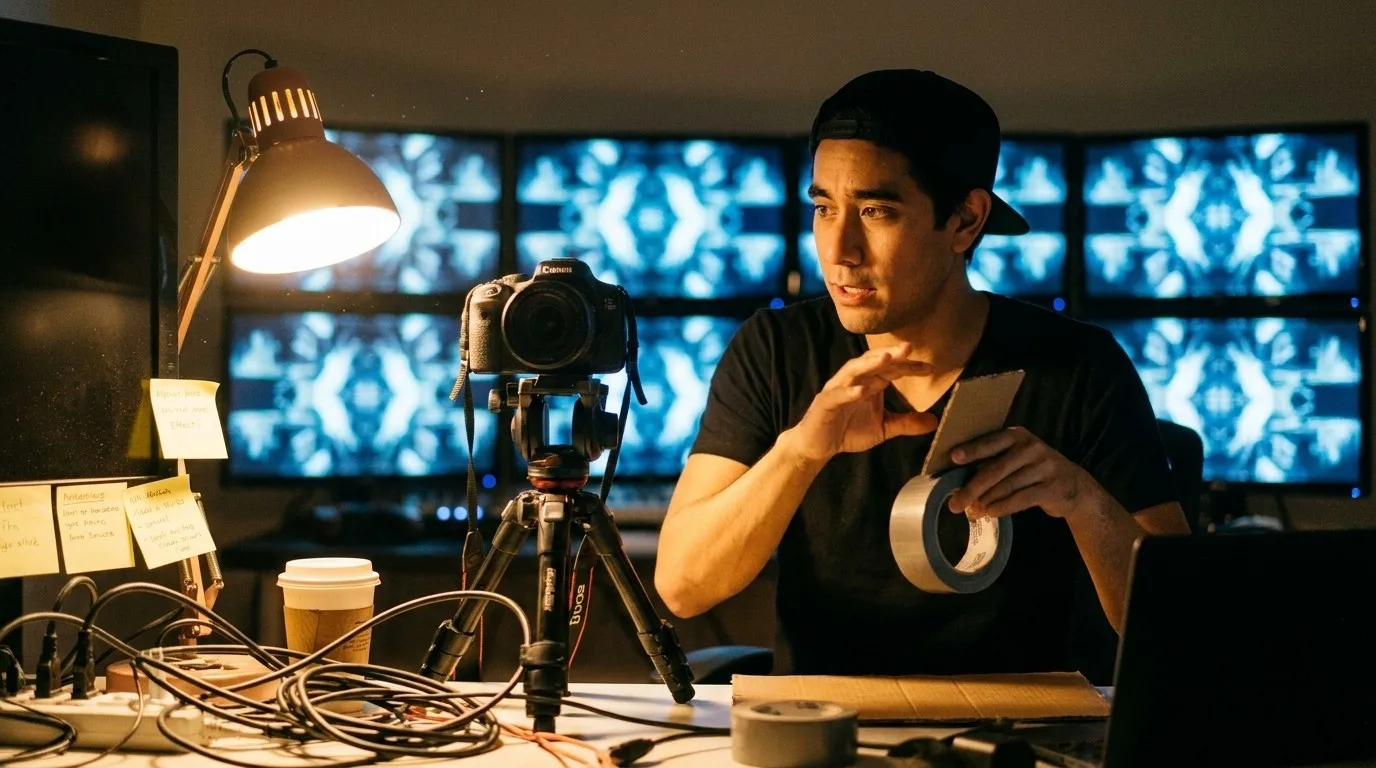
The best anti-AI argument of 2026 fits into twelve seconds of homemade video.
In late June, Zach King, the visual-effects artist whose every video I followed for its creativity, declared war on artificial intelligence. His mission fits into one sentence he owns with complete seriousness: stealing the AI’s job.
A Magician Declares War on the Machines
His plan is absurd and magnificent. Produce so many handmade videos that no one has any reason left to watch a machine-generated scene. One man, a camera, some tape, and the ambition to flood the internet with human gestures.
Zach King is no amateur discovering social media. Twenty-nine million followers on Instagram, forty-three million on YouTube, and a signature you can spot among thousands: illusions built with real sets and meticulous editing, without a single automatically generated image (Yahoo Entertainment). When he pulls off feat after feat in Dubai or elsewhere, his fans don’t wonder which model he used. They wonder how a human being managed to do that (Gulf News).
Behind the joke lies an anxiety that millions of digital professionals carry in silence. The fear of seeing ten years of craft reduced to a single line of prompt. An editor, an illustrator, a copywriter, a designer, all now watch a tool produce in seconds what took them years to master.
Zach King’s gesture deliberately runs against the ambient panic. Where many ask how to integrate AI without being replaced, he asks the opposite, joyful question: how to become so human that the machine looks bland next to you. His answer lies in repetition, accumulation, presence. He doesn’t hide his methods, he shows them off. The cardboard, the tape, the sweat become selling points.
The Fear of Becoming Obsolete
I call it the fear of becoming obsolete, and it ranks among the most paralyzing ones I describe in my book (chapter 6).
The numbers feed this anxiety. In France, nearly five million employees are said to be exposed to a direct threat linked to artificial intelligence within the next two to five years (Journal du Geek). Creative jobs, design, media, arts and entertainment, sit at the top of the exposed sectors, because generative tools have knocked down the barriers to producing images, video, music and text (Statistics Canada). The subject is taken so seriously that the French administration itself publishes its own analyses of AI’s effects on employment (French Treasury).
This fear has a vicious quirk. It strikes the best first, those who invested the most in a precise skill, because they have the most to lose. The rarer and harder-won your expertise, the more violent the feeling of being overtaken by a machine. Technical excellence, long a rampart, turns into a zone of fragility.
Flee, Freeze or Fight
This fear produces three reactions: flight, paralysis, or fight. The first two condemn you, the third turns anxiety into fuel. In front of his camera, Zach King chose the third.
Fleeing means denying the wave and hoping it spares your beach. Freezing means watching the water rise without moving your feet, convinced that past merit will protect you. Fighting means coldly identifying what the machine does better than you, abandoning it without regret, and pouring all your energy into the ground where it won’t follow you.
His gesture says more than his tricks. The audience consumes the human time invested in it, the hours of editing, the failed takes, the owned clumsiness. Every video becomes proof of presence as much as a spectacle.
The Audience Buys Your Ten Hours, Not Your Image
A machine makes a perfect image in ten seconds. A human makes an imperfect image in ten hours, and that imperfection creates attachment, conversation and sharing.
The attention economy is tipping before our eyes. When perfect content becomes free and infinite, its value tends toward zero. What stays rare, and therefore precious, is proof of human effort, the trace of an intention, the owned risk of failure. Employment studies confirm it in their own way: the skills hardest to automate are those that mobilize empathy, judgment and presence, not mere production (HEC Paris).
Zach King’s value never resided in producing images, but in being someone people want to watch at work. That isn’t generated, it’s built, one video after another, one relationship after another. A generative model can copy a style in seconds. It cannot manufacture a decade of trust accumulated with an audience.
Strengthen What a Machine Will Never Sign
Faced with a technology that outpaces you, strengthen what it will never be able to imitate. Those who cross this wave won’t be the fastest, but the most recognizable.
Your signature, your point of view, your singular way of failing and starting over: that is your last advantage. An avatar can reproduce your aesthetic, it cannot carry your story or stake your name. Recognition is earned over time, through owned choices, defended convictions and real presence. None of those can be downloaded.
Zach King’s bet looks lost in advance against raw computing power. Yet it stands on a principle machines won’t overturn: we grow attached to people, not to files.
What do you do today that a machine couldn’t sign in your place?
Rest assured, I cover this subject in my talks, workshops and coaching, and no avatar climbs on stage in my place.

References
- (Yahoo Entertainment) https://www.yahoo.com/entertainment/celebrity/articles/ai-jealous-viral-artist-stuns-095343641.html?utm_source=philippeboulanger.com
- (Gulf News) https://gulfnews.com/entertainment/hollywood/how-zach-king-made-the-impossible-possible-in-dubai-1.62663728?utm_source=philippeboulanger.com
- (Journal du Geek) https://www.journaldugeek.com/2026/04/02/5-millions-demplois-menaces-par-lia-en-france-voici-les-professions-concernees/?utm_source=philippeboulanger.com
- (Statistics Canada) https://www150.statcan.gc.ca/n1/pub/36-28-0001/2026003/article/00003-fra.htm?utm_source=philippeboulanger.com
- (French Treasury) https://www.tresor.economie.gouv.fr/Articles/2026/06/30/l-intelligence-artificielle-quels-effets-sur-l-emploi?utm_source=philippeboulanger.com
- (HEC Paris) https://www.hec.edu/sites/default/files/documents/Exposition%20a%20l%20intelligence%20artificielle%20generative%20et%20emploi_A%20Bergeaud.pdf?utm_source=philippeboulanger.com