An Unusual Back-to-School at Salamanca
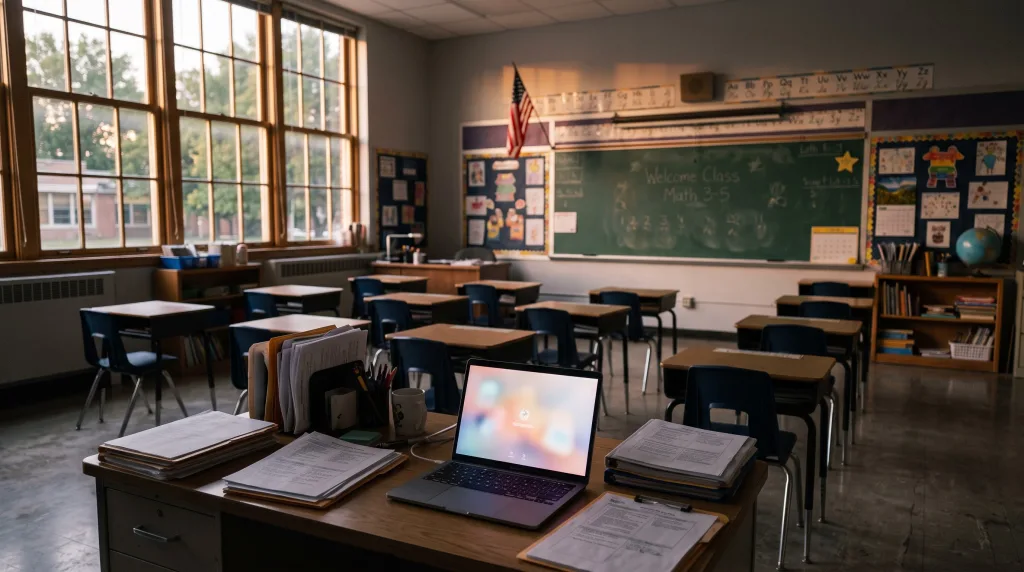
In autumn 2026, high school students in Salamanca, a small school district in New York State located on the Seneca Nation reservation, will find an unusual face in their robotics classroom. Her name is Sally. Silicone skin, long brown hair, a mobile upper body, adjustable facial expressions. She will remain permanently seated. She will assist in science, coding and robotics classes for eleventh and twelfth graders. The district signed a contract worth roughly €50,270 including discount, covering the machine and its associated teaching avatar, while Realbotix lists the M-Series model at close to €83,000 (Clubic).
The full setup deserves attention. Sally operates during class hours. After the bell, an avatar named Optio takes over on students’ laptops: reviewing a lesson, answering homework submitted as a photo, translating exchanges into more than a hundred languages. Each student receives a unique identification code to retrieve the thread of previous conversations. According to the district superintendent, the system runs offline, collects no personally identifiable information, records neither video nor audio, and sends nothing back to the manufacturer. An automatic alert reaches the administration when keywords related to suicide or self-harm appear (NY Focus).
So much for the facts. And the facts are already far more interesting than the story we tell ourselves.
The Story We Project onto the Machine
Since the announcement, two narratives have circulated in parallel.
The first is enchantment. A large, benevolent robot repeating the same explanation a hundred times without ever losing patience, judging no one, in front of whom shy students finally dare to raise their hands, and who assigns less homework. The second is dread. A machine coming to take the job, teachers on strike outside the building, the dehumanisation of school.
Both narratives share a remarkable feature: neither describes what is actually happening in Salamanca. Both are projections. One projects a fantasy of repair, the other a fantasy of dispossession. I have observed exactly the same pattern for three years in companies that call me after letting AI walk in without an instruction manual.
When an organisation says nothing, people do not stop thinking. They fill the vacuum. And under uncertainty, the human brain fills vacuums with threat or with miracle, rarely with realism.
What This Robot Really Says About American Schooling
Let us leave the symbol aside and look at the economics.
The National Center for Education Statistics data is unambiguous: for the 2024-2025 school year, 64% of American public schools reported a lack of qualified candidates and 62% reported too few applications. In rural areas, more than 30% of schools with vacancies could not fill them, with failure rates reaching 57% in foreign languages, 41% in special education, 38% in physical sciences and 35% in mathematics (NCES).
Add the local context. Nearly eight in ten students in the Salamanca district live below the poverty line. A third of students are American Indian or Alaska Native. These families do not hire a private tutor at $60 an hour.
A district unable to recruit a physics teacher spends €50,000 once, on an asset amortised in under a year that works no overtime. On a spreadsheet, the trade-off makes sense. In human terms, it raises a far heavier question: at what point did we give up on making teaching attractive in rural areas, to the point where silicone became the reasonable option?
The robot does not replace a teacher. It replaces the absence of a teacher. Those are radically different things, and conflating them derails the entire debate.
The Evidence Exists, and It Is Uncomfortable
One can find the approach regrettable and still acknowledge that AI tutoring works.
The strongest study to date comes from the World Bank and Stanford researchers, conducted in Edo State, Nigeria, in 2024. A six-week after-school programme, with students working in pairs under direct teacher supervision, using Microsoft Copilot powered by GPT-4. Measured through a randomised controlled trial: a gain of 0.31 standard deviations on the overall assessment, equivalent to roughly two years of traditional schooling, at $48 per student. The programme outperforms 80% of education interventions ever rigorously evaluated. The strongest effect appeared among girls, narrowing a pre-existing gender gap (World Bank Blogs).
Note the detail that changes everything: under direct teacher supervision. The gain comes from the combination, not from replacement. AI supplies infinite patience and permanent availability. The human supplies the frame, the intent and the meaning.
Why Teachers Are Right to Push Back
In May 2026, the New York State United Teachers union adopted a resolution calling for limits on AI and screen time in schools: no one-to-one device use through second grade, no student-facing AI for the youngest pupils, mandatory paper-and-pencil assessment options, and above all a firm principle that any AI use must remain educator-led and serve critical thinking rather than replace human instruction, creativity or judgement (Chalkbeat). A few weeks later, the chancellor of New York City public schools froze purchases of new technology tools pending a clear doctrine.
That reflex is entirely rational, and I document it in my book in chapter 14, devoted to applying the intelligence innovationnelle® system to artificial intelligence.
I recount the case of La Poste there. In early 2024, the French postal service deployed an AI system to calculate mail carrier routes. The tool was imperfect, and certain personal constraints were no longer accounted for. But the real problem lay elsewhere: the AI strategy had been defined in July 2023 and staff were presented with a fait accompli in January 2024, at go-live. Six months of silence. Immediate result: a strike.
In Salamanca, one mother discovered the robot project through a Facebook post by the school. Six months of silence at La Poste, a Facebook post in Salamanca. The mechanism is identical.
When AI arrives, three questions fire automatically in everyone’s mind, and they belong to the survival instinct: what does this mean for me, how obsolete have I become, is my job at risk. An organisation that fails to answer those three questions before deploying anything makes its own intentions suspect. It harvests resistance rather than adoption.
The Blind Spot: Psychological Safety
One element of the popular narrative deserves to be taken seriously, because it lands close to the truth without knowing it: the idea that shy students would finally dare to ask their questions to a machine that judges no one.
If teenagers prefer exposing their confusion to an avatar rather than to an adult in front of their peers, the diagnosis has nothing to do with technology. It concerns the level of psychological safety in the classroom. I devote chapter 9 of my book to this specific pillar, because no innovation survives in an environment where saying “I did not understand” carries a social cost.
A robot that absorbs embarrassing questions relieves a symptom and hides a cause. Used intelligently, it becomes a detector: if the volume of questions asked to Optio after class spikes on one specific chapter, the district holds gold-standard pedagogical information about what is going wrong in the room. Used lazily, it becomes a cover-up that spares anyone the work of repairing the classroom climate.
The Awkward Subject Nobody Wants on the Table
Until 2024, Realbotix operated as Tokens.com and sold virtual land parcels in the metaverse for cryptocurrency. That same year, the company acquired Simulacra, parent of RealDoll, a maker of silicone dolls and later companion robots. The company states that the two brands share no employees, no technology and no premises, and is negotiating a shareholder separation expected before September (Businesswire).
The argument may be technically accurate. It remains strategically fragile, because it forces a school district to publicly defend an industrial lineage that collapses in ten seconds of parent-to-parent conversation. In my book, I stress a point leadership teams systematically underestimate: the perceived legitimacy of the supplier forms an integral part of the adoption strategy. Picking the right tool with the wrong story still amounts to failure.
What a Clear-Sighted Leadership Would Have Done
The intelligence innovationnelle® system imposes a specific order, and that order was inverted in Salamanca just as it is in nine companies out of ten.
Step one, decide whether and how AI changes the institution’s vision, with the intellectual humility to admit the leadership team may lack the competence to settle it alone.
Step two, communicate before deploying, after first measuring internal sentiment. The formula I recommend fits in one sentence: our strategy rests on our current understanding of AI, and what we learn will lead us together to make it evolve. It asserts a direction while acknowledging that the path remains to be drawn collectively.
Step three, assemble a multidisciplinary exploration team, a SWAT team of volunteer teachers and ambassadors, testing the tool around two questions only: how do I increase my productivity and the quality of what I deliver, and what can I now do that was impossible before. Any use answering neither counts as a distraction.
Step four, and only then, deployment, with a community space to share discoveries, successes, difficulties and support requests, plus genuine impact measurement.
Salamanca bought first and will communicate afterwards. That is the reverse order, and precisely why the project will make headlines for the wrong reasons before producing any measurable result.
What I Take Away for Your Organisation
You will probably never buy a silicone robot. But you already have, inside your teams, people using AI in secret, others refusing it in silence, and a leadership team that has yet to state clearly what it expects from any of it.
Sally is merely a particularly photogenic revealer of a universal phenomenon. An organisation gets the adoption it prepared, never the adoption it hoped for. The tool matters far less than imagined. The narrative, the sequence and the psychological safety matter far more.
And if you still hesitate to open the subject with your teams, remember the mail carriers of Évreux. Silence always costs more than the conversation.

References
- (Clubic) https://www.clubic.com/actualite-621466-un-robot-professeur-fait-ses-premiers-cours-devant-des-eleves-a-new-york.html?utm_source=philippeboulanger.com
- (NY Focus) https://nysfocus.com/2026/07/14/new-york-humanoid-robot-teacher-salamanca-school-district?utm_source=philippeboulanger.com
- (Businesswire) https://www.businesswire.com/news/home/20260624597868/en/Realbotix-to-Deploy-First-Humanoid-Robot-and-AI-Teachers-Assistant-in-U.S.-School-District?utm_source=philippeboulanger.com
- (GovTech) https://www.govtech.com/education/k-12/salamanca-n-y-schools-to-pilot-ai-robot-teaching-assistant?utm_source=philippeboulanger.com
- (Chalkbeat) https://www.chalkbeat.org/newyork/2026/06/01/nysut-teachers-union-wants-ban-on-ai-screens-for-young-students/?utm_source=philippeboulanger.com
- (World Bank Blogs) https://blogs.worldbank.org/en/developmenttalk/addressing-the-learning-crisis-with-generative-ai–lessons-from-?utm_source=philippeboulanger.com
- (NCES) https://nces.ed.gov/programs/coe/indicator/llc?utm_source=philippeboulanger.com
- (Mashable) https://mashable.com/tech/new-york-school-testing-robot-teacher?utm_source=philippeboulanger.com