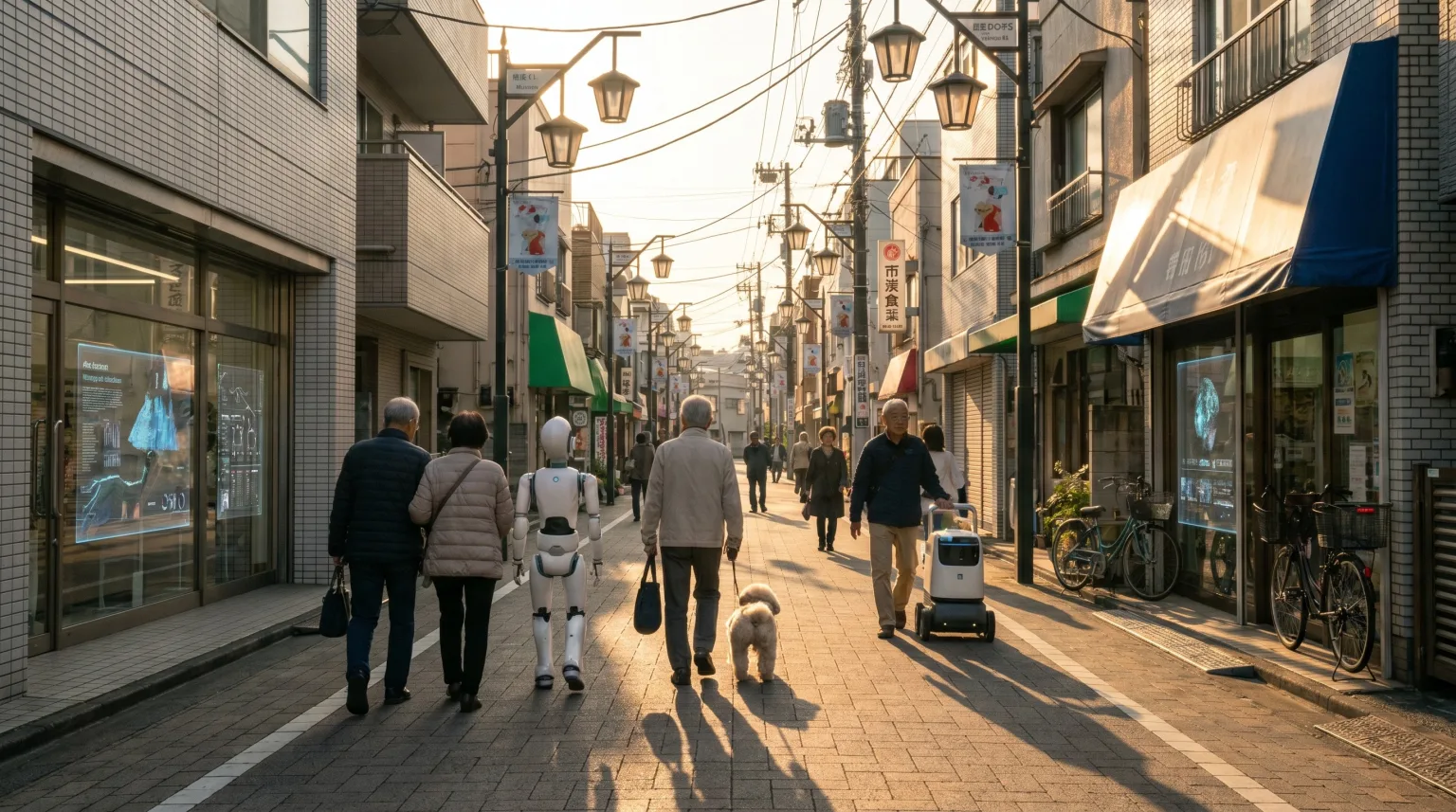
Japan is not just aging. It is accelerating the future.
Japan may have just invented the next productivity revolution: the economy without enough humans.
While many companies are still talking about employer branding, Japan is facing a much more uncomfortable equation.
Fewer births.
More elderly people.
Fewer workers.
More needs.
In 2025, Japan recorded 705,809 births and 1,605,654 deaths, which means a natural population decline of almost 900,000 people in a single year (Nippon.com).
In 2026, children under 15 represented only 10.8% of Japan’s population, while people aged 65 and over represented 29.5% of the total (Nippon.com).
This is no longer just a demographic curve.
It is an organizational shockwave.
The global laboratory of constraint
Japan is not managing a temporary crisis.
It is testing, at full scale, a new model of society under demographic constraint.
Japan’s population fell to about 123 million in 2025 according to preliminary census data, more than three million fewer people than in 2020 (Le Courrier du Vietnam).
Japan is becoming an advanced mirror for every economy that will have to produce, care, transport, serve, train and protect with fewer available workers.
This is not only a Japanese issue.
It concerns Europe.
It concerns public services.
It concerns healthcare.
It concerns industry.
It concerns logistics.
It concerns every company discovering that available talent is not an infinite resource.
First acceleration: operational automation
When staffing shortages become structural, robots, AI agents, voice interfaces and autonomous tools are no longer futuristic options.
They become infrastructure.
The OECD states that Japan faces serious labour and skill shortages because of a declining birth rate and an ageing population, and that AI can contribute by automating tasks, complementing human skills and supporting decision-making (OECD).
Reuters reported in May 2026 that one-third of Japanese companies were already using or considering AI-powered robots, mainly in manufacturing, dangerous tasks and some customer-facing services (Reuters).
That is the strategic shift.
Automation is no longer only about margins.
It becomes about continuity.
When there are not enough people to run a service, deliver a product, open a restaurant, maintain a factory or care for elderly people, the conversation changes.
The question is no longer: “Is it profitable?”
The question becomes: “What happens if nobody is available to do it?”
Second acceleration: the redesign of work
The trap would be to believe that Japan’s response is only about robots.
It goes much deeper.
The talent shortage forces companies to rethink tasks, roles, processes, decisions and priorities.
A company cannot solve a structural shortage with additional meetings.
It must ask uncomfortable questions.
Which tasks should disappear?
Which decisions should be automated?
Which processes should be simplified?
Which jobs should be augmented?
Which know-how should be transferred faster?
Which roles were designed for a time when human time was available, abundant and undervalued?
According to the OECD, employees in Japanese companies facing moderate labour shortages make greater use of AI than those in companies with appropriate staffing levels, although the OECD also states that causality cannot be determined directly (OECD).
This is the central point: demographic pressure turns AI into a tool for organizational redesign.
AI that writes meeting minutes saves time.
AI that reorganizes a workflow changes the structure of work.
AI that assists an expert extends their range of action.
AI that reduces dependency on a scarce skill modifies the operating model.
That is why this is much more than a technology topic.
Third acceleration: service design
An aging country does not consume, move, get treated or work like a young country.
Products, places, interfaces and organizations must be redesigned around a different population.
In elderly care, Reuters documented the development of AIREC, an experimental humanoid robot designed to assist with certain care tasks, while Japan’s care sector faces a serious staffing shortage and had only one applicant for every 4.25 job openings in December 2024 (Reuters).
That figure says more than “HR problem.”
It describes the future of a system that will have to care for more people with fewer available professionals.
The future of services will not only be more digital. It will have to be more accessible, more autonomous, more preventive, more local, simpler and more compatible with older users.
The design of public services.
The design of hospitals.
The design of stores.
The design of banks.
The design of transport.
The design of interfaces.
Everything changes when the customer, patient, employee or citizen gets older.
Productivity will not be enough
Many companies talk about productivity as if the problem were only to do what they already do a little faster.
That reasoning is becoming insufficient.
In an economy without enough humans, the issue is no longer merely to gain 5% productivity. The issue is to make possible what becomes humanly impossible.
That is a major difference.
Optimization improves the existing model.
Innovation changes the model when the existing one can no longer absorb the constraint.
In my approach to innovation, an idea becomes innovation only when it is implemented in a product, a service, a process or an organization. This is one of the points I develop in my book, chapter 3.
Japan is precisely on that field.
Turning demography into a driver of new processes.
Turning talent scarcity into augmented services.
Turning aging into more adaptive organizations.
Turning constraint into a learning advantage.
Scarcity exposes lazy organizations
Talent scarcity has one merciless virtue: it exposes lazy business models.
As long as labour is available, a company can hide its inefficiencies.
It can stack useless tasks.
It can add controls.
It can multiply meetings.
It can keep poorly integrated software.
It can tolerate absurd processes.
It can compensate with human time.
When talent becomes scarce, that illusion collapses.
Bad organization becomes visible.
Bad management becomes costly.
Bad processes become dangerous.
Bad interfaces become barriers.
Bad employee experience becomes an operational risk.
The country running out of humans may amplify the human
Japan is so interesting because it is not only experiencing decline.
It is undergoing a civilizational stress test.
The country running out of humans may become the one that invents the best methods to amplify human impact.
Not for comfort.
Out of necessity.
That may be the most fascinating part of the story.
Innovation does not always come from abundance.
It often comes from a constraint that can no longer be ignored.
Fewer young people.
More seniors.
Fewer available talents.
More essential needs.
Demography then becomes a strategic brief.
And the brief is simple: do better with fewer available humans, without dehumanizing what must remain deeply human.
The signal for leaders
Many leaders still look at Japan as a distant, culturally specific, almost exotic case.
That is a dangerous mistake.
Japan may simply be ahead on a trajectory that other countries will follow with a few years of delay.
The useful question for an executive committee is not: “Will this happen to us?”
The useful question is: “What should we already redesign before we are forced to?”
In your sector, which activity should be redesigned now if tomorrow you had 20% fewer available talents?
This is a topic I address in my keynotes, workshops and advisory work, because talent scarcity is an excellent detector of lazy business models.



References
(Nippon.com) = https://www.nippon.com/en/japan-data/h02717/
(Nippon.com) = https://www.nippon.com/fr/japan-data/h02774/
(Le Courrier du Vietnam) = https://lecourrier.vn/japon-baisse-record-de-la-population-sur-cinq-ans/1348441.html
(OECD) = https://www.oecd.org/content/dam/oecd/en/publications/reports/2025/11/artificial-intelligence-and-the-labour-market-in-japan_a67a343c/b825563e-en.pdf
(OECD) = https://www.oecd.org/en/publications/artificial-intelligence-and-the-labour-market-in-japan_b825563e-en/full-report/ai-use-in-the-japanese-workplace_faf178d2.html
(Reuters) = https://www.reuters.com/business/autos-transportation/one-three-japan-firms-using-or-considering-ai-robots-2026-05-20/
(Reuters) = https://www.reuters.com/technology/artificial-intelligence/ai-robots-may-hold-key-nursing-japans-ageing-population-2025-02-28/
(IMF) = https://www.elibrary.imf.org/view/journals/001/2025/184/article-A001-en.xml