Some images say more than an 80-page strategy report.
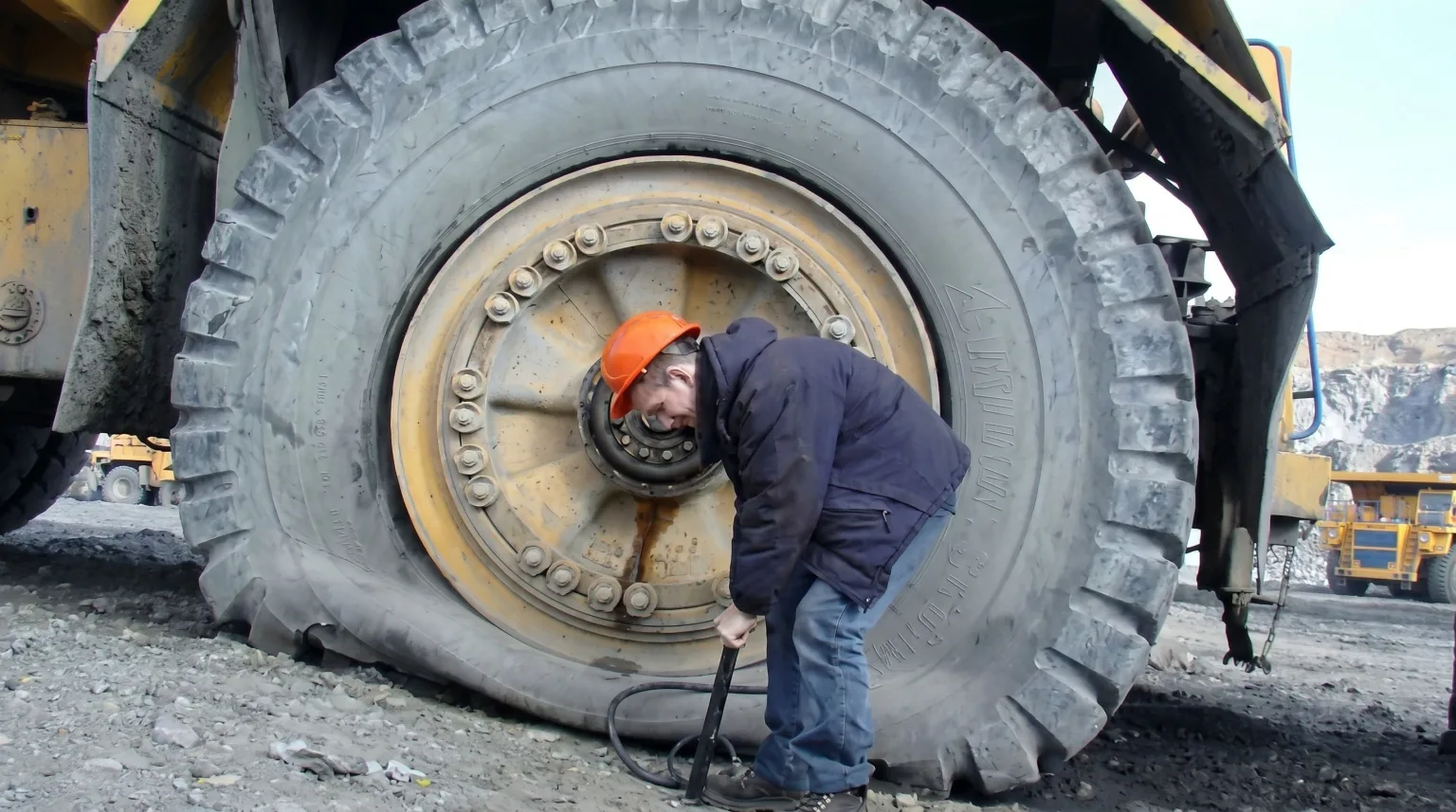
A worker, wearing a helmet, bends over a gigantic tire and tries to inflate a truck wheel with a bicycle pump. At first, the scene is funny. Then it becomes uncomfortable.
Because it looks strangely familiar.
Many companies operate exactly like this.
They want fast transformation, but keep slow tools.
They want to adopt artificial intelligence, but rely on processes designed for a pre-Internet world.
They want innovation, but route every new idea through so many approvals that it becomes obsolete before receiving its third signature.
They want motivated talent, but mainly ask people not to move too much.
They want acceleration, but keep the handbrake on.
And when someone asks why the organization still works this way, the majestic answer arrives:
“We’ve always done it this way.”
That sentence sounds wise. It smells like experience, prudence and operational discipline.
In reality, it often hides fear: fear of being wrong, fear of losing control, fear of changing tools, fear of admitting that the old method has become ridiculous.
The issue is not only technological. It is mental, cultural and organizational.
The OECD defines innovation as a new or improved product or process that has been made available to users or brought into use by the organization. In other words, without actual use, innovation remains a polished intention. (OECD)
That is why this image works so well.
The visible problem is the tire.
The real problem is the tool.
The deeper problem is emotional attachment to the tool.
The comfort of the wrong tool
In many organizations, outdated tools do not survive because they are effective. They survive because they are familiar.
A patched-up spreadsheet becomes a management system.
A weekly meeting with no decision becomes a ritual.
An absurd procedure becomes proof of seriousness.
An extra committee becomes a polite way to avoid deciding.
A hierarchical approval becomes a substitute for courage.
The bicycle pump feels safe. People know it. They know where it is stored. They know who used it before. They even know it works, sometimes, for a bicycle.
But when the tire becomes industrial, massive and strategic, the pump becomes a symbol of blindness.
In business, this mismatch appears everywhere: digital tools, decision-making methods, project rituals, management habits, performance indicators, innovation budgets, meeting formats and communication channels.
The status quo has formidable strength. Samuelson and Zeckhauser’s work on status quo bias shows that individuals tend to stick with the existing option more often than purely rational decision-making would predict. (Journal of Risk and Uncertainty)
Inside organizations, this bias becomes collective.
Nobody really wants to defend the absurd.
Yet everyone ends up tolerating it.
When the tool becomes identity
Changing tools should be simple.
When a tool no longer fits the need, replace it.
But an organization is not a toolbox. It is a human system made of habits, hierarchies, territories, memories, past successes and accumulated fears.
The old tool is no longer just a tool. It becomes proof of expertise.
“I master this system.”
“I know this procedure.”
“I know how to get a file approved.”
“I know how to avoid trouble.”
Changing the tool then threatens an acquired skill, a position, sometimes even a professional identity.
That is why transformations rarely fail because of a lack of slogans. They fail because behaviors, incentives, fears and decision systems remain aligned with the old world.
McKinsey points out that successful transformations require, among other factors, a bold aspiration, mobilized leadership, structured execution and communication that helps the organization understand the change. (McKinsey)
In other words: change does not live in a slide. It lives in system coherence.
Innovation hates empty rituals
Innovation can handle useful constraints.
It can handle a limited budget, a short deadline, a small team and strong uncertainty.
But it struggles with empty rituals.
Meetings without decisions.
Approvals without added value.
Reporting that consumes more energy than it creates clarity.
Committees that confuse caution with paralysis.
Transformation plans where everyone talks about speed while moving at administrative pace.
Harvard Business Review identified internal politics, turf wars, lack of alignment and cultural issues among the major obstacles to innovation in large companies. (Harvard Business Review)
These obstacles rarely appear on office walls.
Organizations prefer to talk about governance.
Robustness.
Risk control.
Compliance.
Sometimes, these words are legitimate. Often, they turn a bicycle pump into an “industrial-grade” illusion.
The painful question: why are we still using this?
Innovation rarely begins with a flash of genius.
It often begins with discomfort.
Irritation.
Astonishment.
A disruptive sentence:
“Why are we still using this?”
The question sounds simple. In some corporate cultures, it is dangerous.
Because it attacks comfort.
Because it forces people to justify the existing system.
Because it reveals inconsistencies.
Because it compares declared ambition with operational reality.
In my book, I explain that challenging the status quo is a typical capability of innovators, inventors and entrepreneurs, and that this capability can be developed step by step (my book, chapter 6).
Challenging the status quo does not mean destroying everything.
It means honestly assessing whether the tool, method or ritual still fits the problem to be solved.
That distinction matters.
Mature organizations do not change everything all the time. They know what must be preserved and what must be replaced.
The trouble begins when they protect obsolescence in the name of experience.
AI as a detector of bicycle pumps
Artificial intelligence makes this situation even more visible.
Many companies want to integrate AI into their operations. Good.
But some try to do it with organizations that cannot experiment quickly, share knowledge, secure data, train teams, measure usage or decide fast.
They add breakthrough technology to a structure that has not learned how to breathe.
The result: pilots everywhere, adoption nowhere.
Impressive demos, no deep change.
Paid licenses, teams still working as before.
Technology moves forward. The organization resists.
AI does not automatically transform a company. It first reveals the quality of its decision system, methods, culture and tools.
Prosci reminds us that organizational change requires individual change, reflected in the ADKAR model: Awareness, Desire, Knowledge, Ability and Reinforcement. (Prosci)
A company that wants AI adoption without addressing behaviors often buys a more expensive, shinier, more “digital” bicycle pump, still unfit for the tire.
Psychological safety, the forgotten compressor
In the image, you can easily imagine someone standing outside the frame, seeing the scene, and not daring to say:
“You know there’s a better tool, right?”
That silence exists inside companies too.
Employees see absurdities.
Managers know some processes no longer work.
Teams identify bottlenecks.
But nobody speaks, or they speak too late, or only at the coffee machine.
Why?
Because organizations often lack the psychological safety required to ask difficult questions without being labeled “negative,” “complicated,” “not aligned” or “not corporate.”
Amy Edmondson defined team psychological safety as a shared belief that the team is safe for interpersonal risk-taking. Her research links psychological safety with learning behavior in teams. (MIT)
Google re:Work also presents psychological safety as a key factor in team effectiveness in Project Aristotle. (Google re:Work)
An innovative organization is therefore not only an organization that buys the right tools.
It is an organization where someone can say:
“This pump does not fit.”
And be thanked for saving everyone’s time.
How to spot your bicycle pump
Here are a few signs.
A tool has probably become a bicycle pump when it requires more effort than the problem itself.
A method has probably become a bicycle pump when it slows down the people it was supposed to help.
A committee has probably become a bicycle pump when it mainly validates its own existence.
A report has probably become a bicycle pump when it reassures more than it helps decide.
A process has probably become a bicycle pump when it survives only because nobody dares to question it.
An organization is probably surrounded by bicycle pumps when it talks about agility but rewards conformity.
Innovation begins with that clarity.
Then the work starts.
Replace the tool.
Train the teams.
Simplify the circuits.
Clarify responsibilities.
Remove unnecessary approvals.
Test faster.
Decide better.
Learn continuously.
In my book, I emphasize that awareness is essential to improve our capacity to contribute to innovation (my book, chapter 6).
The elegance of the right tool
The right tool is not necessarily the most expensive one.
It is not necessarily the newest one.
It is not necessarily the most spectacular one.
The right tool is the one that matches the size of the problem, the maturity of the team, the expected speed and the real risk.
For a bicycle, a pump is enough.
For a truck, you need something else.
In companies, this obvious truth often disappears behind habits.
Innovation then requires a simple form of courage: stop celebrating misdirected effort.
Because the man in the picture is working. He is making an effort. He is focused. He is involved. He looks sincere.
But effort does not compensate for mismatch.
That is a hard message for organizations that glorify work intensity instead of questioning the relevance of the means.
Working longer with the wrong tool does not create transformation. It creates fatigue, frustration and eventually cynicism.
The next meeting
In your next meeting about transformation, innovation, AI or performance, ask a simple question:
“What is our bicycle pump?”
Then observe.
The nervous smiles.
The silences.
The exchanged looks.
The people who know exactly what it is.
You may have found the beginning of a real conversation.
Not a conversation about the declared vision.
A conversation about the real means.
Not a conversation about ambition.
A conversation about execution.
Not a conversation about the desire to change.
A conversation about the tools you finally agree to replace.
Innovation does not always start with an invention.
Sometimes, it starts with a pump placed back on the ground, followed by one sentence:
“Now, let’s get the right compressor.”
👉 In your company, what is the “bicycle pump” everyone keeps using to inflate truck tires?


References
(OECD) = https://www.oecd.org/en/publications/2018/10/oslo-manual-2018_g1g9373b.html
(Harvard Business Review) = https://hbr.org/2018/07/the-biggest-obstacles-to-innovation-in-large-companies
(Journal of Risk and Uncertainty) = https://link.springer.com/article/10.1007/BF00055564
(McKinsey) = https://www.mckinsey.com.br/capabilities/transformation/our-insights/how-to-gain-and-sustain-a-competitive-edge-through-transformation
(Prosci) = https://www.prosci.com/methodology/adkar
(MIT) = https://web.mit.edu/curhan/www/docs/Articles/15341_Readings/Group_Performance/Edmondson%20Psychological%20safety.pdf
(Google re:Work) = https://rework.withgoogle.com/intl/en/guides/understand-team-effectiveness