When a court dismantles the perfect excuse
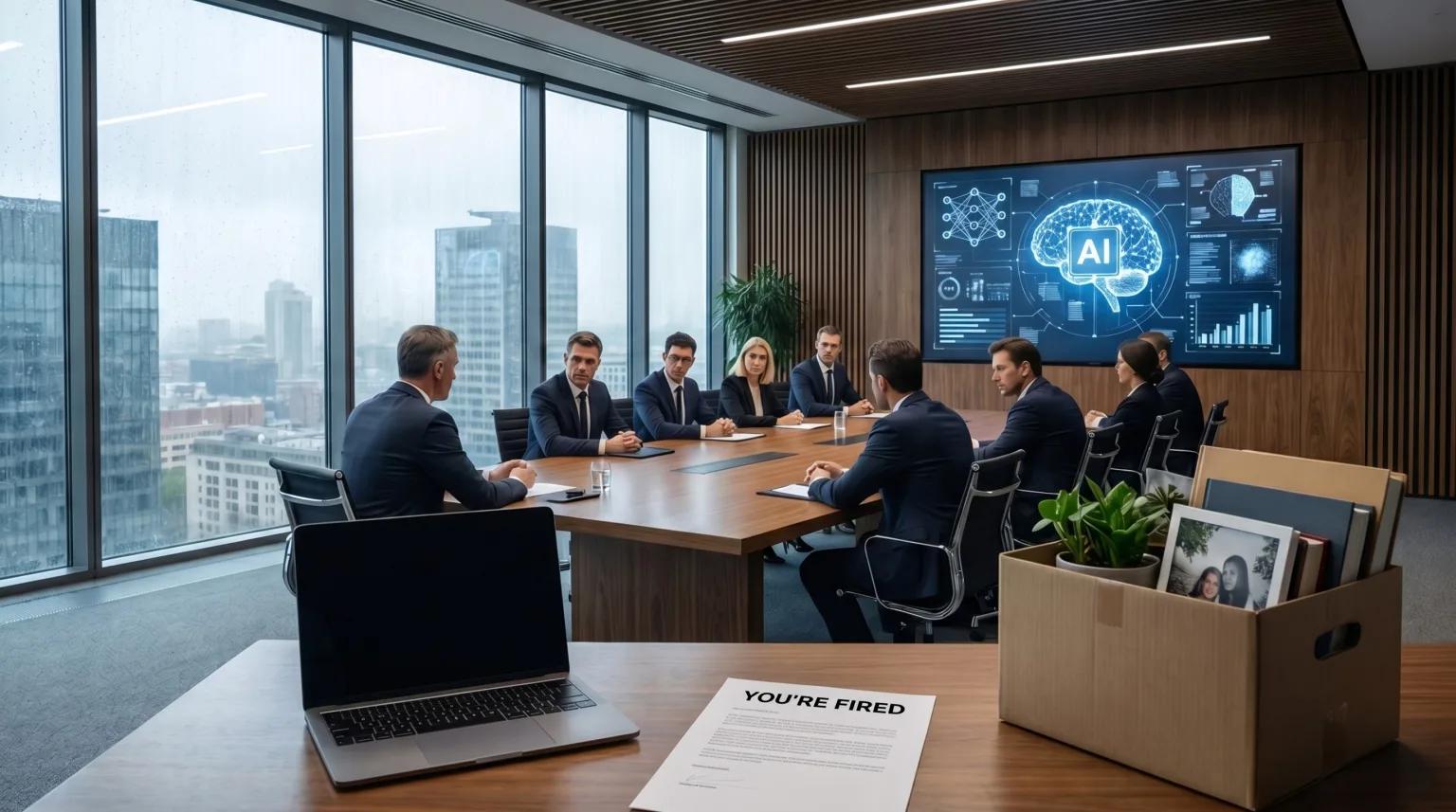
A judge has just slapped down the great management fiction of 2026: “It’s AI, not us.”
In a Chinese company, an employee saw his role gradually absorbed by AI models. His employer then offered him another position with a major salary cut. He refused. He was dismissed.
The argument presented: AI is cheaper.
The court did not applaud innovation. It reminded everyone of something many executive committees would rather avoid: automating an activity does not instantly turn an employee into a disposable organizational variable. According to Tom’s Hardware, the court considered the shift to AI a business strategy, not an objective circumstance allowing automatic termination of an employment contract. (Tom’s Hardware)
That is the real discomfort.
For two years, some companies have presented AI-related layoffs as a natural law. Like weather. Like gravity. As if an algorithm came down from the cloud carrying a termination letter.
But AI does not fire people.
Leaders do.
Leaders choose their vision. They choose their strategy. They choose to train, redeploy, upskill, or cut quickly to tell a more attractive story to shareholders.
AI has become the new shield for managerial cowardice
The World Economic Forum’s Future of Jobs Report 2025 says that 40% of employers expect to reduce their workforce where AI can automate tasks. The same report also shows that employers plan to hire people with AI skills and reshape their business around the technology. (World Economic Forum)
That tension says everything.
AI can be used to reduce costs. It can also be used to augment humans. Between the two stands a management decision.
IBM was one of the first visible examples of this new rhetoric. In 2023, Arvind Krishna discussed pausing hiring for some back-office roles that could be replaced by AI, with around 7,800 jobs potentially affected over time. (Ars Technica)
Klarna also embodied the shift. In 2024, the company said its AI assistant handled two-thirds of customer service conversations in its first month and did the equivalent work of 700 full-time agents. (Klarna)
Duolingo announced an “AI-first” strategy, including a gradual reduction in contractors for tasks that AI could handle. (The Verge)
Meta illustrates another version of the narrative. According to Reuters, Mark Zuckerberg linked job cuts to financial trade-offs between massive investment in AI infrastructure and people-related costs, while saying the cuts were not directly tied to an AI reorganization. (Reuters)
The same refrain keeps coming back: fund AI, automate, streamline, accelerate.
Fine.
Then let us name it correctly: these are not technology decisions. They are governance decisions.
The comfortable lie: “we had no choice”
The “we had no choice” narrative is convenient.
It removes responsibility from leaders’ shoulders. It turns a social decision into a mechanical consequence. It disguises a financial strategy as technological destiny.
That is precisely why the Chinese ruling matters. It does not say companies cannot automate. It does not say AI should stay outside the organization. It says an automation strategy is not enough to erase workers’ rights.
In plain words: innovation does not cancel responsibility.
In my book, I explain that AI is first and foremost a process innovation. It changes the way activities are performed. It reconfigures gestures, processes, methods, trade-offs and rhythms. It therefore triggers a deep fear of being replaced, because it directly touches the perceived value of human work (my book, chapter 14).
The panic does not come only from AI.
It comes from the void left by management when leaders refuse to explain where the company is going, how jobs will evolve, which skills will be developed and what place humans will have in the new architecture.
Automating a task does not mean deleting a person
The confusion is massive.
An automated task is not a deleted profession. A faster process is not a useless human being. Improved productivity is not a moral authorization to treat employees like spreadsheet lines.
Real work is almost never a simple sum of isolated tasks. It contains experience, judgment, relationships, intuition, organizational memory, the ability to handle exceptions and sometimes a degree of diplomacy that even the best models do not truly carry.
When a company says, “AI does the work of 700 people,” it does not always say what it loses along the way. Relational quality? Trust? Management of atypical cases? Detection of weak signals? Emotional connection with an angry, vulnerable or worried customer?
The obsession with immediate cost can make companies dangerously short-sighted.
A company can save quickly and destroy slowly. Destroy its culture. Destroy internal trust. Destroy employer attractiveness. Destroy the willingness of its talent to engage in the next transformation.
AI reveals the real maturity of management
AI is not only a technology shock. It is a revealing agent.
It reveals leaders with a vision. It also reveals those hiding behind a trend.
It reveals companies able to train before cutting. It reveals those that cut before understanding.
It reveals cultures where jobs are discussed clearly. It reveals cultures where rumors do the work of leadership.
It reveals managers who support people. It reveals those who use automation as an implicit threat.
Responsible leaders start by mapping activities. They identify automatable tasks, augmentable tasks, transferable skills, emerging jobs and vulnerable jobs. They open a transparent dialogue with teams. They invest in training. They create exploration teams. They experiment. They measure. They adjust.
Opportunistic leaders do something simpler: they announce that AI is coming, that the market is changing, that costs must come down, then they dress up workforce reductions with futuristic vocabulary.
Same spreadsheet. New fragrance.
Cutting costs or augmenting humans?
Cost reduction is legitimate. A company that rejects any form of optimization weakens itself.
But cost reduction cannot become the only compass. A company is not merely a portfolio of expenses to compress. It is also a system of skills, trust, know-how and engagement.
A mature AI strategy should ask three simple questions:
What can we automate without degrading value?
What can we augment to improve the quality of human work?
What should we preserve because humans create irreplaceable value through relationships, judgment or responsibility?
The problem starts when the first question swallows the other two.
A company that uses AI to augment its talent builds a competitive advantage. A company that uses AI as a social alibi builds a cultural time bomb.
The future of work will test leadership courage
The future of work will not be human versus machine.
It will be responsible leader versus opportunistic leader.
AI does not impose one single path. It opens several options. Automate. Augment. Train. Redeploy. Reorganize. Redefine the value of jobs. Create new services. Reinvent customer relationships. Rethink productivity without sacrificing trust.
Each option corresponds to a worldview.
The Chinese judge has reminded companies of a principle worth considering: automation does not remove ethics, law or responsibility.
AI can write code, answer customers, summarize documents, produce images, prepare analyses and accelerate processes.
It cannot carry the moral responsibility of a human decision.
When a company lays people off, the algorithm is not choosing courage or convenience.
The leader is.
👉 In your view, should AI first serve to cut costs or to augment humans?
I also shake this topic in my keynotes, workshops and advisory work, with the usual tact of a fire extinguisher in a server room.


References
(Tom’s Hardware) = Tom’s Hardware
(Reuters) = Reuters
(World Economic Forum) = World Economic Forum
(Klarna) = Klarna
(Ars Technica) = Ars Technica
(The Verge) = The Verge
(Challenger, Gray & Christmas) = Challenger, Gray & Christmas