A knock at the lab door
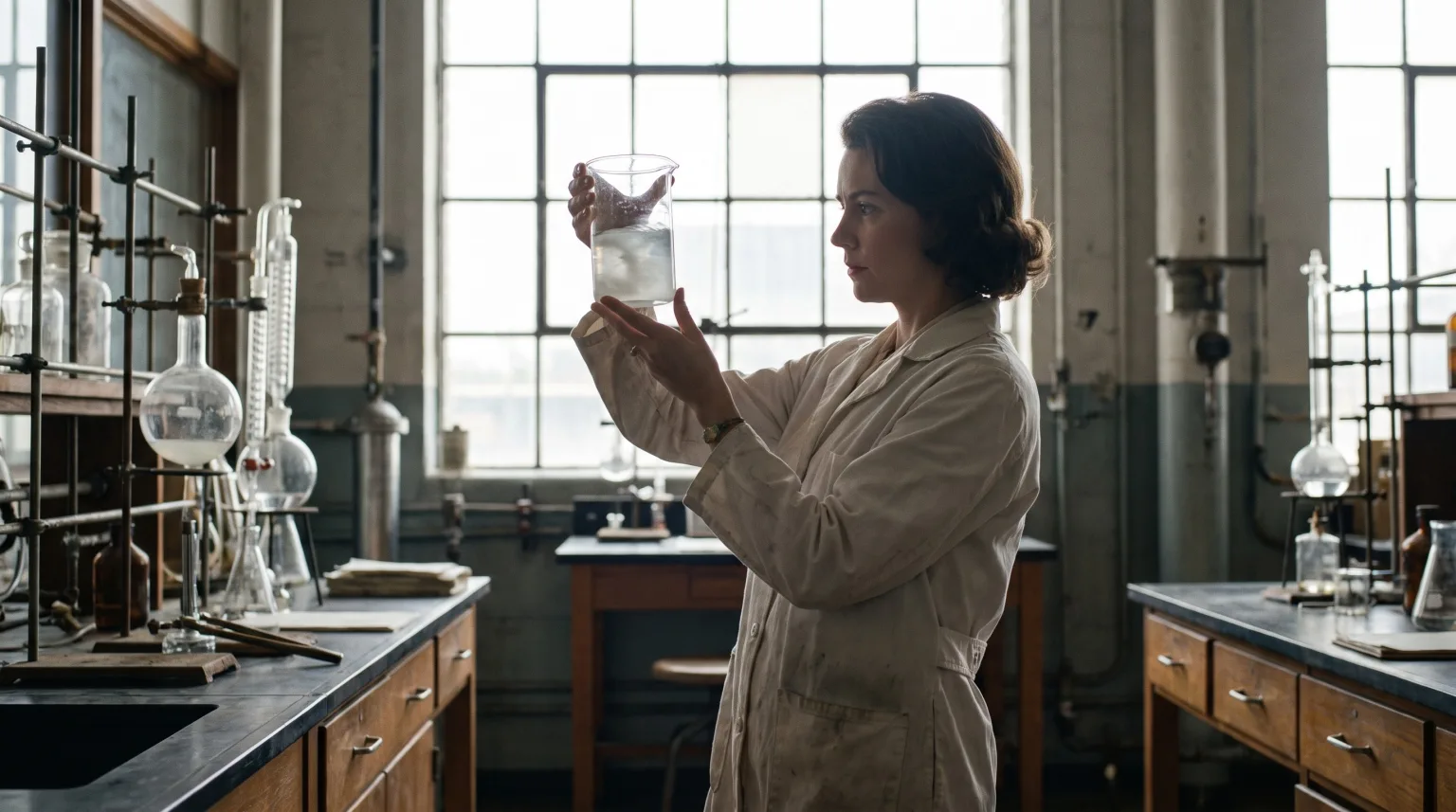
Wilmington, Delaware, spring 1965. A forty-two-year-old chemist stares at a beaker that lets her down. The liquid should be clear and syrupy. Instead it is cloudy, thin, almost as runny as water. Stephanie Kwolek is working at DuPont on a lightweight fiber meant to replace steel in tires. What she holds in her hand looks nothing like what she was after.
What comes next hangs on a three-second decision. Most chemists would have poured the beaker down the drain. A cloudy batch is a contaminated batch, a suspect batch, a batch for the bin. Kwolek does the opposite. She asks the technician running the spinneret, Charles Smullen, to test her solution anyway (Science History Institute). He hesitates, worried the strange liquid will clog the machine. She insists.
The fiber that comes out does not break. It is five times stronger than steel by weight, heat-resistant, lighter than fiberglass (American Chemical Society). Kevlar was just born in a beaker everyone else would have emptied. Today that material protects tens of thousands of lives in bulletproof vests, and appears in some two hundred applications, from helmets to cables to boat hulls (DuPont).
The bias that empties beakers
Let’s pause on the act of emptying the sink. It is a rational act. You look for A, you get B, you throw out B and start again. In my book that reflex has a name: goal framing. You have defined what you are looking for so tightly that your brain files everything else under “failure.” The cloudy result is not read as information, it is read as a nuisance.
I know that reflex from the inside. I spent years believing that to innovate you simply had to respect known processes and protect yourself from bad decisions with data. I was wrong. The data point that does not fit the expected box is often the most valuable, precisely because it contradicts your hypothesis. And assumptions are highly dangerous, they should be killed with experimentation as early as possible.
Kwolek had a quality I rank first among an innovator’s skills: curiosity. In my book, in the chapter on the lived experience of the individual, I break curiosity into three very concrete sub-behaviors. Serendipity, which means creating a space to explore the unfamiliar. Observation, which lets you detect the unexpected. Questioning, which asks the right questions in front of a phenomenon. (Book)
Serendipity, observation, questioning: the Kwolek trio
Watch how closely those three sub-behaviors map onto what happened at DuPont.
Serendipity first. Kwolek did not throw out the cloudy batch because she had cultivated a taste for the unusual. A liquid that pours “almost like water” and stays opaque is exactly the kind of anomaly most people flee and the innovator looks at more closely (NPR).
Observation next. She saw what others would have wiped away. Under certain conditions, polyamide molecules line up in parallel and form a liquid crystalline solution of exceptional stiffness. That cloudiness in the beaker was the visible signature of a new molecular order (Smithsonian).
Questioning last. Instead of concluding “failed,” she asked “why does this liquid behave this way, and what happens if we spin it anyway?” That question made the difference between a waste product and a patent.
Want a simple test to place yourself? Take my development scale, 0 to 5. Rate honestly your capacity for serendipity, your capacity for observation, your capacity for questioning. Zero means “I throw out everything that doesn’t match the plan.” Five means “I stop on every anomaly and I test it.” I’ll tell you plainly: I am not always at 5 either. That admission is where progress begins.
An anomaly does not survive in a deaf company
There is a second actor in this story, often forgotten. The technician. Smullen first refused to spin Kwolek’s solution. Had he said no all the way, Kevlar would still be asleep in a lab notebook.
This is where individual curiosity meets organizational responsibility. In my book I list the brakes and the accelerators of curiosity. The most common brake: no time or resource budget to explore, a hierarchy that pushes back the moment you stray from the plan. The decisive accelerator: management ready to react to discoveries. Kwolek had the luck of working in an environment where her persistence could lead somewhere. How many of your people have a cloudy beaker in a drawer, for want of a manager ready to listen?
Ask yourself without flattery. When a member of your team turns up with a result that doesn’t match the spec, what is your organization’s default reaction? A shrug, or the spinneret switched back on to see? Psychological safety, that belief you can bring a weird finding without being mocked, decides whether your anomalies survive. Without it, no one dares tell the boss the project is heading somewhere unexpected, and you lose your Kevlar before you ever saw it.
How many materials have we thrown away?
The thought that haunts me, and I suspect it haunts you too, fits in one sentence. How many materials, processes, molecules never saw daylight because their manufacturing window was too narrow, and the first disappointing result went down the sink?
We will never know, by definition. But we can decide to cut that waste starting tomorrow. In my Innovational Intelligence™ System, the invariant of innovation was never the technology. It is always the human being, their biases, their fears, their ability or inability to stop on what looks wrong. Kevlar did not come from better chemistry than DuPont’s competitors had. It came from a chemist who resisted the reflex to throw it out.
At a time when artificial intelligence serves us “clean,” optimized, averaged results, this story carries a particular weight. A machine trained to produce the most probable output tends to smooth the anomaly, correct it, make it vanish. Yet the anomaly is exactly where the breakthrough hides. Keep the human eye that stops on the cloudy beaker, when everyone, the algorithm included, wants to move on to the next batch.
The essentials
- A result that contradicts your hypothesis is information, not waste. Test the anomaly before you throw it out.
- Curiosity is trained through three moves: create a space for serendipity, observe the unexpected, question the phenomenon. Rate yourself 0 to 5 on each.
- One person’s curiosity is not enough. Without management ready to react to discoveries and real psychological safety, your anomalies die in a drawer.
- The invariant of innovation stays human. Kevlar was born from a three-second decision, not an equation.
So next time a batch comes out cloudy, before you empty it, ask what Stephanie Kwolek asked: what if we spin it anyway?

References
- (Book) https://philippeboulanger.com/book/
- (American Chemical Society) https://www.acs.org/education/whatischemistry/women-scientists/stephanie-kwolek.html
- (Science History Institute) https://www.sciencehistory.org/education/scientific-biographies/stephanie-l-kwolek/
- (Smithsonian) https://invention.si.edu/invention-stories/stephanie-kwolek-kevlarr-inventor
- (NPR) https://www.npr.org/sections/thetwo-way/2014/06/20/323951708/stephanie-kwolek-chemist-who-created-kevlar-dies-at-90
- (DuPont) https://www.dupont.com/what-is-kevlar.html
- (PBS) https://www.pbs.org/newshour/show/the-life-and-achievements-of-chemist-stephanie-kwolek-inventor-of-kevlar