Young Inventors: They Haven’t Learned Impossible Yet
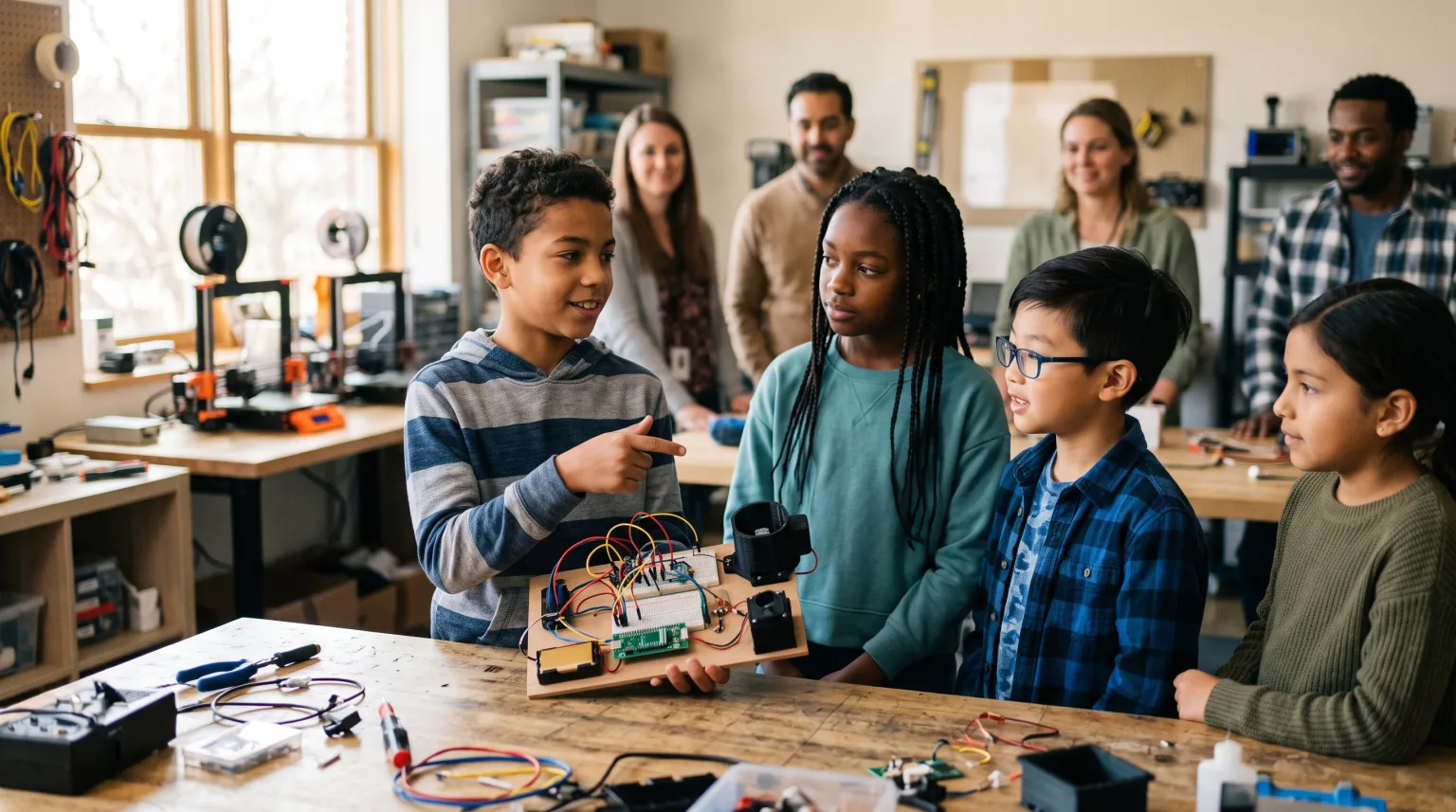
Santa Clara, California. A Saturday evening in mid-August 2026. On the stage of the Silicon Valley International Inventions Festival, the jury chairman calls out a name. A ten-year-old boy walks up to receive a gold medal and the best invention award from the International Federation of Inventors’ Associations. His name is Hsu Ting-wei. He comes from Taiwan, he attends Kang Chiao International School, and he just invented an electronic nose.
A nose that detects what machines still miss
His invention carries a plain name, the “Novel Artificial Electronic Nose.” Behind that name sits a non-contact screening platform combining three technologies: a real-time air sampling system, gas chromatography coupled with mass spectrometry, and AI-driven odor recognition. The device is designed to sit right behind airport X-ray baggage scanners, exactly where luggage already passes under visual inspection but where smell remains, to this day, the blind spot of security screening (Focus Taiwan).
Hsu Ting-wei did not build a science-fair toy. On stage, he explained that he hoped his invention could help stop pork products carrying African swine fever from entering countries, and help United States authorities intercept fentanyl at the border (Taipei Times). Jury chairman Amin Ghafooripour made a point of clarifying something important: this medal was not an encouragement prize handed out because of the boy’s age. The jury had recognized genuine practical value, and the project had left a deep impression on the evaluators (Taipei Times).
That year, Taiwanese inventors brought home a record number of gold medals from the festival, twenty-four in total, and several jury members praised the quality of projects submitted by very young participants (Focus Taiwan).
What psychology has measured since 1968
In 1968, NASA was looking for a way to identify its most creative engineers and scientists among its candidates. The agency asked George Land and Beth Jarman to design a test. The tool worked well enough that the two researchers wanted to know where creativity actually came from, before professional selection even entered the picture. They gave the same test to 1,600 children aged four and five. The result stunned them: 98 percent of the children tested scored at the “creative genius” level. The same children, retested at age ten, dropped to 30 percent. At fifteen, 12 percent. The same test, given to 280,000 adults, produced only 2 percent at that level (Work on Strategy). Land’s conclusion fits in one sentence: non-creative behavior is learned.
A comparable pattern shows up in a different corner of cognitive psychology, problem solving. In 1945, psychologist Karl Duncker designed what is now known as the candle problem: a subject receives a candle, a box of thumbtacks, and a box of matches, and must fix the lit candle to a wall so wax does not drip onto the table below. Most adults try to tack the candle straight to the wall, or melt it against the surface. Very few think to empty the tack box and use it as a holder. This blind spot has a name, functional fixedness: once an object is perceived through its familiar use, it becomes hard to reimagine it for anything else. Research following Duncker’s original work shows that five-year-olds display almost no sign of this bias on this kind of task, while it appears reliably by age six or seven (Wikipedia).
Hsu Ting-wei is ten for a reason worth noting. He sits precisely in the window where, by Land’s numbers, measured creativity has already lost two-thirds of its starting level, but where the functional block that paralyzes so many adults has not fully set in yet. He is still young enough to look at a box of tacks and see a candle holder, or an airport X-ray scanner and see the missing spot for an electronic nose.
Creativity, invention, innovation: three words business keeps blurring together
In my book, I take care to separate these three notions that everyday language keeps mixing up. Creativity is an individual’s capacity to imagine a new concept or an original solution to a problem; it doesn’t necessarily lead to concrete action, it can remain an idea circulating in someone’s head or on a whiteboard. Invention demands action: an object, a prototype, something that now exists in the world and can be shown, tested, broken. Innovation goes further still, it requires that a real use takes hold for someone and that they extract value from it. (My book, chapter 3)
Hsu Ting-wei went through all three stages in a single season. He had the idea, he built the object, and his invention already works behind a scanner. Few adults in a company complete that full path, not for lack of intelligence, but because an idea that never reaches the right people at the right time never becomes anything concrete. A hundred percent of uncommunicated ideas never become innovations.
Peter, or the scene that repeats in every leadership meeting
Peter leads a small R&D team at a mid-sized industrial company. Two months ago, he presented his leadership committee with a low-cost sensor able to detect anomalies on a production line, an idea born from field observation rather than from a formal spec sheet. The answer came within seconds: “That doesn’t fit our roadmap,” the finance director replied, without looking up from his dashboard. No one in the room asked why. No one suggested testing the hypothesis on a small scale first. The project was closed before it had really been opened.
This reflex has a name in organizational psychology, status quo bias: preferring a known situation over a potentially better alternative, purely because it is known. It often travels with a second bias, learned helplessness, the one that sets in once a team has watched enough projects get rejected that it simply stops proposing new ones. Neither Peter nor his leadership committee were born with these reflexes. They learned them, much the way the children in George Land’s study learned, between ages five and twenty-five, to lose ground on their own creativity.
Psychological safety, the measured antidote
Harvard Business School researcher Amy Edmondson gave a name to the condition that lets a fragile idea survive long enough to be tested: psychological safety, the belief that one will not be punished or humiliated for speaking up, asking a question, or proposing an imperfect idea. Google rediscovered this factor at scale through its internal Project Aristotle study: among everything that distinguishes the company’s highest-performing teams, psychological safety comes out on top, ahead of individual experience and ahead of team composition (HBS Working Knowledge).
An organization that recreates, even partially, the conditions under which a ten-year-old dares to present a prototype in front of an international jury improves its odds of finding its next useful invention. The difference has less to do with individual genius than with the environment surrounding it.
What a leader can do starting Monday
Rewarding a failed but properly measured experiment matters more, over time, than applauding a flawless presentation that was never tested against reality. It’s a principle I’ve defended for years with the teams I work with: kill the assumption with experimentation before it kills the project. An imperfect prototype that exists is worth more than a perfect slide that never will.
In practice, that means measuring before, during, and after every initiative rather than settling for a committee’s opinion. It means asking two simple questions of any idea coming up from the field: are the expected gains realistic, and are they verifiable? Finally, it means accepting that an employee can be wrong in front of you without paying for it with their career, the same way a ten-year-old can present an imperfect prototype to an international jury without fearing ridicule.
The essentials
Remember three things:
- Creativity declines measurably with age, but according to George Land’s research that decline is learned, not inevitable.
- Business keeps blurring three notions together: creativity, invention, and innovation. Only the last one creates measurable value for someone.
- Psychological safety isn’t a managerial nicety. According to Google, it’s the factor most closely correlated with team performance.
Hsu Ting-wei may learn, fifteen years from now, that some things are impossible. Until then, he keeps building what others would call unrealistic. Every organization can ask itself how much longer it plans to wait before finding that same reflex in its own teams.


References
- (My book) philippeboulanger.com/book
- (Focus Taiwan) focustaiwan.tw/sci-tech/202608170010
- (Taipei Times) taipeitimes.com/News/taiwan/archives/2026/08/18/2003862691
- (Wikipedia) en.wikipedia.org/wiki/Functional_fixedness
- (Work on Strategy) workonstrategy.substack.com/p/the-fourth-grade-slump-why-kids-lose
- (HBS Working Knowledge) library.hbs.edu/working-knowledge/four-steps-to-build-the-psychological-safety-that-high-performing-teams-need-today