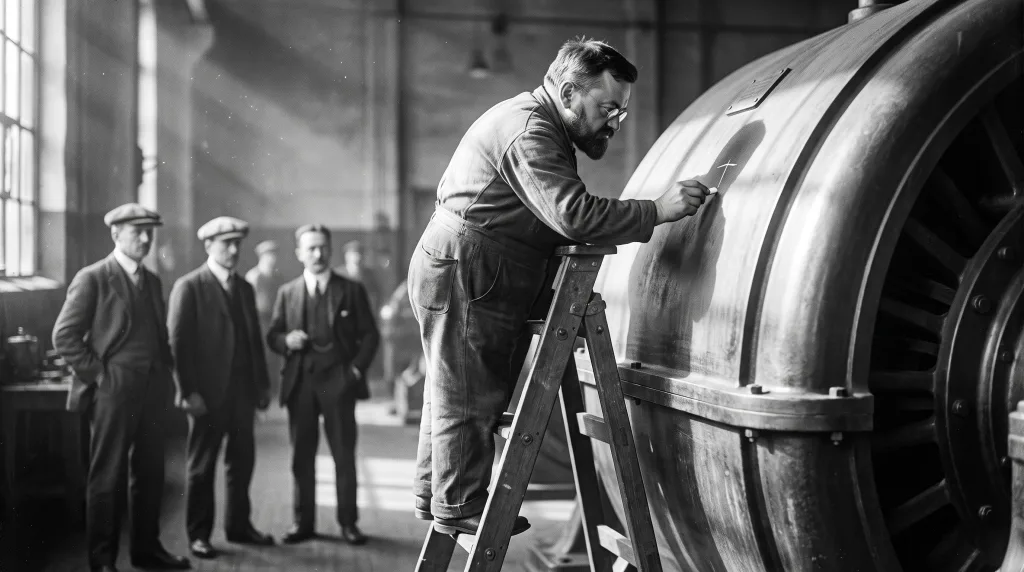
In 1934, at a blackboard, Albert Einstein derived special relativity for a group of students. Today, an entire generation is tempted to outsource that kind of intellectual effort to a chatbot. Yet a disturbing thesis is circulating among physicists: had Einstein had access to ChatGPT, he would never have used it to think for him. And if he had, he would never have become Einstein. The idea is developed by astrophysicist Ethan Siegel, and it deserves attention, because it strikes at the heart of what makes an innovator (Big Think).
The Myth of the Lone Genius
We were sold a legendary Einstein: the dropout who failed his studies, the patent clerk who reinvented physics alone in his corner. Almost none of it is true. Einstein completed his physics degree at one of Europe’s top universities, today’s ETH Zürich, in 1900. He then continued his graduate studies at the very same place.
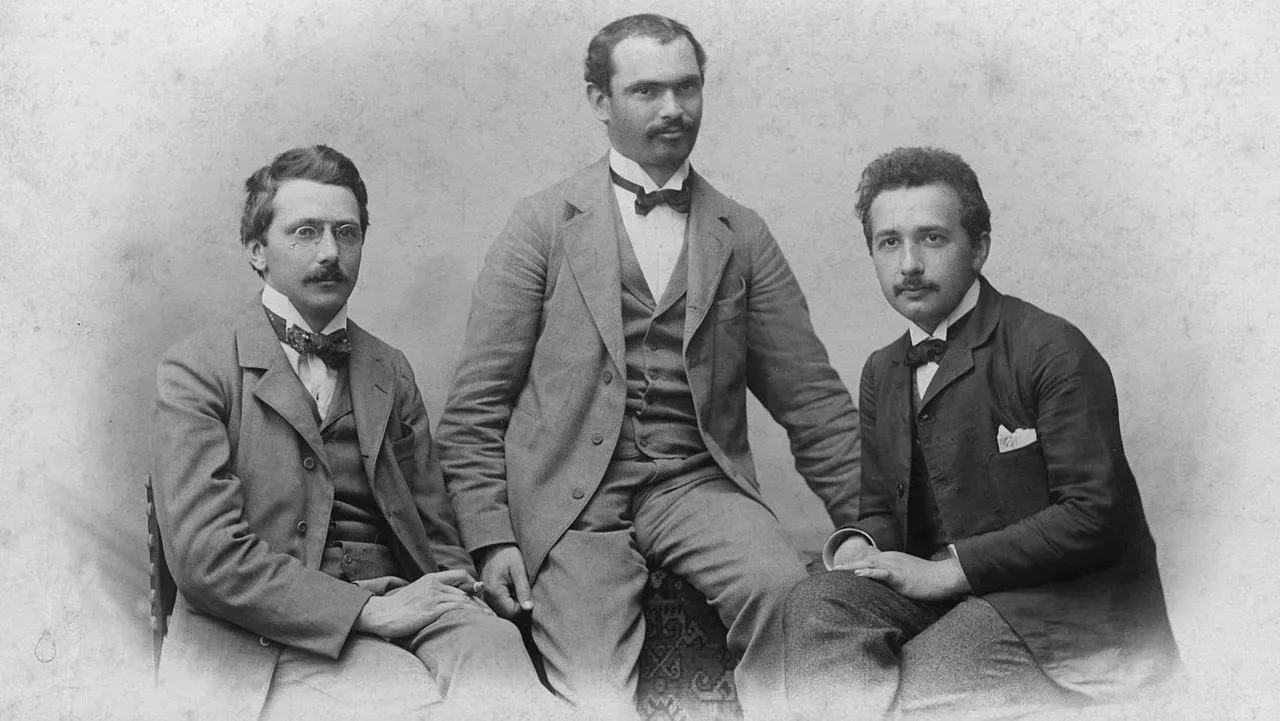
Far from a loner, in 1902 he founded a discussion circle, the Olympia Academy, where he debated physics, philosophy and mathematics with his friends Conrad Habicht, Maurice Solovine and Marcel Grossmann (Wikipedia). It was Grossmann who, through his father, secured Einstein his post at the Bern Patent Office, a student job that left him time for research. His 1905 “miracle year”, with special relativity, mass-energy equivalence, Brownian motion and the photoelectric effect, is not the product of an isolated brain, but of an intelligence nourished by a community (Wikipedia).
And the dropout myth? His teacher, mathematician Hermann Minkowski, thought him lazy, absent from lectures, with shaky mathematical foundations. Except Minkowski was judging the performance of a seventeen-year-old, not a potential. He could not see the immense, sustained effort Einstein would invest in building his mathematical foundations and learning to think about a problem long and deeply.
“Imagination Is More Important Than Knowledge”: The Great Misreading
Einstein’s most famous quote is also the most betrayed. People wield it to claim imagination matters and knowledge is secondary. That misses the point entirely. The line was spoken in 1929, in an interview with George Sylvester Viereck, as Einstein discussed the validation of general relativity by the 1919 eclipse (Quote Investigator).
In context, Einstein simply says he was convinced he was right before any experimental confirmation. His imagination rested on deep knowledge. Without the knowledge underpinning his intuitions, without the skills to formally develop his ideas, none of his predictions could have come to be. In 1921, he had already written it plainly, as recorded by his biographer Philipp Frank: the value of an education is not to accumulate facts, but “the training of the mind to think something that cannot be learned from textbooks”.
That single sentence explains why he would have kept AI at arm’s length. An engine that writes for you, reasons for you and concludes for you strips away the very effort that builds the mind. Einstein might have used it to look up a fact, provided he checked it was not a hallucination. Never to outsource his thinking.
What No AI Will Replace
The strongest argument comes from an AI researcher, not a nostalgic. At the 248th meeting of the American Astronomical Society in June 2026, Professor Sanmi Koyejo, who leads the Stanford Trustworthy AI Research lab, drew a clear distinction: doing well on a test, or for a model “performing well on a benchmark”, has nothing to do with doing science (Astrobites).
A benchmark assumes three things: cheap and near-instant verification, a short feedback loop, and questions fixed in advance. In physics and astronomy, none of these three conditions holds. Data is noisy, ambiguous, sometimes several answers are plausible, and you often need new observations no amount of computing power can manufacture. When a model announces the result of an experiment not yet run, you must not believe it: at best it is a guess dressed up as a confident conclusion.
Koyejo sums up the danger in a formula worth remembering far beyond astrophysics: “When the thing being measured and the thing doing the measuring share the same blind spots, the errors do not cancel. They reinforce.” A consensus among AIs measures agreement, not truth. That is exactly where humans, with their critical thinking, their culture of rigor and reproducibility, remain irreplaceable.
The Brown Case: When Cheating Becomes the Norm
A recent example is chilling. In an economics course at Brown University, 86 students scored a 96% average on a take-home midterm, a level never seen, when scores had never exceeded 80% before. Suspecting massive AI use, Professor Roberto Serrano imposed an in-person final. Eighteen students dropped the course, nine did not show up, and the average of the remaining 59 collapsed to 48.6% (Inside Higher Ed).
The professor’s verdict lands like a warning: “We cannot afford to have a society in which a significant fraction of our best young minds think that cheating is OK.” As essayist Nicholas Carr puts it, “armed with generative AI, a B student can produce A work while turning into a C student” (New Cartographies). The illusion of competence destroys real competence.
Innovate, or Outsource Your Brain?
This is where the debate meets my deepest conviction. In my book, in the chapter on the key competencies of innovation, I identify eight attributes that make an innovator thrive: curiosity, empathy, boldness, learning, creativity, communication, the capacity for self-questioning, and taking action. None of these skills can be downloaded. Each is built through effort, friction, and wrestling with a problem without a safety net.
Systematically outsourcing your thinking to AI methodically sabotages these eight levers. You do not become curious by reading a ready-made answer. You do not learn to question yourself by accepting the first synthesis that comes along.
Make no mistake: I am no technophobe, quite the opposite. In my book, in the chapter devoted to the application of artificial intelligence, I describe a five-step process for adopting AI in an organization without destroying what matters. AI is treated there as a process innovation, framed by two fundamental questions: how do I increase my productivity and the quality of what I deliver, and what can I do today that was impossible yesterday? Any use that answers neither is merely a distraction. AI must augment the human, never anesthetize them.
Einstein actively sought out intellectual challenges. That is precisely what transformed him, from a student Minkowski judged mediocre into one of the greatest minds in history. Every time you hand your critical thinking to a machine, you rob yourself of the chance to grow the only thing of value you will be left with once the exam is over: your own mind. Einstein would have refused that bargain. You can too.

References
- (Big Think) = https://bigthink.com/starts-with-a-bang/einstein-ai/?utm_source=philippeboulanger.com
- (Inside Higher Ed) = https://www.insidehighered.com/news/faculty/learning-assessment/2026/07/08/brown-professor-suspects-most-his-class-used-ai-cheat?utm_source=philippeboulanger.com
- (Astrobites) = https://astrobites.org/2026/06/14/aas248-sanmi-koyejo/?utm_source=philippeboulanger.com
- (New Cartographies) = https://www.newcartographies.com/p/the-myth-of-automated-learning?utm_source=philippeboulanger.com
- (Quote Investigator) = https://quoteinvestigator.com/2013/01/01/einstein-imagination/?utm_source=philippeboulanger.com
- (Wikipedia) = https://en.wikipedia.org/wiki/Olympia_Academy?utm_source=philippeboulanger.com
- (Wikipedia) = https://en.wikipedia.org/wiki/Annus_mirabilis_papers?utm_source=philippeboulanger.com